Simon Willison Analyzes Impact of AI Coding Agents on Personal Output via Code Frequency Chart
Score
76提供了一手实验数据,直观展示AI编码智能体对个人生产力的影响,信息增量较高。
内容来自知名开发者,方法清晰,结论可信,图文结合,质量上乘。
对开发者评估AI辅助工具效果有实际参考意义,但通用性有限。
发布于2026年7月13日,是最新内容,时效性极高。
来源为Simon Willison的官方博客,信源权威可靠。
Base 84.5 × T2 Source weight ×0.9 = 76
Curation line 70Selected
Why selected
Content comes from a first-hand experiment by renowned developer Simon Willison, with intuitive methodology and practical reference value, earning a high score.
AI commentary
「This blog post is a must-read for developers, as it quantitatively validates the real productivity gains from AI coding agents rather than just talking about trends. For teams and individuals evaluating whether to adopt AI-assisted tools, this is an intuitive reference case.」
Quick overview
In his blog, Simon Willison shares an experiment where he uses a GitHub code frequency chart to visually illustrate how coding agents (such as Opus 4.5-class models) alter his development productivity. The post highlights the significant impact of AI-assisted programming tools on personal workflows and output patterns, sparking reflection on the future of human-AI collaboration.
- Simon Willison uses a GitHub code frequency chart to compare commit patterns before and after introducing AI coding agents.
- Advanced coding agents like Opus 4.5-class models significantly boost personal code output.
- The experiment reveals that AI tools can alter developer work rhythms and creative approaches.
- The analysis sparks discussion on the long-term implications of AI-assisted programming.
Full text
Showing the source text; the full translation is being generated.
datasette code-frequency chart on GitHub
Out of curiosity I decided to see if I could find a useful illustration of the impact of coding agents and Opus 4.5 class models on my own output. The best I've found so far is this GitHub chart of frequency of code changes to my Datasette open source project: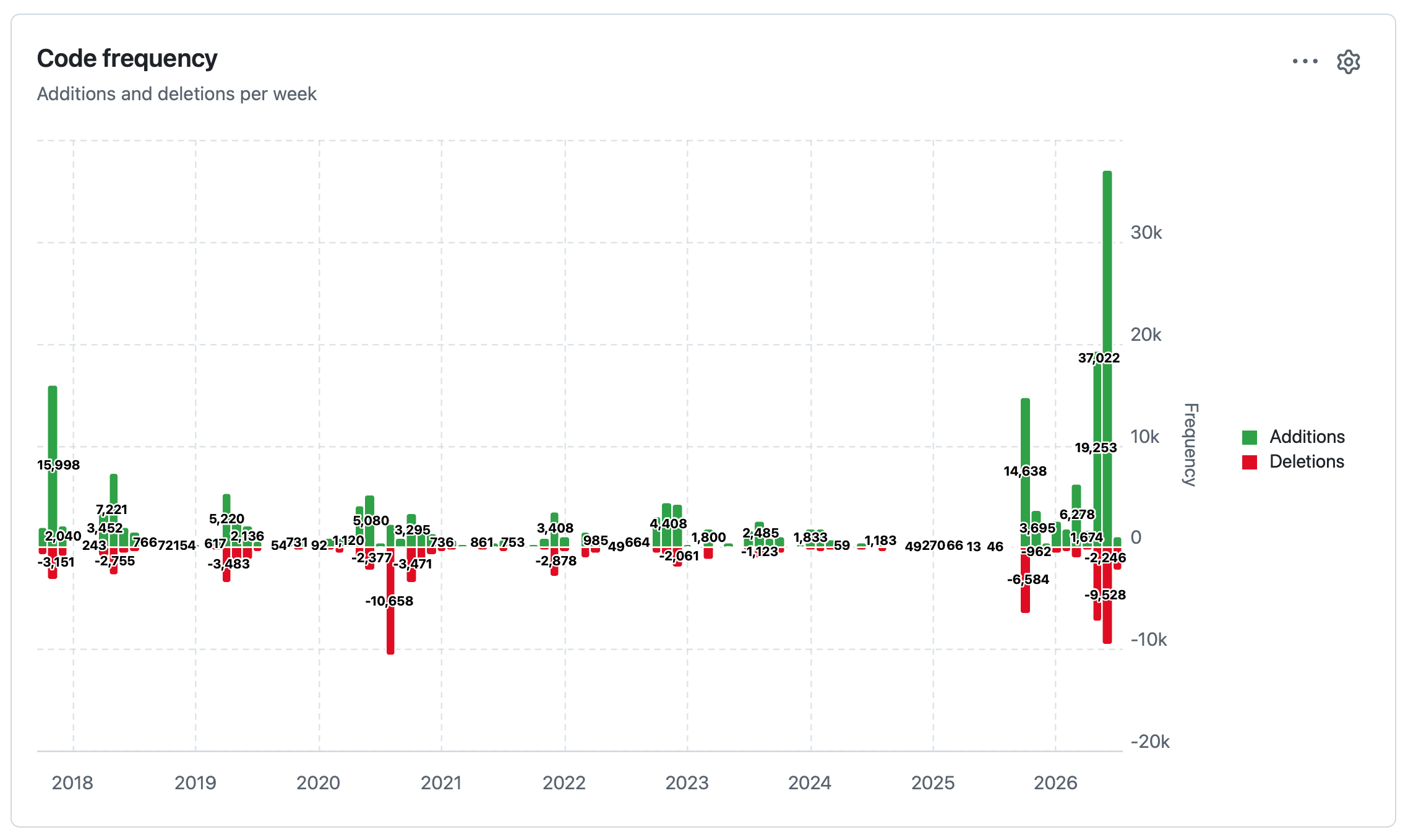
The big spike in activity at the end aligns with Opus 4.8, GPT-5.5, Fable 5 and GPT-5.6 Sol.
Tags: github, ai, datasette, generative-ai, llms, ai-assisted-programming, coding-agents
Related items
89
FeaturedOpenAI Research: AI Is Redefining Job Boundaries
OpenAI研究:AI正在重新定义工作边界
If you care about the real impact of AI on work, this research is a must-read. Instead of theory, it uses data to show how ChatGPT users expand their task scope, offering direct insights for HR, managers, and every professional looking to upgrade their skills.
87
FeaturedOpenAI CFO Shares Five Lessons for Building an AI-Native Finance Function
OpenAI CFO 分享构建 AI 原生财务职能的五大经验
As an editor, I find this article uniquely valuable because it comes from a finance chief at an AI leader, not an external consultancy, making it highly practical. I recommend it to finance digitalization leads, CFOs, and anyone interested in AI-driven transformation.
87
FeaturedScientific Computing in the Age of Agentic AI: OpenAI Releases New Field Report
智能体AI时代下的科学计算:OpenAI发布新领域报告
This report is one of the most practical analyses in the current AI agent wave, especially suitable for practitioners in computational biology and drug discovery. It answers the key question 'What can AI agents do besides writing code?' and directly demonstrates productivity gains in complex scientific computing.
87
FeaturedReal World VoiceEQ: Measuring the Human Quality of Voice AI
Real World VoiceEQ:量化语音AI的人类自然度
What's noteworthy is that this benchmark truly focuses on the soft metric of 'human-likeness', not traditional speech recognition rate or MOS scores. For teams working on speech synthesis, voice cloning, or voice interaction, this is a highly practical reference tool that quickly identifies model deficiencies in emotion, prosody, etc. However, language support is currently limited; looking forward to future expansion.
85
FeaturedOpenAI Introduces AI Age Scorecard: A New Way to Measure ROI
OpenAI 推出AI时代记分卡:衡量投资回报的新方法
This blog post hits a sore point in the current AI industry: how to quantify input-output. For enterprise decision-makers deploying or planning large-scale AI, it helps avoid herd mentality. My personal advice: try defining 'useful work' based on your own business scenario, and avoid designing metrics that are merely formality.
85
FeaturedHow to Manage AI Investments in the Agentic Era: Focus on Useful Work per Dollar and High-Value Workflows
代理时代如何管理AI投资:聚焦每美元有用功与高价值工作流
This article is especially important for enterprises scaling AI agents. It reminds us that focusing solely on falling API prices is a trap; what really matters is the return per unit of work. I recommend CTOs and CFOs read it together and establish quantitative evaluation mechanisms internally.
85
FeaturedDesigning Organisations That Can Keep Up With AI: Organisational Latency as the Biggest Barrier
设计能跟上AI的组织:组织延迟成为最大障碍
What makes this article truly worth following is that it raises a neglected bottleneck: no matter how strong the technology is, if the organisation can't keep up, it's useless. For CTOs, CIOs, and transformation leaders, this is a more important framework than tech selection.
84
FeaturedRuff v0.16.0 Released: Default Rules Jump from 59 to 413, CI Pipelines Need Attention
Ruff v0.16.0 发布:默认规则从59条激增至413条,CI工作流需关注
For Python developers, this is an unmissable update signal. The significant increase in Ruff's default rules means we can no longer ignore potential issues in our code, and AI fix tools can lower the upgrade cost. Notably, Astral (OpenAI) is deeply integrating AI coding capabilities with static analysis tools, which may become the norm in future engineering practices.