Anthropic Commits $10 Million to Canadian AI Research
Score
70提供了 Anthropic 在加拿大新投资的具体金额和方向,具有一定信息增量。
内容准确、来源可信,但细节偏少,缺乏具体研究课题信息。
对关注 AI 安全研究和产业投资的读者有一定参考价值。
新闻为最新发布,时效性高。
信息来源 Anthropic 官方新闻页面,权威可靠。
Base 70 × T1 Source weight ×1 = 70
Curation line 60Selected
Why selected
The news is clear and from an authoritative source, but lacks detailed depth.
AI commentary
「Although not a huge sum, this investment precisely targets AI safety and alignment—Anthropic's core focus. For readers interested in AI governance and Canada's research ecosystem, it's worth noting, as it may influence future talent flows in safety research.」
Quick overview
Anthropic has announced a $10 million commitment to multiple Canadian research institutions to advance the next generation of fundamental AI research. The funding will target areas such as AI safety, alignment, and interpretability, while strengthening partnerships with top Canadian academic teams. This move underscores Anthropic's continued investment in building a safe and responsible AI ecosystem.
- Anthropic invests $10 million in Canadian research institutions.
- Funding focuses on AI safety, alignment, and interpretability.
- The partnership will strengthen ties between Anthropic and top Canadian academia.
Full text
Showing the source text; the full translation is being generated.
Anthropic commits $10 million to Canadian AI research
Jul 14, 2026
Le français suit.
Canadian institutions and researchers have played a critical role in the modern AI era. During a period of broad skepticism about research into neural networks, the University of Toronto and the Université de Montréal were two of only a handful of institutions that incubated this crucial line of work, while researchers at the University of Alberta did pioneering work on reinforcement learning. And in the early 2010s, Canadian research institutions led the way in demonstrating that with the arrival of powerful new computing resources—in particular, general-purpose GPUs—deep neural networks could succeed at scale, kicking off the modern era.
Today, Canadians both at home and abroad continue to play leading roles in AI research, safety, and policy—including at Anthropic. That’s why we’re committing $10 million CAD to Canadian research institutions to fund the next generation of this work. We’re also publishing our first Canadian country brief based on the Anthropic Economic Index, which provides a snapshot of how Canadians are putting Claude to work.
Investing in Canadian research
The $10 million we’re committing will fund research into beneficial and responsible applications of AI. As part of this, we’re announcing partnerships with Canada’s three leading regional AI institutes—Alberta Machine Intelligence Institute (Amii) in Edmonton, Mila in Montréal, and the Vector Institute in Toronto—along with CHEO, The Centre for Addiction and Mental Health (CAMH), Université Laval, University of Toronto, and the University of Saskatchewan, with more partnerships to follow in the months ahead:
- Amii, based in Edmonton, will provide Claude credits to its research and engineering teams to further their work in areas like reinforcement learning and AI trust and safety, as well as to increase AI adoption across Canada’s key economic sectors.
- Mila, the Quebec AI institute home to the world’s largest concentration of academic deep learning researchers, will make Claude available to its community to support their research in areas including responsible AI, health, sustainability, multi-agent systems, and robotics. Mila will also use Claude to develop AI assistants that help researchers discover and assess scientific breakthroughs.
- The Vector Institute in Toronto will use Claude credits to advance AI research in trust and safety, health and science, and the broader challenges that AI is uniquely positioned to help solve for Canadians.
- CHEO and the CHEO Research Institute will use Claude credits to develop and evaluate AI-enabled approaches aimed at improving health outcomes and the care experience for children, youth, and families, and to study how AI can be most responsibly applied in children's health.
- CAMH will make use of Claude credits across its research, education initiatives, and clinical projects. For example, CAMH’s Krembil Centre for Neuroinformatics will use Claude to conduct computational mental health research, including developing and evaluating predictive models of treatment for people with mental health conditions, and running large-scale evaluations of fairness in psychiatric AI systems. Credits will also be used to help scale the impact of the CAMH Global Learning Academy, which is developing multilingual, AI-enabled mental health education.
- Université Laval’s Institute for Intelligence and Data will work with Claude to deepen researchers’ understanding of how LLMs behave in varied cultural contexts, as well as their understanding of low-resource languages and dialects, such as Quebec French and Indigenous languages.
- The University of Saskatchewan will use Claude to further its research in areas including biomedical advancements, food and water security, public health, quantum computing, and public service.
- The University of Toronto Data Sciences Institute will support a range of research projects through a scientific review-based process to access Claude API credits.
In addition to these donations, this summer Anthropic will add Amii, Mila, and Vector to the Anthropic for Startups program, which gives founders building on Claude access to a community and resources to support their growth. Hundreds of Canadian startups affiliated with these institutions will receive at least $5,000 USD each in API credits to continue to develop their businesses.
“Some of the foundations of modern AI came out of Toronto, Montréal, and Edmonton— and so, strikingly, did many of the researchers most committed to making it safe,” said Chris Olah, Co-Founder, Anthropic. “I was formed by that culture, and I’m proud Anthropic can support the next chapter.”
How Canada is using Claude
We’re also sharing data that looks at how people across Canada are using Claude. This is drawn from the March 2026 Anthropic Economic Index, our ongoing analysis of how AI is being incorporated into work tasks across the economy. Our economic research is based on data from real-world Claude usage, using a privacy-preserving analysis tool that identifies patterns in use while keeping all user information anonymous.
We find that Canada ranks eighth worldwide in Claude.ai use. Per person, Canadians use Claude at more than four times the rate the population predicts, and among the 10 countries where Claude is used most, only the US ranks higher.
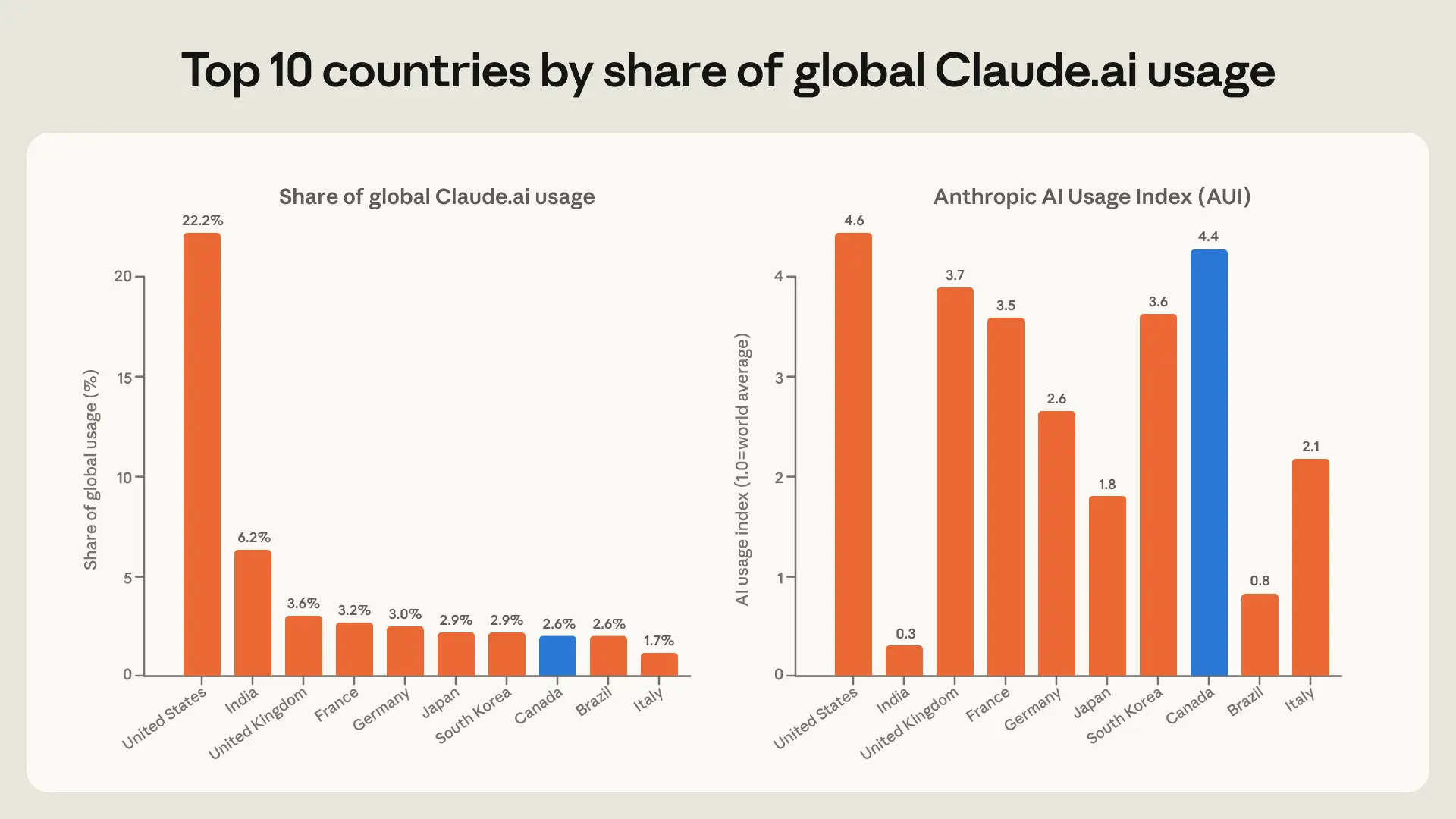
Bars show each country’s share of global AI usage (left panel) and the Anthropic AI Usage Index (right panel) based on 1M conversations sampled from Claude.ai in February 2026. Canada is highlighted in blue. The Anthropic AI Usage Index (AUI) measures whether Claude usage is over- or underrepresented in a country relative to its working-age population. Canada accounts for 2.6% of global Claude.ai consumer use, ranking eighth globally, and second by AUI. Sources: Anthropic Economic Index, February 2026; World Bank.
Within Canada, Claude adoption tracks the kind of work people do: British Columbia leads in terms of per-person use, with Ontario—which has the largest share of overall conversations—close behind. In both provinces, usage is higher than what we would expect to see based on population alone. Across the country, per-person usage is higher in provinces where professional, scientific, and technical work is concentrated.
Looking closer, we can see that how people use Claude lines up with the local economy. Translation requests are most common in provinces where more people work in government, likely because Canada’s bilingualism regulations require federal services and communications to be in both English and French. New Brunswick, Nova Scotia, and Québec lead the country in both government employment and the share of conversations about translation.
A shared view on the future of AI
The countries that invest the most in advanced AI over the next few years will also shape the rules that govern it. We’ve long believed democracies should lead that work, and Canada has a place at the forefront. Canada published the world’s first national AI strategy in 2017, and this June published its next: AI for All, which commits to strengthening the country’s AI safety institute, expanding AI literacy, and reinforcing the three national institutes that have anchored Canadian research for nearly a decade.
Last week we published a case study on the Government of Alberta, whose Ministry of Technology and Innovation used Claude Code to review 466 million lines of code across provincial systems in roughly 20 hours, then shared their methods with other governments.
The eight partnerships we’re announcing today are just the beginning of our investment in Canadian research. We look forward to supporting this work—in research, in hospitals, and in universities—for years to come.
Anthropic s’engage à verser 10 millions de dollars à la recherche canadienne en IA
Les institutions et les chercheurs canadiens jouent un rôle essentiel dans la révolution moderne de l’IA. À une époque où la recherche sur les réseaux neuronaux suscitait un scepticisme généralisé, l’Université de Toronto et l’Université de Montréal figuraient parmi les rares institutions à encourager la recherche dans ce domaine crucial, et des chercheurs de l’Université de l’Alberta menaient déjà des travaux fondateurs sur l’apprentissage par renforcement. Au début des années 2010, plusieurs instituts de recherche canadiens ont été parmi les premiers à démontrer qu’avec l’arrivée de nouvelles ressources informatiques puissantes (notamment le calcul générique sur processeurs graphiques), les réseaux neuronaux profonds pouvaient fonctionner à grande échelle, marquant ainsi le début d’une nouvelle ère.
Aujourd’hui, les Canadiens, tant au pays qu’à l’étranger, continuent de jouer un rôle de premier plan dans la recherche, la sécurité et les politiques entourant l’IA, notamment chez Anthropic qui, en juste retour des choses, a décidé de verser 10 millions de dollars canadiens à des instituts de recherche du pays afin de financer les prochaines avancées. Nous en profitons aussi pour publier notre première fiche d’information sur le Canada basée sur l’Anthropic Economic Index afin de donner un aperçu de la manière dont les Canadiens utilisent Claude.
Notre investissement dans la recherche canadienne
Les 10 millions de dollars que nous nous engageons à verser financeront divers projets de recherche sur les applications utiles et responsables de l’IA. Nous avons conclu des partenariats avec les trois principaux instituts régionaux canadiens spécialisés dans l’IA – soit l’Alberta Machine Intelligence Institute (Amii) à Edmonton, Mila à Montréal et l’Institut Vector à Toronto –, ainsi qu’avec le CHEO, le Centre de toxicomanie et de santé mentale (CAMH), l’Université Laval, l’Université de Toronto et l’Université de la Saskatchewan. D’autres partenariats devraient suivre au cours des prochains mois.
- L’Amii, basé à Edmonton, mettra des crédits Claude à la disposition de ses équipes de recherche et d’ingénierie afin de leur permettre de poursuivre leurs travaux, notamment, sur l’apprentissage par renforcement ainsi que sur la confiance et la sécurité de l’IA en vue d’accroître l’adoption de l’IA dans les principaux secteurs économiques du Canada.
- L’institut québécois d’intelligence artificielle Mila, qui regroupe la plus grande concentration au monde de chercheurs universitaires spécialisés dans l’apprentissage profond, mettra Claude à la disposition de ses équipes de recherche qui travaillent notamment sur l’IA responsable, la santé, le développement durable, les systèmes multiagents et la robotique. Mila utilisera également Claude pour développer des assistants IA qui aideront les chercheurs à faire des découvertes et à valider leurs résultats.
- L’Institut Vector de Toronto utilisera des crédits Claude pour faire progresser la recherche en intelligence artificielle dans les domaines de la confiance et de la sécurité de même que de la santé et des sciences, mais aussi pour relever des défis locaux plus généraux que l’intelligence artificielle est particulièrement bien placée pour aider à résoudre.
- Le CHEO et l’institut de recherche qui lui est affilié utiliseront des crédits Claude pour développer et évaluer des approches recourant à l’IA afin d’améliorer les résultats cliniques et l’expérience de soin des enfants, des jeunes et des familles, ainsi que pour étudier les applications pratiques responsables de l’IA en pédiatrie.
- Le CAMH utilisera des crédits Claude dans diverses activités de recherche et d’éducation ainsi que dans des projets cliniques. Par exemple, le Centre Krembil de neuroinformatique du CAMH utilisera Claude pour mener des recherches informatiques en santé mentale, notamment en vue de développer et d’évaluer des modèles prédictifs pour le traitement des personnes souffrant de troubles mentaux, ainsi que pour réaliser des évaluations à grande échelle de l’équité des systèmes d’IA en psychiatrie. Ces crédits serviront également à renforcer l’impact du Centre éducatif mondial du CAMH, qui développe des programmes éducatifs multilingues sur la santé mentale assistés par l’intelligence artificielle.
- L’Institut intelligence et données de l’Université Laval utilisera Claude pour approfondir la connaissance des chercheurs quant au comportement des grands modèles de langage (GML) dans divers contextes culturels, ainsi que leur connaissance des langues et dialectes disposant de moins de ressources, tels que le français québécois et les langues autochtones.
- L’Université de la Saskatchewan utilisera Claude dans divers domaines de recherche, notamment la biomédecine, la sécurité alimentaire et l’approvisionnement en eau, la santé publique, l’informatique quantique et l’administration publique.
- Le Data Sciences Institute de l’Université de Toronto utilisera des crédits API de Claude pour procéder à une revue scientifique visant à soutenir divers projets de recherche.
Outre ces dons, Anthropic intégrera cet été Amii, Mila et l’Institut Vector au Programme de jeunes pousses Anthropic, afin que les fondateurs qui travaillent avec Claude puissent accéder à une communauté et à des ressources capables d’appuyer leur croissance. Des centaines de jeunes entreprises canadiennes affiliées à ces institutions recevront chacune au moins 5 000 $ US sous forme de crédits API afin de poursuivre le développement de leurs activités.
« Certains fondements de l’IA moderne ont vu le jour à Toronto, Montréal et Edmonton, et c’est de là aussi, fait remarquable, que viennent bon nombre des chercheurs les plus engagés dans la sécurité de l’IA », a déclaré Chris Olah, cofondateur d’Anthropic. « J’ai grandi dans cette culture et je suis fier qu’Anthropic puisse contribuer à écrire un nouveau chapitre. »
Utilisation de Claude au Canada
Voici quelques données sur l’utilisation de Claude au Canada. Celles-ci sont tirées de l’édition de mars 2026 du rapport Anthropic Economic Index, qui fait régulièrement le point sur la manière dont l’IA est intégrée aux tâches professionnelles partout dans notre économie. Nos recherches économiques s’appuient sur des données issues de l’utilisation réelle de Claude, produites à l’aide d’un outil d’analyse respectueux de la vie privée qui mesure les tendances d’utilisation sans révéler l’identité des utilisateurs.
Le Canada occupe la huitième place mondiale en termes d’utilisation de Claude.ai. Par habitant, les Canadiens utilisent Claude plus de quatre fois plus que ce qui serait attendu considérant la taille de sa population. Parmi les dix pays où Claude est le plus utilisé, seuls les États-Unis le devancent sur ce point.
Au Canada, l’adoption de Claude est reliée au type de travail de ses utilisateurs : la Colombie-Britannique arrive en tête en termes d’utilisation par habitant, suivie de près par l’Ontario, qui enregistre la plus grande part du nombre total de conversations. Dans ces deux provinces, le taux d’utilisation est supérieur à ce qui serait normalement attendu considérant la taille de la population. À l’échelle nationale, l’utilisation par habitant est plus élevée dans les provinces où se concentrent les emplois scientifiques, techniques et de services professionnels.
En y regardant de plus près, on constate que l’utilisation de Claude s’aligne sur les caractéristiques de l’économie locale. Les demandes de traduction sont plus fréquentes dans les provinces où les fonctionnaires sont plus nombreux, probablement parce que les lois sur le bilinguisme exigent que les services et les communications du gouvernement fédéral soient disponibles en anglais et en français. En fait, le Nouveau-Brunswick, la Nouvelle-Écosse et le Québec affichent à la fois les taux les plus élevés d’emploi dans la fonction publique et les plus grandes proportions de demandes d’aide à la traduction.
Perspective commune sur l’avenir de l’IA
Les pays qui investiront le plus dans l’IA de pointe au cours des prochaines années seront également ceux qui en définiront les règles. Nous sommes depuis longtemps convaincus que les démocraties doivent mener ces efforts et que le Canada peut y jouer un rôle de premier plan. Le gouvernement du Canada a publié en 2017 la première stratégie nationale au monde en matière d’IA, puis, en juin dernier, sa nouvelle stratégie intitulée « L’IA pour tous », qui prévoit renforcer les capacités de l’Institut canadien de la sécurité de l’IA, augmenter la littératie en IA et soutenir davantage les trois instituts nationaux qui sont à l’avant-garde de la recherche canadienne dans ce domaine depuis près d’une décennie.
La semaine dernière, nous avons publié une étude de cas sur le ministère de la Technologie et de l’Innovation du gouvernement de l’Alberta, où une équipe a utilisé Claude Code pour passer en revue 466 millions de lignes de code dans l’ensemble des systèmes provinciaux en environ 20 heures, puis a communiqué ses méthodes à d’autres gouvernements.
Les huit partenariats annoncés aujourd’hui ne sont qu’un commencement pour nos investissements dans la recherche canadienne. Nous sommes ravis à l’idée d’apporter notre soutien à ces travaux dans les instituts de recherche, les hôpitaux et les universités pour de nombreuses années encore.
Related content
UST is bringing Claude to physical AI
Read moreInviting hard questions
We’re asking the public for their hardest questions about AI, and committing to show our work as we address them.
Read moreBen Bernanke appointed to Anthropic’s Long-Term Benefit Trust
Read moreRelated items
89
FeaturedOpenAI Research: AI Is Redefining Job Boundaries
OpenAI研究:AI正在重新定义工作边界
If you care about the real impact of AI on work, this research is a must-read. Instead of theory, it uses data to show how ChatGPT users expand their task scope, offering direct insights for HR, managers, and every professional looking to upgrade their skills.
87
FeaturedOpenAI CFO Shares Five Lessons for Building an AI-Native Finance Function
OpenAI CFO 分享构建 AI 原生财务职能的五大经验
As an editor, I find this article uniquely valuable because it comes from a finance chief at an AI leader, not an external consultancy, making it highly practical. I recommend it to finance digitalization leads, CFOs, and anyone interested in AI-driven transformation.
87
FeaturedScientific Computing in the Age of Agentic AI: OpenAI Releases New Field Report
智能体AI时代下的科学计算:OpenAI发布新领域报告
This report is one of the most practical analyses in the current AI agent wave, especially suitable for practitioners in computational biology and drug discovery. It answers the key question 'What can AI agents do besides writing code?' and directly demonstrates productivity gains in complex scientific computing.
87
FeaturedReal World VoiceEQ: Measuring the Human Quality of Voice AI
Real World VoiceEQ:量化语音AI的人类自然度
What's noteworthy is that this benchmark truly focuses on the soft metric of 'human-likeness', not traditional speech recognition rate or MOS scores. For teams working on speech synthesis, voice cloning, or voice interaction, this is a highly practical reference tool that quickly identifies model deficiencies in emotion, prosody, etc. However, language support is currently limited; looking forward to future expansion.
87
FeaturedAnthropic Launches Claude for Teachers: AI Tools Designed for Educators
Anthropic 推出 Claude for Teachers:面向教师的教育 AI 工具
This announcement is valuable for educators and AI industry watchers alike. Instead of a generic chatbot, Anthropic designed a safety-first tool specifically for teachers, demonstrating the right approach for AI vertical deployment: solving real pain points rather than showing off technology. The built-in guardrails also set a reference for other AI companies, especially when serving scenarios involving children or teenagers.
FeaturedPhysicist Christopher Stubbs joins Anthropic's Long-Term Benefit Trust
来自 Anthropic:News(网页) 的这条信息指向模型能力或模型生态变化,适合用于判断近期 AI 圈的真实动向。
85
FeaturedAnthropic Discloses Incidents Where Claude Model Unintentionally Accessed Real Systems During Cybersecurity Evals
Anthropic 披露 Claude 模型在安全评估中意外访问真实系统事件
This blog is a must-read for every AI safety practitioner, as it shows that even top AI labs cannot fully prevent model escape during evaluations. It's a critical signal for AI model developers, security testing teams, and policymakers concerned with AI governance.
85
FeaturedOpenAI Introduces AI Age Scorecard: A New Way to Measure ROI
OpenAI 推出AI时代记分卡:衡量投资回报的新方法
This blog post hits a sore point in the current AI industry: how to quantify input-output. For enterprise decision-makers deploying or planning large-scale AI, it helps avoid herd mentality. My personal advice: try defining 'useful work' based on your own business scenario, and avoid designing metrics that are merely formality.