Mistral Studio Introduces Version Control for Prompts & Skills
Score
76引入版本控制到提示词管理是较新的产品方向,但已有类似概念。
公告信息明确,但缺乏技术细节和实际应用案例。
对企业团队管理 AI 行为有直接帮助,降低运维风险。
刚刚发布的新闻,具有高时效性。
信息来源为 Mistral AI 官方博客,可信度高。
Base 76 × T1 Source weight ×1 = 76
Curation line 60Selected
Why selected
The feature is practical and directly addresses enterprise pain points, but lacks specific user case studies or performance data.
AI commentary
「This feature brings software engineering best practices to prompt management, addressing pain points in team collaboration and version rollback. Especially critical for enterprise developers deploying LLM applications.」
Quick overview
Mistral AI adds version control for prompts and skills on its Studio platform, offering a system of record that is versioned, owned, and traceable. Teams can iterate quickly while maintaining control, ensuring consistent and auditable AI behavior. This feature addresses enterprise challenges in managing prompt and skill versions for AI applications.
- Studio provides a version control system for prompts and skills, enabling rapid iteration and controlled releases.
- Each version has clear ownership and audit trail, improving team collaboration and compliance.
- Helps enterprises maintain consistent AI behavior in production environments.
Full text
Showing the source text; the full translation is being generated.
Product
Your Prompts and Skills need a system of record.
July 9, 2026
By Mistral
Back to Blog
5 min read
Share this post Copy url to clipboard CopiedThinking
Summary
Most enterprises struggle with unmanaged, scattered AI prompts and skills, leading to inconsistent behavior and untraceable issues. Studio provides a centralized system of record for versioning, ownership, and traceability, enabling fast iteration and controlled deployment while maintaining compliance. By treating prompts as production assets with immutable versions, clear ownership, and audit logs, Studio ensures AI behavior is governed, discoverable, and aligned with business policies.

Most enterprises can't say which version of a prompt is running in their AI right now. The instructions that decide how that AI behaves get scattered the moment more than one team touches them, leading to an inconsistent experience for users and an untraceable problem for teams.
As of today, Studio gives your Prompts and Skills a system of record: a single place where each one is versioned, owned, and traceable.
Prompts and skills outgrew the way they're managed
Prompts and Skills are production assets. They hold the business logic, the tone, and the policy your AI follows when it answers a customer or makes a call. What your AI does in front of a customer comes down to the prompts and skills in use. When that behaviour is wrong, the fix has to ship as fast as any production incident, not wait for the next code release.
And in most enterprises, they're managed like scratch notes. Prompts started as quick experiments, then they shipped. Now they sit in code repos, notebooks, and Slack threads, with no clear owner and no shared history. Skills get rebuilt, or forked by one team because they lacked visibility to another team’s version.
In many enterprises, prompts already live in version-controlled code, which means tracking changes was never the hard part. The friction is elsewhere. The people who understand the instructions best, the line-of-business teams who set the policy and the wording, don't work in the codebase, so every change waits on an engineer. And refining an instruction takes iteration and testing, which a codebase makes expensive: one version ships at a time, and every attempt means editing code and waiting for a deploy.
So most teams stop iterating early. They ship a version that's good enough and then may leave it, and the instructions that shape every customer answer can stay well short of what they could be.
Iterate fast, ship with control
While you're building, iterating on an instruction should be quick. In code, even a one-line change to a prompt can mean waiting on a CI run before you see how it behaves. Studio lets any AI builder, developer or not, edit a prompt or skill and test it right away, without a pipeline run for every attempt.
Shipping to production is different, and it should be. A change bound for production goes through the tests and approvals your enterprise already requires. What changes is who can drive it. A domain expert or line-of-business owner can improve a production instruction the same way a developer would, and the promotion using simple labels still triggers your CI/CD, for example through the SDK in a GitHub Actions workflow. The people closest to the work improve the behaviour, inside the controls you already run.
Because every asset is governed and discoverable, good work spreads instead of getting rebuilt. Anything in a workspace is available to that whole team today, so a prompt one person gets right is usable by their colleagues at once.
A system of record for AI behavior.
Studio treats every prompt and skill as a tracked, versioned asset with an owner, a full history, and a lineage.
Immutable versions. Every version is recorded and fixed. A version that shipped can't be quietly changed after the fact, so the record always matches what ran.
Rollback. Compare any two versions, see exactly what changed, and revert to a known-good version in minutes.
Clear ownership. Every asset has a named owner, so there's always an audit trail to track changes.
Classification labels. Helps call or find the right prompts and skills by their labels easily (e.g. “Production” vs “Staging”).
Audit logs. Each change is logged with who made it and when. The trail an auditor will ask for exists by default.
The part a standalone catalog can't do.
A separate prompt tool can list your assets. It can't tell you whether they work, because it sits outside the system that runs them.
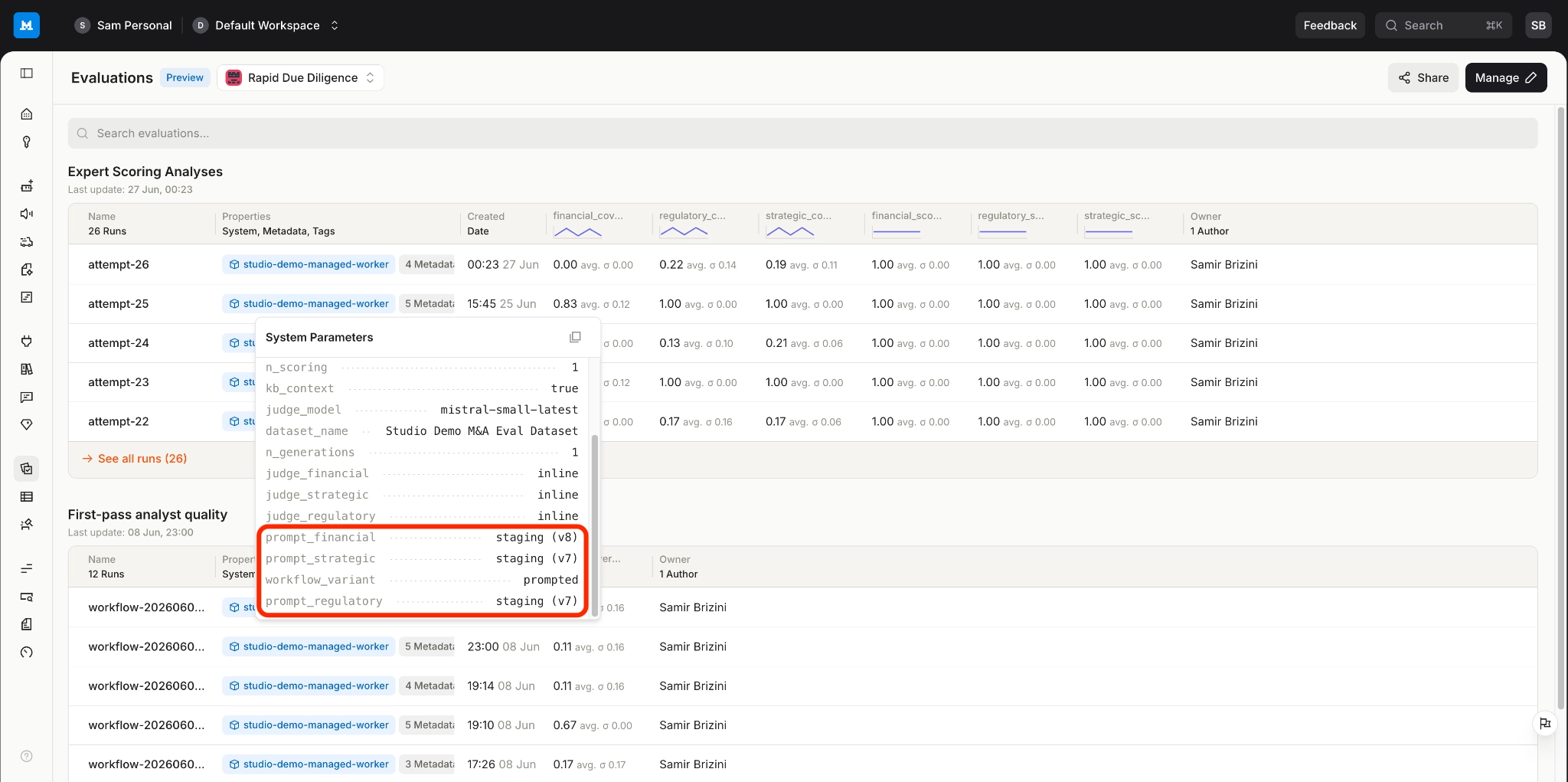
Because your prompts and skills live where your AI runs, Studio can connect them to how it actually behaves. Through Observability, lineage and telemetry trace a production output back to the version of the asset behind it, and back to the usage that prompted the last change. The skills your agents run are reachable as MCP servers straight from Studio, so what executes in production is the same governed asset you versioned, not a copy that drifted. You define behaviour, watch it run, and improve it, all against one source of truth. That closed loop is the difference between cataloging your AI and governing it.
Control for the people who answer to auditors.
Ungoverned prompts are a liability for the people who answer to auditors. They embed data-handling rules and policy decisions someone will eventually have to defend, and today they often live where no compliance team can see them.
Studio changes the default. Every asset moves through a clear path to production, from a staging version to a tagged production version, so shipping a change is deliberate rather than accidental.
An asset starts as visible only to its creator, then when appropriate can be promoted to the workspace and, in time, across the organisation, with control over who can use it at each step. Across every deployment mode, your data stays inside your perimeter.
Available now in Studio.
Prompts and skills are available to Mistral Studio customers today. If you run AI in production, Studio turns scattered prompts and skills into governed assets you can trust.
Read documentation:
Create reusable prompts in Studio
Create reusable skills in Studio
Or explore Prompts and Skills in Studio.
0%
Related items
92
FeaturedOpenRouter Launches Prompt Caching with Sticky Routing to Drastically Reduce Multi-Turn Costs
OpenRouter 推出提示缓存与粘性路由,大幅降低多轮对话成本
For developers making frequent AI API calls, this feature is a direct money-saver. Sticky routing guarantees cache hit rates, and session_id requires zero configuration—every OpenRouter user should try it immediately.
91
FeaturedChatGPT Work: An AI Agent That Takes Action Across Apps and Files
ChatGPT Work:可在跨应用和文件中执行操作的AI Agent
I think this is a key step for AI assistants moving from Q&A to execution. Especially noteworthy for professionals who need to automate complex workflows. ChatGPT Work could become a new paradigm for productivity tools.
90
FeaturedAnatomy of a Frontier Lab Agent Intrusion: A Technical Timeline of the July 2026 Incident
前沿实验室代理入侵事件技术时间线:2026年7月事件剖析
This technical timeline is a must-read for all AI security researchers and agent developers—it doesn't just describe one attack but sounds an alarm on the weak defense systems of agent architectures. For teams deploying autonomous agents, this is an essential disaster prevention manual.
90
FeaturedBetter Tools Made Copilot Code Review Worse? Here's How GitHub Improved It
更好的工具反而让Copilot代码审查更糟?GitHub这样改进
This blog post deserves close reading by all AI product engineers and ML practitioners—it breaks the intuition that 'more powerful tools = better AI' and instead emphasizes an engineering philosophy aligned with agent reasoning patterns. Especially important for teams optimizing code review or similar agent-based products.
88
FeaturedOpenRouter Launches Unified Multimodal API: Single Endpoint for Image, Video, Audio, Embeddings, and Transcription
OpenRouter 推出统一多模态 API:单端点支持图像、视频、音频、嵌入与转录
This news is worth attention from all developers building multimodal AI applications: OpenRouter's unified API solves the pain of model switching, especially for startups or rapid prototyping. If you're struggling with multiple API keys and SDKs, this interface could be the unified layer you need.
87
FeaturedAnthropic Launches Claude for Teachers: AI Tools Designed for Educators
Anthropic 推出 Claude for Teachers:面向教师的教育 AI 工具
This announcement is valuable for educators and AI industry watchers alike. Instead of a generic chatbot, Anthropic designed a safety-first tool specifically for teachers, demonstrating the right approach for AI vertical deployment: solving real pain points rather than showing off technology. The built-in guardrails also set a reference for other AI companies, especially when serving scenarios involving children or teenagers.
86
FeaturedOpenRouter Introduces New Auto Router: Model Routing Powered by Market Wisdom
OpenRouter发布全新Auto Router:用市场智慧优化模型路由
This update is worth attention for anyone using APIs to build AI apps. Instead of guessing or testing model selection, market data now does the heavy lifting. Though sparse on details, the direction is right, especially for teams relying on aggregated model services.
86
FeaturedClaude Code v2.1.211 Release: Multiple Fixes and Improvements
Claude Code v2.1.211 发布:多项修复与改进
As a developer who frequently uses Claude Code for automated coding, I'm particularly interested in the security fixes, especially the permission preview character bypass and auto mode overriding hook decisions—these directly affect the security boundaries during team collaboration. The improvement in background agent reporting also makes long-running tasks more reliable. I recommend all users upgrade as soon as possible.