datasette-charts 0.1a0
Score
65Why selected
保留在全量动态池,可作为背景信息或后续聚合信号。
AI commentary
「来自 Simon Willison 博客(Atom) 的这条信息指向模型能力或模型生态变化,适合用于判断近期 AI 圈的真实动向。」
Quick overview
Release: datasette-charts 0.1a0 I've been thinking about this problem for over a year now, but on Sunday I finally fired up Claude Fable 5.2 to build an initial prototype. The prototype went so well that this is now a f…
- Release: datasette-charts 0.1a0 I've been thinking about this problem for over a year now, but on Sunday I finally fired up Claude Fable 5.2 to build an initial prototype.
- The prototype went so well that this is now a full plugin.
- You can try it out in Datasette Lite here.
Full text
Showing the source text; the full translation is being generated.
Release: datasette-charts 0.1a0
I've been thinking about this problem for over a year now, but on Sunday I finally fired up Claude Fable 5.2 to build an initial prototype. The prototype went so well that this is now a full plugin.
You can try it out in Datasette Lite here. It looks like this:
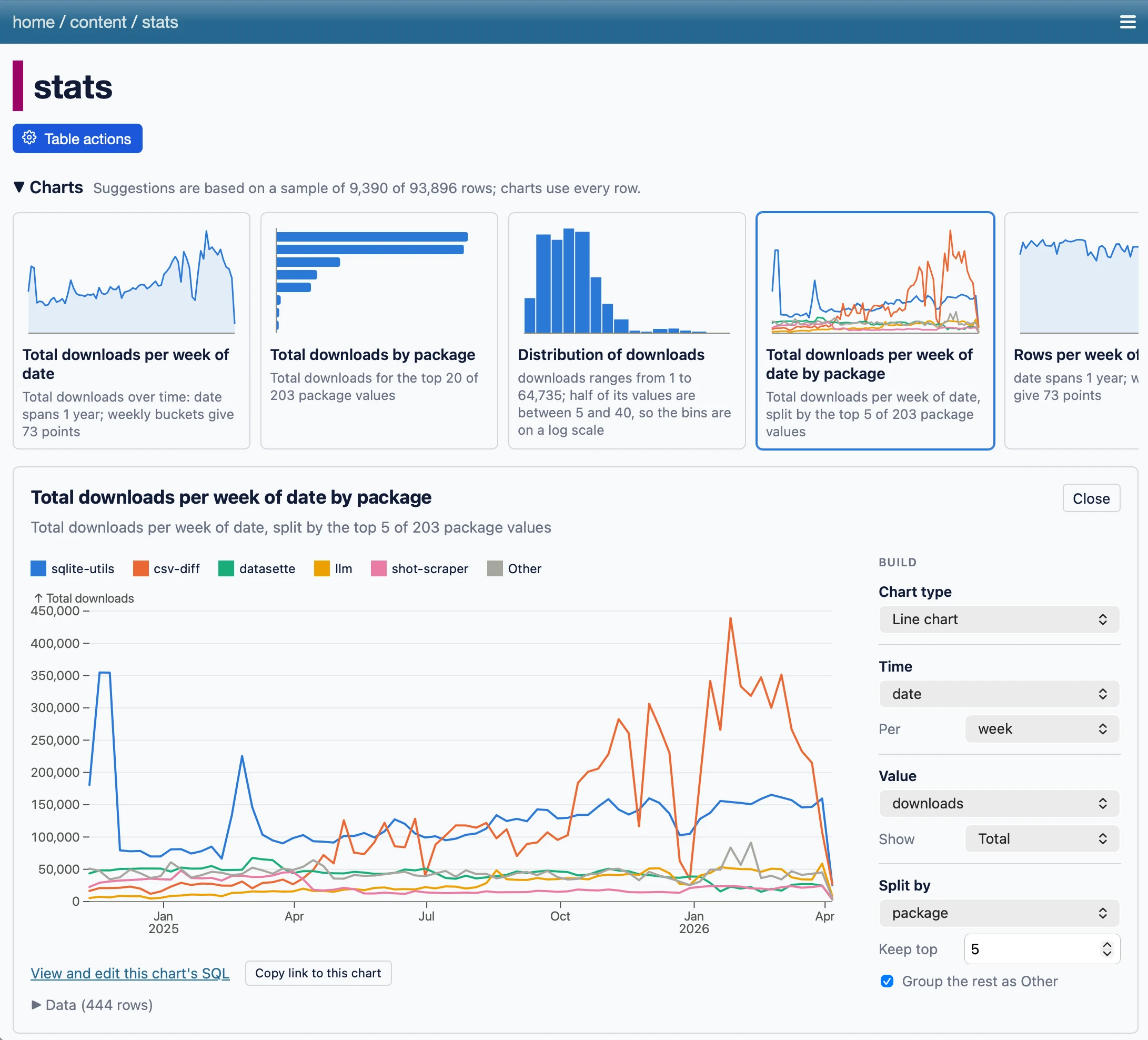
The new charts plugin works against any table or arbitrary SQL query in Datasette. It defines several different chart types (using vendored D3, Observable Plot, and topojson-client), each with a set of heuristics for identifying when they might be a good match for a specific set of rows.
Those suggestion thumbnails at the top are actual visualizations driven by the data, and selecting one pulls up the full chart along with tools for modifying it. You can also manually construct a chart from scratch.
As with other Datasette visualization plugins, the current state of your chart is persisted in a #fragment in the URL - so you can bookmark charts or share them with others.
The most important feature is that the charts take all rows into account. Previous charting plugins like datasette-vega would only show charts for the current page of results, generally up to 100 rows.
The new plugin compiles each chart to a SQL query that aggregates across the entire result set (potentially millions of rows) using GROUP BY, time bucketing, and window functions. Each query returns a result capped at 5,000 rows, suitable for display on the chart. The plugin uses sampling to help suggest charts for larger tables without evaluating the full result set.
I'm really happy with this initial release of the plugin. It's still very much an alpha, but it's the closest I've got to the dream of Datasette helping visualize data with as little required direction from the user as possible.
Tags: coding-agents, generative-ai, projects, ai, llms, datasette, visualization, claude-mythos-fable
Related items
FeaturedDeepSeek V4 Doubles Token Share on OpenRouter, Driven by Agentic Workloads
DeepSeek V4 在 OpenRouter 上的代币份额翻倍,智能体工作负载成主要驱动力
The rapid adoption of DeepSeek V4 signals a strong market preference for high-performance, low-cost inference models, especially as agentic use cases reshape AI deployment.
91
FeaturedEnabling Two Settings Triples ARC-AGI-3 Benchmark Scores
启用两项设置使ARC-AGI-3基准测试分数提升三倍
This finding is crucial! It shows that model performance depends not only on training but also on inference-time configuration. For AI engineers and researchers, this is a must-know optimization direction. Teams deploying models on resource-constrained devices in particular could find a low-cost way to boost capabilities.
91
FeaturedGPT-5.6: Fusing Frontier Intelligence with Frontier Efficiency
GPT-5.6:前沿智能与前沿效率的融合
This news is worth watching as it marks a shift from pure parameter scaling to efficiency competition. For AI developers and business decision-makers, GPT-5.6 means higher performance at lower cost, especially for long-context or agentic tasks previously hindered by inference expenses. OpenAI's move may redefine what 'frontier' means.
91
FeaturedLFM2.5-Encoders: New Models for Fast Long-Context Inference on CPU
LFM2.5-Encoder:面向CPU快速长上下文推理的新模型
This blog post catches my eye because it directly solves the pain point of running long-context LLMs on CPU. For teams or individual developers without high-end GPUs, the LFM2.5-Encoder series offers a ready-to-use open-source solution. Highly recommended for those working on RAG, document search, or code analysis—now a standard server can handle million-token documents.
91
FeaturedGPT-Red: OpenAI Automates Red Teaming via Self-Play to Boost Model Robustness
GPT-Red:OpenAI通过自我对弈实现AI红队自动化,提升模型鲁棒性
GPT-Red marks a milestone from human to automated red-teaming—essential for safety engineers and alignment researchers. While reducing cost, it also raises ethical questions about automated attacks, worth pondering for everyone in AI governance.
91
FeaturedOpenAI Launches GPT-5.5 Bio Bug Bounty Program
OpenAI推出GPT-5.5生物漏洞赏金计划
This program deserves attention as it pioneers the extension of AI bug bounty to biosecurity, offering a new research direction for the security community and a practical training ground for AI risk governance. It is particularly important for model safety researchers, biosecurity experts, and practitioners concerned about dual-use AI risks.
91
FeaturedvLLM Introduces Native-Speed Transformers Modeling Backend for Enhanced Inference Performance
vLLM推出原生速度Transformers建模后端,大幅提升推理性能
This update is critical for AI engineering teams: eliminating format conversion speeds up model iteration, and 2-5x speedup directly reduces GPU costs. If you're building LLM online services or batch inference, this is practically a must-read technical update.
90
FeaturedGoogle DeepMind Introduces SL2T, a Sign Language-to-Text Model for Deaf Users
Google DeepMind 发布手语转文本模型 SL2T,助力聋人用户
This news matters not only as a technical breakthrough but also as a sign that AI is beginning to address the needs of marginalized groups. For developers, the architecture and technical approach of SL2T merit deep study; for accessibility advocates, it's a key case for advancing industry standards.