LLM 0.32 Released: Reasoning Traces, OpenAI Responses, and Server-Side Tools
Score
77除了例行版本更新,还首次系统化展示了推理轨迹、服务端工具与内容寻址日志的结合方式,具有方法论价值。
作者是项目创始人,发布说明细致完整,示例丰富,覆盖 CLI 与 Python API 两大场景。
提供了直接可用的命令、插件和代码示例,对使用 LLM CLI 的开发者有很强实操指导性。
2026年8月4日发布,文章当天更新,反映了最新版本状态。
来自 Simon Willison 个人博客,他是 LLM 项目作者,属于一手权威信源。
Base 85.5 × T2 Source weight ×0.9 = 77
Curation line 70Selected
Why selected
The post is packed with actionable new features from the project's lead developer, making it highly timely and relevant.
AI commentary
「This update ties reasoning traces, server-side tools, and content-addressable storage together, making LLM look like an agent scaffold. Developers who want to prototype agents from the command line or study tool composition should pick up 0.32 right away; even Python-API users will find stream_events a better way to handle mixed model outputs.」
Quick overview
Simon Willison released LLM 0.32, the most significant upgrade since the project's initial launch. The new version adds visible reasoning traces for reasoning models, support for the OpenAI Responses API, server-side tools from providers, and redesigned content-addressable SQLite logs. The default model is now GPT-5.6 Luna, an inexpensive but capable option. Python API users get a new messages parameter and a stream_events interface that can handle reasoning text, tool calls, and attachments. New commands like llm openai endpoint enable one-liner prompts against any OpenAI-compatible service, while plugins for Anthropic, Gemini, and OpenRouter also received substantial updates. With these changes, LLM is beginning to look like an agent framework, capable of mixing tools from different sources with different models.
- LLM 0.32 introduces visible reasoning traces written to stderr, with -R/--hide-reasoning to turn them off.
- Adds support for the OpenAI Responses API, the GPT-5.6 family, and server-side tools like CodeInterpreter and WebSearch.
- Python API gains model.prompt(messages=...) and stream_events to handle reasoning text, tool calls, and attachments uniformly.
- Content-addressable logging improves long conversation storage; LLM is evolving into an agent framework.
Full text
Showing the source text; the full translation is being generated.
I released LLM 0.32 this morning, the most significant new version of LLM since the initial launch of the project. The new version includes support for visible reasoning traces, server-side provider tools, redesigned content-addressable SQLite logs, new models, and new features enabled by the OpenAI Responses API. I also released new versions of the llm-anthropic, llm-gemini, and llm-openrouter plugins, each with substantial updates of their own.
Headline features for LLM CLI users
Running LLM against reasoning models now displays their reasoning traces to standard error, so you can see what they are "thinking" without that information being included in the standard output that you might pipe to another tool. Add -R/--hide-reasoning to turn this off.
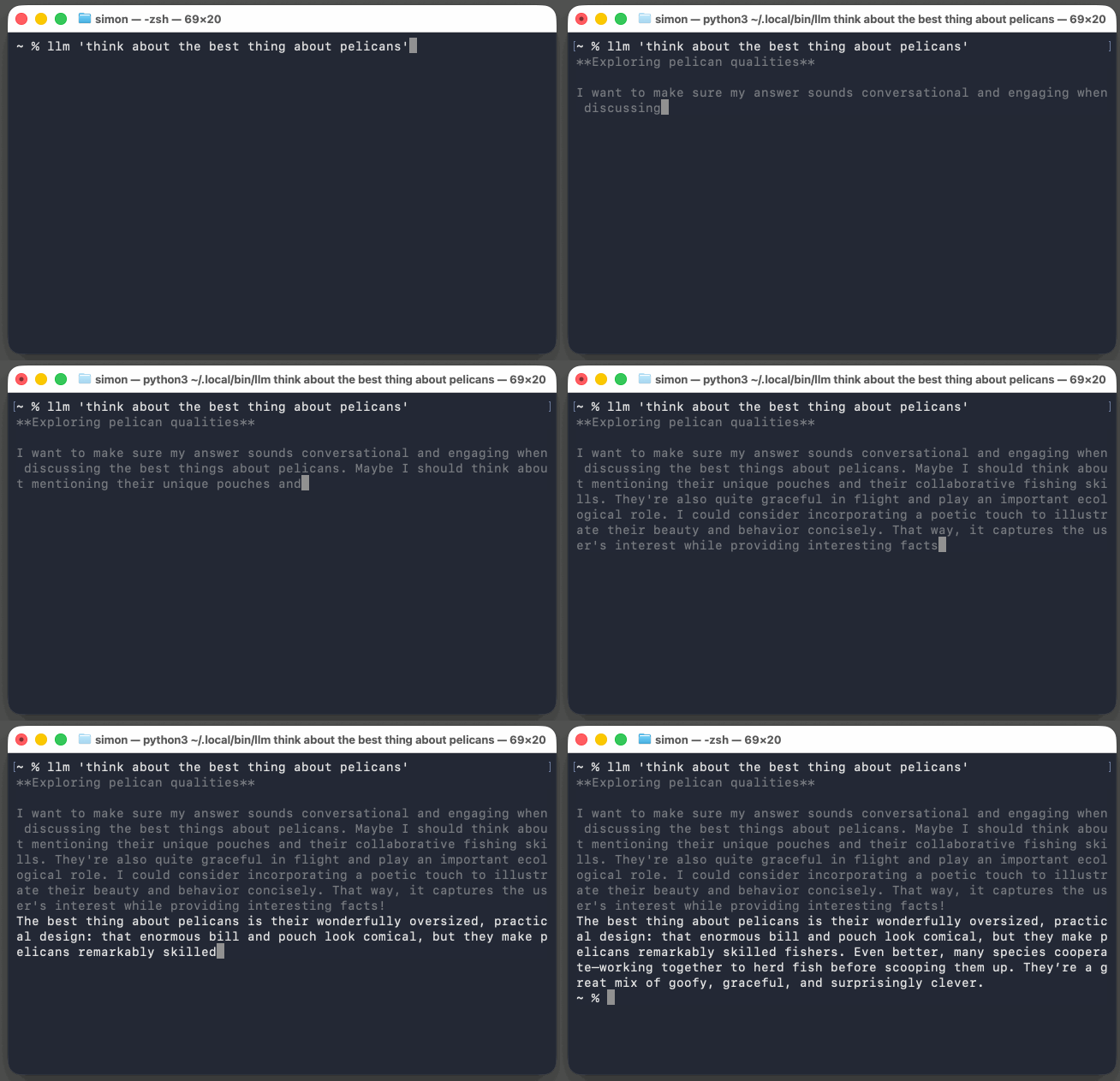
LLM includes support out-of-the-box for the GPT-5.6 model family, and the new default model used with llm "prompt" is now the inexpensive but capable GPT-5.6 Luna.
LLM calls can now use server-side tools from various providers. OpenAI provide a code execution environment as a server-side tool; LLM can now run prompts that benefit from that like so:
llm --tool CodeInterpreter 'Show current python and SQLite versions'
OpenAI also gets a WebSearch tool.
The llm-anthropic plugin adds WebSearch, WebFetch, CodeExecution, and AnthropicMCP, which looks like this:
llm -m claude-sonnet-5 -T 'AnthropicMCP("https://datasette.simonwillison.net/-/mcp")' \
  'how many rows in the blog_blogmark table?'
That causes Anthropic to execute MCP calls against my new datasette-mcp plugin as part of a single request/response interaction with their API.
The new llm openai endpoint command provides a tool for executing prompts against any OpenAI compatible endpoint as a one-liner. These aren't logged, which makes this a handy tool for running one-off prompts against anything that speaks the lingua franca of the LLM API world.
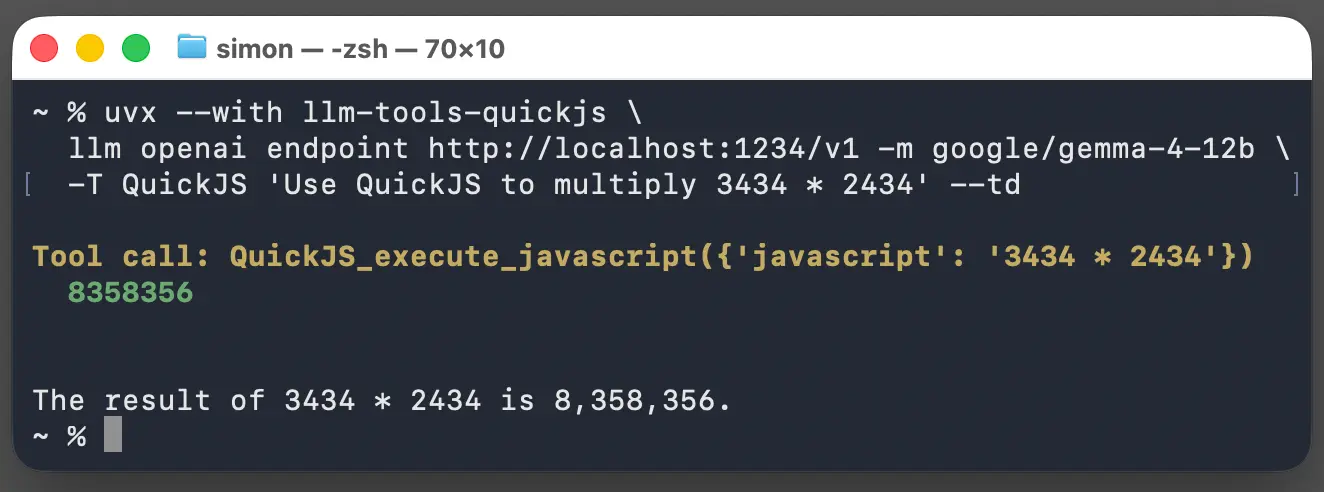
Here's how I use that to run prompts against Gemma 4 12B running in my localhost LM Studio API, via uvx (no LLM installation required) and mixing in the llm-tools-quickjs tool plugin for good measure:
uvx --with llm-tools-quickjs \
  llm openai endpoint http://localhost:1234/v1 -m google/gemma-4-12b \
  -T QuickJS 'Use QuickJS to multiply 3434 * 2434' --td
New features in the Python API
LLM's Python API previously required you to create a conversation and then send messages to it one at a time. This was an abstraction over the true nature of LLMs, where each request carries a complete history of the messages that came before it. That abstraction started to get in the way for some more advanced cases, so the new release introduces a model.prompt(messages=[]) parameter that can be used like this:
import llm
from llm import user, assistant, system

model = llm.get_model("gpt-5.6-luna")

response = model.prompt(messages=[
    system("You are a helpful pirate."),
    user("What is the capital of France?"),
    assistant("Paris, matey."),
    user("And Germany?"),
])
print(response.text())
LLM previously returned an iterable sequence of strings from each prompt. This worked great when models returned a string response, but failed to predict the weird shape that models would evolve towards. Today many models return a mix of reasoning text, output strings, tool calls, and even image attachments. With LLM 0.32 you can do this instead:
for event in model.prompt("Explain cats").stream_events():
    if event.type == "reasoning":
        print(f"[thinking] {event.chunk}", end="", flush=True)
    elif event.type == "text":
        print(event.chunk, end="", flush=True)
    else:
        print(f"Other event: {event}")
Combine these features and we can finally provide a robust implementation of the semi-standard OpenAI chat completions API, which I've now released as the llm-chat-completions-server plugin:
llm install llm-chat-completions-server
llm chat-completions-server --port 9000
# Server is now running on http://127.0.0.1:9000/v1
Now you can run prompts against LLM via that server, using the new llm openai endpoint command!
llm openai endpoint http://127.0.0.1:9000/v1 'hello' -m gpt-5.4-mini
The bigger challenge with that kind of API concerns logging. If we're going to support the pattern where the message sequence is appended to on every request, ideally we can avoid logging all of that duplicate JSON for every turn.
The solution is the new content-addressable message store, modeled after Git. You can see the new schema for that in the documentation, but the llm logs and llm logs --json commands have both been upgraded to convert that format back into something that's easy to consume.
And the rest
There is a whole lot more in this release. The 0.32 release notes are pretty comprehensive, and the notes for 0.32rc2, 0.32rc, 0.32a3, 0.32a2, and 0.32a0 should fill in any gaps.
Existing LLM plugins should all continue to work, but plugins that provide extra models will need to be upgraded to 0.32 in order to participate fully in the new streaming events system. There's a guide to implementing plugins with Structured messages and streaming events in the documentation.
I've updated some of my own plugins:
-
llm-anthropic 0.26 adds support for the Claude 5 family of models, plus
WebSearch,WebFetch,CodeExecution, andAnthropicMCPserver-side tools. - llm-gemini and llm-openrouter and llm-mistral are nearly there, releases coming soon.
I guess LLM is an agent framework now
Quite a few of the lower-level tools changes in this release were driven by the needs of Datasette Agent. When I started work on LLM, the term "agent" had such a vague definition that I refused to use it. In September 2025 I came around to the idea that "An LLM agent runs tools in a loop to achieve a goal" is well established enough now that I could stop avoiding the term entirely.
Tool chains can now pause for human approval and resume from a stored message history - both needed by Datasette Agent.
Looking at LLM today it's beginning to look very agent-shaped to me. There's something neat about having a CLI utility that can mix and match different tools from different sources with different models all as a one-liner, and that includes a Python library powerful enough to build systems like Datasette Agent and llm-coding-agent.
Maybe the next version of LLM will bake the concept of an "agent" into the core library. I'm still trying to figure out what that would look like.
Tags: projects, releases, ai, openai, generative-ai, llms, llm, anthropic
Related items
92
FeaturedOpenRouter Launches Prompt Caching with Sticky Routing to Drastically Reduce Multi-Turn Costs
OpenRouter 推出提示缓存与粘性路由,大幅降低多轮对话成本
For developers making frequent AI API calls, this feature is a direct money-saver. Sticky routing guarantees cache hit rates, and session_id requires zero configuration—every OpenRouter user should try it immediately.
91
FeaturedChatGPT Work: An AI Agent That Takes Action Across Apps and Files
ChatGPT Work:可在跨应用和文件中执行操作的AI Agent
I think this is a key step for AI assistants moving from Q&A to execution. Especially noteworthy for professionals who need to automate complex workflows. ChatGPT Work could become a new paradigm for productivity tools.
90
FeaturedAnatomy of a Frontier Lab Agent Intrusion: A Technical Timeline of the July 2026 Incident
前沿实验室代理入侵事件技术时间线:2026年7月事件剖析
This technical timeline is a must-read for all AI security researchers and agent developers—it doesn't just describe one attack but sounds an alarm on the weak defense systems of agent architectures. For teams deploying autonomous agents, this is an essential disaster prevention manual.
90
FeaturedBetter Tools Made Copilot Code Review Worse? Here's How GitHub Improved It
更好的工具反而让Copilot代码审查更糟?GitHub这样改进
This blog post deserves close reading by all AI product engineers and ML practitioners—it breaks the intuition that 'more powerful tools = better AI' and instead emphasizes an engineering philosophy aligned with agent reasoning patterns. Especially important for teams optimizing code review or similar agent-based products.
88
FeaturedOpenRouter Launches Unified Multimodal API: Single Endpoint for Image, Video, Audio, Embeddings, and Transcription
OpenRouter 推出统一多模态 API:单端点支持图像、视频、音频、嵌入与转录
This news is worth attention from all developers building multimodal AI applications: OpenRouter's unified API solves the pain of model switching, especially for startups or rapid prototyping. If you're struggling with multiple API keys and SDKs, this interface could be the unified layer you need.
87
FeaturedAnthropic Launches Claude for Teachers: AI Tools Designed for Educators
Anthropic 推出 Claude for Teachers:面向教师的教育 AI 工具
This announcement is valuable for educators and AI industry watchers alike. Instead of a generic chatbot, Anthropic designed a safety-first tool specifically for teachers, demonstrating the right approach for AI vertical deployment: solving real pain points rather than showing off technology. The built-in guardrails also set a reference for other AI companies, especially when serving scenarios involving children or teenagers.
86
FeaturedOpenRouter Introduces New Auto Router: Model Routing Powered by Market Wisdom
OpenRouter发布全新Auto Router:用市场智慧优化模型路由
This update is worth attention for anyone using APIs to build AI apps. Instead of guessing or testing model selection, market data now does the heavy lifting. Though sparse on details, the direction is right, especially for teams relying on aggregated model services.
86
FeaturedClaude Code v2.1.211 Release: Multiple Fixes and Improvements
Claude Code v2.1.211 发布:多项修复与改进
As a developer who frequently uses Claude Code for automated coding, I'm particularly interested in the security fixes, especially the permission preview character bypass and auto mode overriding hook decisions—these directly affect the security boundaries during team collaboration. The improvement in background agent reporting also makes long-running tasks more reliable. I recommend all users upgrade as soon as possible.