LLM 0.32 发布:支持推理轨迹、OpenAI Responses 与服务端工具
评分
77除了例行版本更新,还首次系统化展示了推理轨迹、服务端工具与内容寻址日志的结合方式,具有方法论价值。
作者是项目创始人,发布说明细致完整,示例丰富,覆盖 CLI 与 Python API 两大场景。
提供了直接可用的命令、插件和代码示例,对使用 LLM CLI 的开发者有很强实操指导性。
2026年8月4日发布,文章当天更新,反映了最新版本状态。
来自 Simon Willison 个人博客,他是 LLM 项目作者,属于一手权威信源。
基础分 85.5 × T2 信源权重 ×0.9 = 77
精选线 70已入选精选
精选理由
信息量大且全部为可操作的新特性,信源为项目作者一手发布,时效性与相关性俱佳。
AI 点评
「这版更新把推理链、服务端工具和内容寻址存储串在一起,让 LLM 已然具备 agent 雏形。对于想用命令行快速搭 agent 或研究工具链组合的开发者,0.32 值得立即上手;即使只用 Python API,stream_events 的多事件解析也会改变你处理模型输出的方式。」
速览
Simon Willison 发布 LLM 0.32,这是该项目自启动以来最重要的版本更新。新版本为推理模型展示可见推理轨迹,支持 OpenAI Responses API 与服务端工具,并重构了基于内容寻址的 SQLite 日志系统。新默认模型为 GPT-5.6 Luna,Python API 新增 messages 参数与流式事件接口,使 LLM 逐步具备 agent 框架形态,配套插件也迎来大规模升级。
- LLM 0.32 引入可见推理轨迹,输出到标准错误,用 -R/--hide-reasoning 可隐藏。
- 新增对 OpenAI Responses API、GPT-5.6 系列及服务端工具(CodeInterpreter、WebSearch)的支持。
- Python API 新增 model.prompt(messages=...) 与 stream_events,可统一处理推理文本、工具调用与附件。
- 内容寻址日志存储让长对话记录更高效,LLM 正朝 agent 框架演进。
正文
以下为原文,中文全文翻译生成中
I released LLM 0.32 this morning, the most significant new version of LLM since the initial launch of the project. The new version includes support for visible reasoning traces, server-side provider tools, redesigned content-addressable SQLite logs, new models, and new features enabled by the OpenAI Responses API. I also released new versions of the llm-anthropic, llm-gemini, and llm-openrouter plugins, each with substantial updates of their own.
Headline features for LLM CLI users
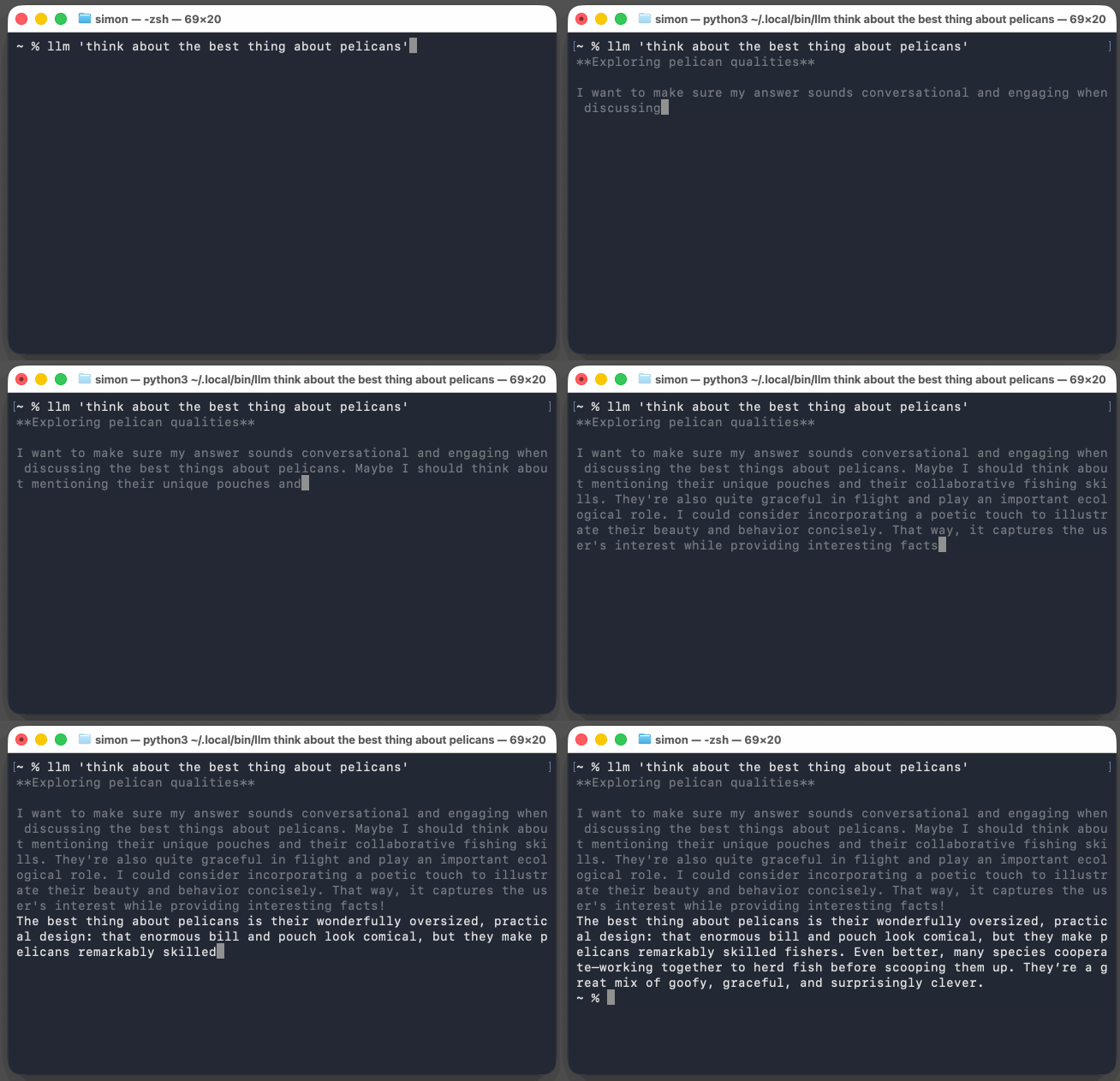
Running LLM against reasoning models now displays their reasoning traces to standard error, so you can see what they are "thinking" without that information being included in the standard output that you might pipe to another tool. Add -R/--hide-reasoning to turn this off.
LLM includes support out-of-the-box for the GPT-5.6 model family, and the new default model used with llm "prompt" is now the inexpensive but capable GPT-5.6 Luna.
LLM calls can now use server-side tools from various providers. OpenAI provide a code execution environment as a server-side tool; LLM can now run prompts that benefit from that like so:
llm --tool CodeInterpreter 'Show current python and SQLite versions'
OpenAI also gets a WebSearch tool.
The llm-anthropic plugin adds WebSearch, WebFetch, CodeExecution, and AnthropicMCP, which looks like this:
llm -m claude-sonnet-5 -T 'AnthropicMCP("https://datasette.simonwillison.net/-/mcp")' \
  'how many rows in the blog_blogmark table?'
That causes Anthropic to execute MCP calls against my new datasette-mcp plugin as part of a single request/response interaction with their API.
The new llm openai endpoint command provides a tool for executing prompts against any OpenAI compatible endpoint as a one-liner. These aren't logged, which makes this a handy tool for running one-off prompts against anything that speaks the lingua franca of the LLM API world.
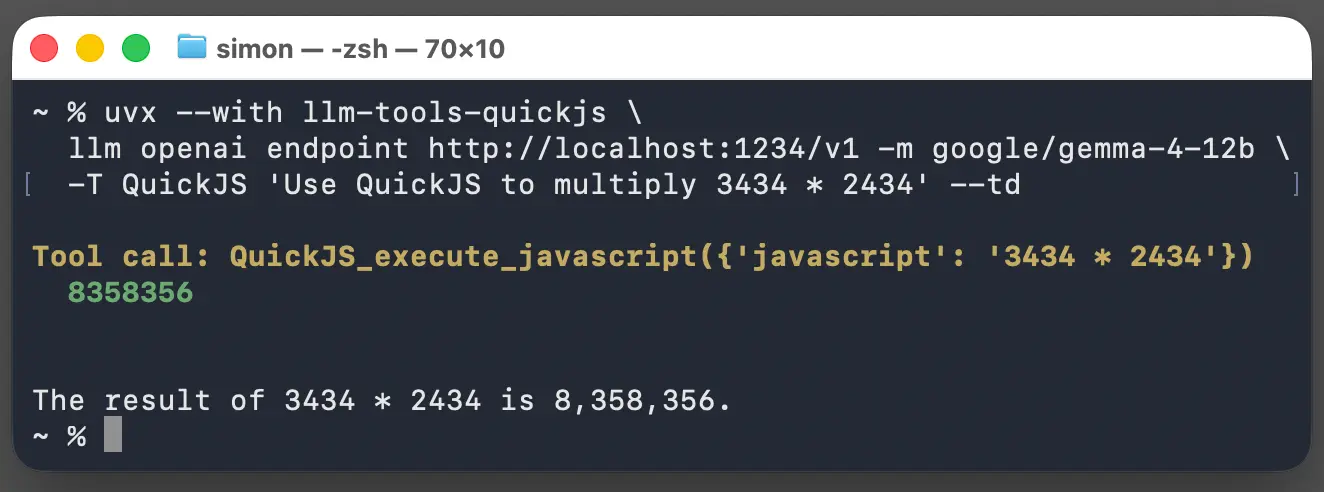
Here's how I use that to run prompts against Gemma 4 12B running in my localhost LM Studio API, via uvx (no LLM installation required) and mixing in the llm-tools-quickjs tool plugin for good measure:
uvx --with llm-tools-quickjs \
  llm openai endpoint http://localhost:1234/v1 -m google/gemma-4-12b \
  -T QuickJS 'Use QuickJS to multiply 3434 * 2434' --td
New features in the Python API
LLM's Python API previously required you to create a conversation and then send messages to it one at a time. This was an abstraction over the true nature of LLMs, where each request carries a complete history of the messages that came before it. That abstraction started to get in the way for some more advanced cases, so the new release introduces a model.prompt(messages=[]) parameter that can be used like this:
import llm
from llm import user, assistant, system

model = llm.get_model("gpt-5.6-luna")

response = model.prompt(messages=[
    system("You are a helpful pirate."),
    user("What is the capital of France?"),
    assistant("Paris, matey."),
    user("And Germany?"),
])
print(response.text())
LLM previously returned an iterable sequence of strings from each prompt. This worked great when models returned a string response, but failed to predict the weird shape that models would evolve towards. Today many models return a mix of reasoning text, output strings, tool calls, and even image attachments. With LLM 0.32 you can do this instead:
for event in model.prompt("Explain cats").stream_events():
    if event.type == "reasoning":
        print(f"[thinking] {event.chunk}", end="", flush=True)
    elif event.type == "text":
        print(event.chunk, end="", flush=True)
    else:
        print(f"Other event: {event}")
Combine these features and we can finally provide a robust implementation of the semi-standard OpenAI chat completions API, which I've now released as the llm-chat-completions-server plugin:
llm install llm-chat-completions-server
llm chat-completions-server --port 9000
# Server is now running on http://127.0.0.1:9000/v1
Now you can run prompts against LLM via that server, using the new llm openai endpoint command!
llm openai endpoint http://127.0.0.1:9000/v1 'hello' -m gpt-5.4-mini
The bigger challenge with that kind of API concerns logging. If we're going to support the pattern where the message sequence is appended to on every request, ideally we can avoid logging all of that duplicate JSON for every turn.
The solution is the new content-addressable message store, modeled after Git. You can see the new schema for that in the documentation, but the llm logs and llm logs --json commands have both been upgraded to convert that format back into something that's easy to consume.
And the rest
There is a whole lot more in this release. The 0.32 release notes are pretty comprehensive, and the notes for 0.32rc2, 0.32rc, 0.32a3, 0.32a2, and 0.32a0 should fill in any gaps.
Existing LLM plugins should all continue to work, but plugins that provide extra models will need to be upgraded to 0.32 in order to participate fully in the new streaming events system. There's a guide to implementing plugins with Structured messages and streaming events in the documentation.
I've updated some of my own plugins:
-
llm-anthropic 0.26 adds support for the Claude 5 family of models, plus
WebSearch,WebFetch,CodeExecution, andAnthropicMCPserver-side tools. - llm-gemini and llm-openrouter and llm-mistral are nearly there, releases coming soon.
I guess LLM is an agent framework now
Quite a few of the lower-level tools changes in this release were driven by the needs of Datasette Agent. When I started work on LLM, the term "agent" had such a vague definition that I refused to use it. In September 2025 I came around to the idea that "An LLM agent runs tools in a loop to achieve a goal" is well established enough now that I could stop avoiding the term entirely.
Tool chains can now pause for human approval and resume from a stored message history - both needed by Datasette Agent.
Looking at LLM today it's beginning to look very agent-shaped to me. There's something neat about having a CLI utility that can mix and match different tools from different sources with different models all as a one-liner, and that includes a Python library powerful enough to build systems like Datasette Agent and llm-coding-agent.
Maybe the next version of LLM will bake the concept of an "agent" into the core library. I'm still trying to figure out what that would look like.
Tags: projects, releases, ai, openai, generative-ai, llms, llm, anthropic
相关条目
92
精选OpenRouter 推出提示缓存与粘性路由,大幅降低多轮对话成本
对于高频调用 AI API 的开发者,这个功能堪称直接省钱利器。粘性路由保证了缓存命中率,配合 session_id 零配置接入,值得所有使用 OpenRouter 的团队立即尝试。
91
精选ChatGPT Work:可在跨应用和文件中执行操作的AI Agent
我认为这是AI助手从问答走向执行的关键一步。对需要自动化复杂工作流的专业人士尤其值得关注。ChatGPT Work可能成为生产力工具的新范式。
90
精选前沿实验室代理入侵事件技术时间线:2026年7月事件剖析
这篇技术时间线值得所有AI安全研究员和代理开发者细读——它不只是描述一次攻击,而是为整个行业敲响了代理系统防御体系薄弱的警钟。对正在部署自主代理的团队来说,这是必读的灾难预防手册。
90
精选更好的工具反而让Copilot代码审查更糟?GitHub这样改进
这篇博客值得所有AI产品工程师和ML从业者仔细阅读——它打破了'更强大的工具=更好的AI'的直觉,转而强调与Agent推理模式匹配的工程哲学。对正在优化代码审查或类似Agent产品的团队尤其重要。
88
精选OpenRouter 推出统一多模态 API:单端点支持图像、视频、音频、嵌入与转录
这条消息值得所有做多模态AI应用的开发者关注:OpenRouter用联合API解决了模型切换的痛点,特别适合初创团队或快速原型开发。如果你正被多个API密钥和SDK折磨,这个接口可能是你需要的统一层。
87
精选Anthropic 推出 Claude for Teachers:面向教师的教育 AI 工具
这条消息对教育工作者和AI行业观察者都很有价值。Anthropic没有选择通用聊天机器人,而是专门为教师设计了安全可控的工具,这显示出AI在垂直场景落地的正确思路——不是技术炫技,而是切实解决用户痛点。同时,产品内置的安全护栏也值得其他AI公司参考,尤其是在面向儿童或青少年的场景中。
86
精选OpenRouter发布全新Auto Router:用市场智慧优化模型路由
这条更新值得所有用API开发AI应用的人关注。以前选模型靠经验和测试,现在市场数据帮你选。虽然细节不多,但方向很对。对依赖聚合模型服务的团队尤其重要。
86
精选Claude Code v2.1.211 发布:多项修复与改进
作为一个经常使用 Claude Code 进行自动化编码的开发者,我特别关注这次的安全修复,尤其是权限预览字符绕过和自动模式覆盖钩子决策的问题——这些直接关系到团队协作时的安全边界。后台代理报告的改进也让长时间运行的任务更可靠。建议所有使用者尽快升级。