The October inflection point for vibe game development
评分
65精选理由
保留在全量动态池,可作为背景信息或后续聚合信号。
AI 点评
「来自 Simon Willison 博客(Atom) 的这条信息指向模型能力或模型生态变化,适合用于判断近期 AI 圈的真实动向。」
速览
I've written before about how November 2025 was an inflection point for coding agents - the point where Opus 4.5 and GPT-5.1 crossed a tipping point that meant their respective coding agents became reliable daily driver…
- I've written before about how November 2025 was an inflection point for coding agents - the point where Opus 4.5 and GPT-5.1 crossed a tipping point that meant their respective coding agents became reliable daily driver…
- I think we've reached a new inflection point in October 2026, and this time it's for vibe coding computer games.
- Tree Appreciator Emberwick Battle Drones Pumpkin Farmer, aka Quarter Sun Cove Four times as insulting What happens if someone actually puts the work in?
正文
以下为原文,中文全文翻译生成中
I've written before about how November 2025 was an inflection point for coding agents - the point where Opus 4.5 and GPT-5.1 crossed a tipping point that meant their respective coding agents became reliable daily drivers for software engineers. I think we've reached a new inflection point in October 2026, and this time it's for vibe coding computer games.
- Tree Appreciator
- Emberwick
- Battle Drones
- Pumpkin Farmer, aka Quarter Sun Cove
- Four times as insulting
- What happens if someone actually puts the work in?
- You should build a game!
Claude Opus 5.5 in particular exhibits meaningful improvements in several areas needed to build a compelling game:
- 3D modeling
- Music generation (see Scrimshaw Jukebox)
- Game design (!)
That last one is particularly important. Models have been able to create something that looks like a game for quite a while now, as seen in my previous experiments. The challenge has been getting to a game that's actually fun to play.
Game design is a deep subject area. I won't pretend to be well versed in it - I know enough to have respect for it as a craft. Creating a novel, compelling gameplay loop which challenges players at the right level and provides a satisfying learning curve is a fine art. I didn't think the models could do it.
Then I tried telling Claude Opus 5.5 to "Make it a LOT more fun"... and it did.
In the past few weeks I've vibe coded (in the classic sense of the term - no looking at the code at all) four games that I've genuinely enjoyed playing.
I attended Foo Camp in Berkeley over the weekend and met several people who were having similar experiences. Building games that play well is shockingly easy now. The new challenge is coming up with concepts for games that are novel and delightful and that wouldn't exist without AI assistance.
I haven't done an exhaustive study, but my current impression is that GPT-6 Astra isn't quite there yet. It can absolutely build a game, but its sense of fun doesn't match that of Opus 5.5. I expect OpenAI will get there by the end of the year.
Here are the four game projects that have convinced me that the models are now capable of producing fun games with very little guidance. All four are built in HTML and JavaScript and run entirely in the browser.
Tree Appreciator
The smallest game I found to be genuinely delightful is Tree Appreciator. I used the regular Claude chat interface for this - it didn't even need Claude Code.
I built this on a whim while we were driving along Skyline Boulevard looking at trees. My prompt was:
Build a three js game called "Tree appreciator" - it shows you two algorithmically generated trees and the game mechanics is about appreciating the differences between them. Think hard about how to make sure it is both fun and beautiful.
I've found that telling models to use three.js works really well. Claude doesn't have its own image generation model but is capable of building full-color 3D models that look and feel excellent.
This game required no iteration or follow-up prompting at all - I got the game in a single shot. It gave me back a charming little mobile-friendly spot-the-difference game. You can play that here. Here's the chat transcript that built it.
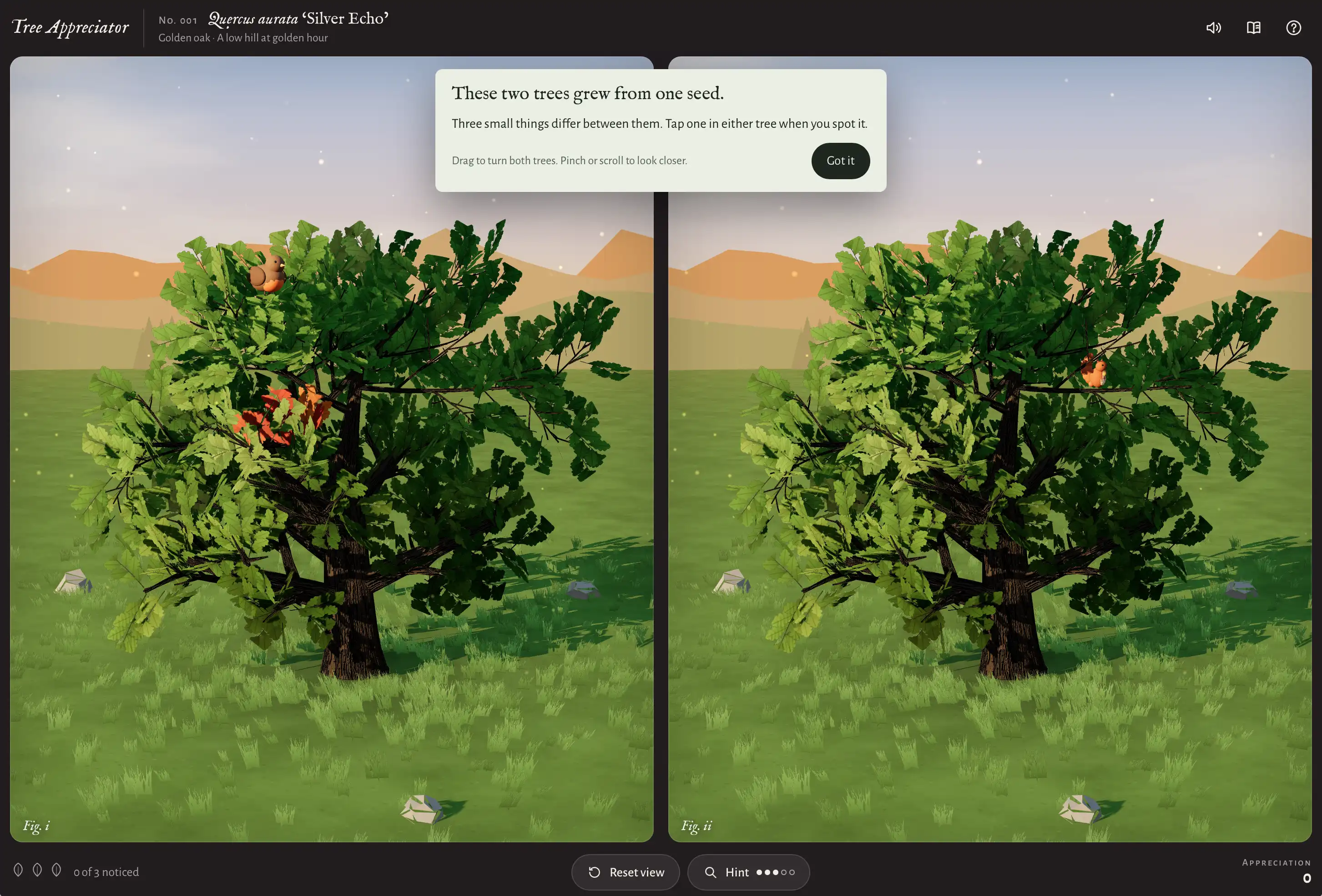
It's pleasingly relaxing. The graphics are fun, and collecting trees that you have completed in a "herbarium" provides a nice, cosy sense of accomplishment.
Emberwick
This was a more ambitious project that I again built using regular Claude chat. I started out by building an experimental prototype of an engine for a top-down fantasy RPG:
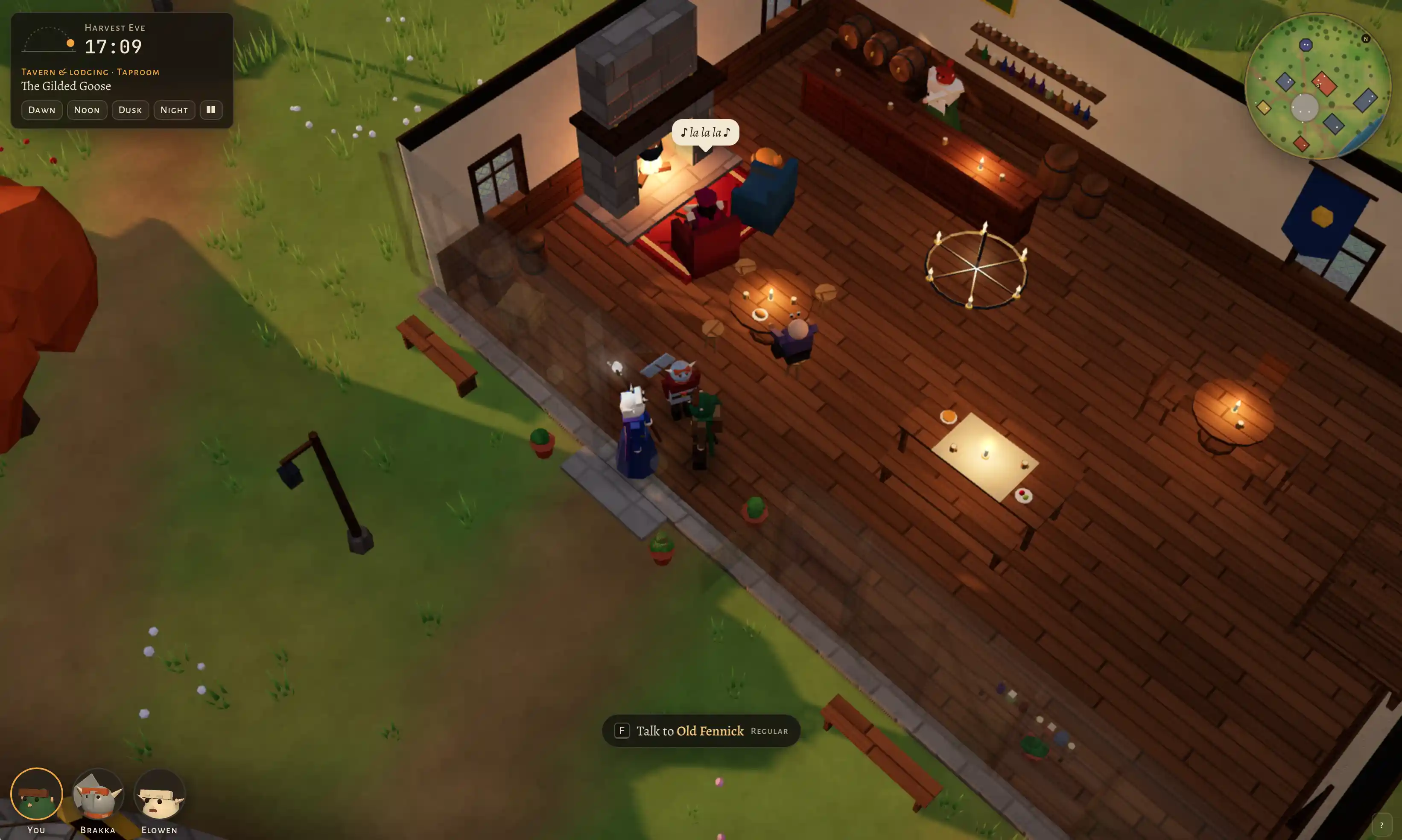
Build a demo game engine three.js which is a top down (but at an angle) RPG - the player gets to move through the world with one or two companions. Create a fantasy village setting that demonstrates walking around outside and then shows how when the player enters a building the wall between the player and the camera goes transparent so the user can see what is happening
Add some NPCs and plenty of furniture and different types of building some with an upstairs - be creative, make it look great
Here's that first version. It worked really well!
I was inspired to increase my ambitions:
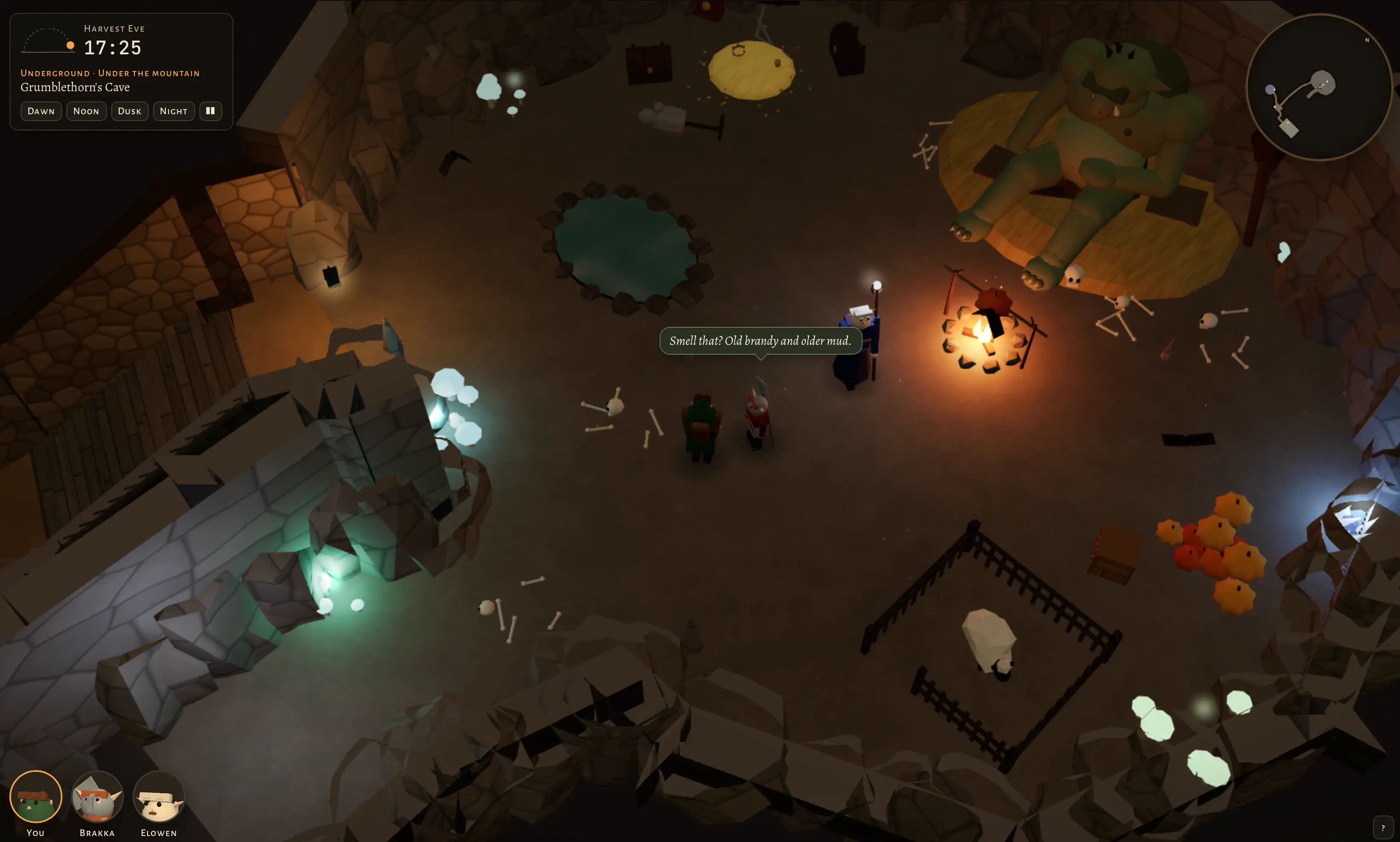
Make it not so flat - the buildings are great but the landscape itself is completely flat at the moment, fix that
Add basements to two of the buildings with a tunnel system joining them below the village
Add the start of a rocky mountain on one side of the village containing a cave with a sleeping troll
Here's that version.
When that produced a good result, I decided to push it all the way:
Now turn this into an actual game - quadruple the size of the playable area, introduce fun game mechanics, add a plot that isn't too cliche, some twists, a magic system, make it really good
We're back to prompts like "make it really good" here! Asking for a plot that "isn't too cliche" seemed to work too - it's a bit cliché, but still novel enough that I enjoyed following the story.
Unlike Tree Appreciator, this took quite a bit of additional playtesting and prompting to get to a finished version. This was mainly due to gameplay problems - things like a character not being in the right place to complete a quest because a different story element had caused them to move to another location.
Here's that final game. It has a full story that takes about 15 minutes to play through.
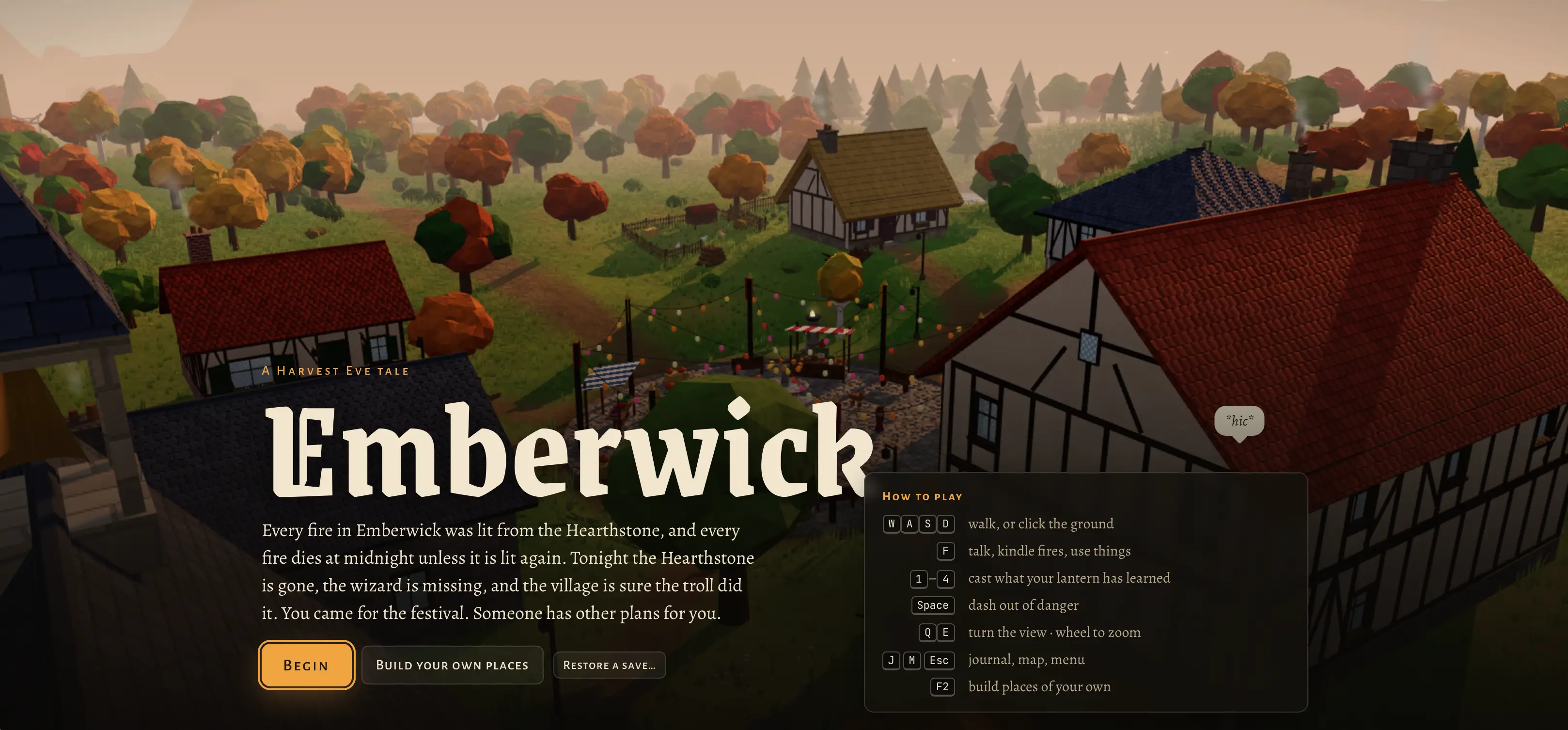
There's even an experimental level editor if you want to drop in your own houses, furniture, and landscape features.
Once it was all working (and I'd iterated through some gameplay bugs), I played it through from start to finish and found myself emotionally affected by the ending! I'm somewhat embarrassed by this, because everything in this game - the graphics, the plot, the characters, the music, the dialog - came from the model. My creative input was pretty much just "it's a fantasy village and there's a troll asleep in a cave".
Here's the full shared Claude chat in which I built this game.
I also fed that same initial sequence of prompts through ChatGPT GPT-6 Pro. Here's the transcript and the finished game for comparison. It looks great, but I don't think it plays nearly as well.
Battle Drones
This is by far my most successful project, which I wrote about last week. It's a Command & Conquer-style Real-Time Strategy game where two robot armies (or four as of Saturday) build units, harvest scrap, and battle over territory.
This is also the project that convinced me that Opus 5.5 knows what "fun" is.
The first versions were built back in July using Claude Fable 5. It got me to a workable 2D Command & Conquer-style game, but it wasn't great to play.
I prompted Opus 5.5 to "Make it a LOT more fun" and then later to "Port this game to three.js" and the game was transformed. There's a blow-by-blow account (prompts included) in my write-up.
Today, Battle Drones has 2-4 player multiplayer (via a vibe coded WebSockets relay server), medals, replays, seven maps, a random map generator, and a set of "mutators" that add variants of the rules.
It also lets different LLMs play against each other, using a mode where the game advances five seconds and then pauses to give different models time to interpret the new game state and line up their next set of commands. Here's a replay of Claude Haiku 5.5 vs. GPT-6 Luna:
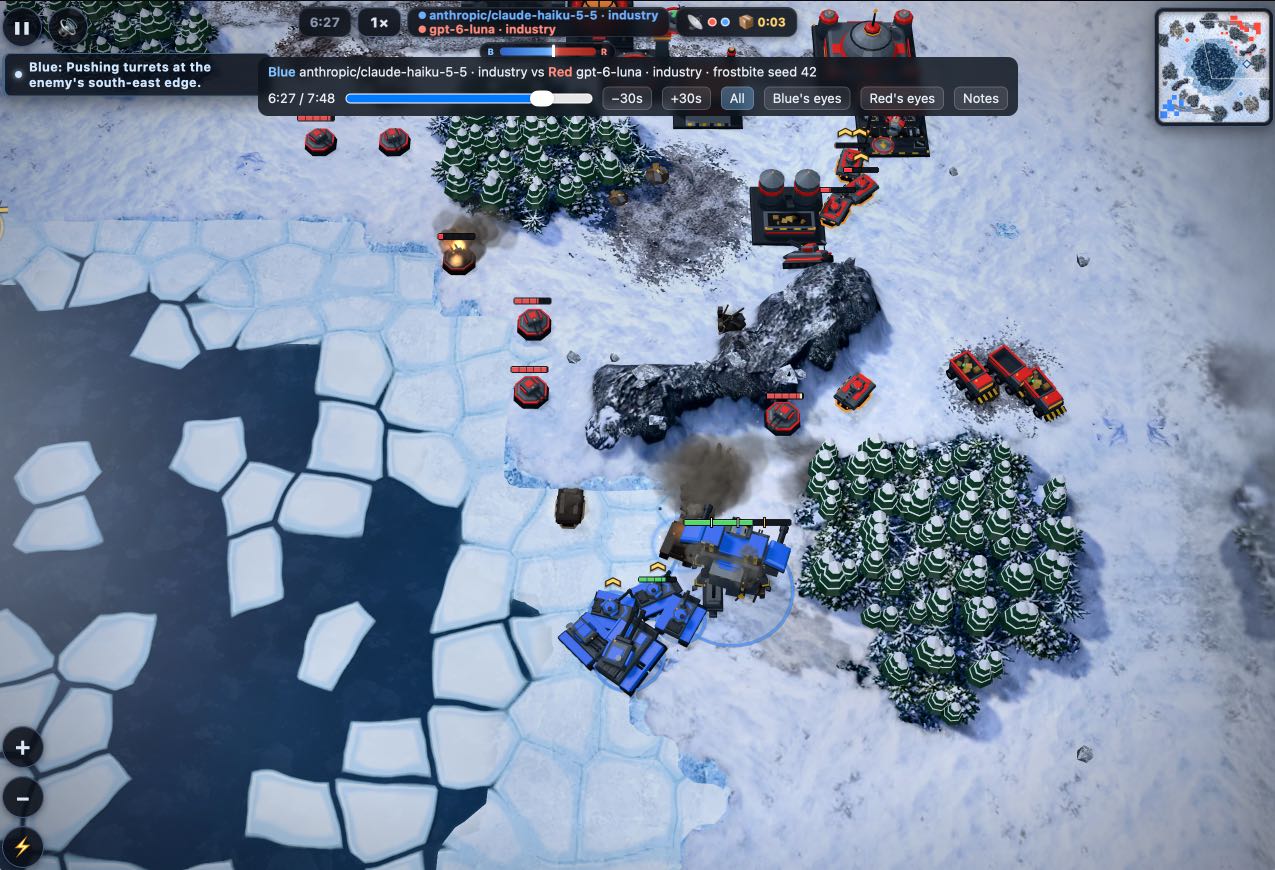
Battle Drones is a particularly good example of Opus 5.5's ability to create 3D models. This page lets you browse all of the models in the game.
I released Battle Drones under the Apache 2.0 License last Tuesday. On Wednesday Gabriel Turpin released Panache (screenshots here), a fork of Battle Drones that reimagined the game for steampunk 1900s Belle Époque France, with new models and music and an animated intro sequence. Open source at work!
Pumpkin Farmer, aka Quarter Sun Cove
I live in Half Moon Bay, California, home of the annual Half Moon Bay Art and Pumpkin Festival, which includes a giant pumpkin weigh-off competition.
I decided to try building a game that wasn't just a cheap imitation of something that already existed, so I set out to create a game about farming pumpkins, growing giant pumpkins, and handling the rush of the October pumpkin season.
I called it "Quarter Sun Cove".
I'm still iterating on this project, but it's shaping up quite nicely. It's a cosy farming simulator where you spend the year tending to your giant pumpkin and planting out regular-sized pumpkins for sale in October, then sell pumpkins during pumpkin season and enter your giant pumpkin in the weigh-off.
Every character in it is a (vegetarian) animal. The mayor of the town is a pelican. You can be a pelican, skunk, raccoon, possum, beaver, coyote, fox, owl, sea otter, or harbor seal. Those species all later show up (accompanied by their children) to buy pumpkins from you.
It's absurdly cute.
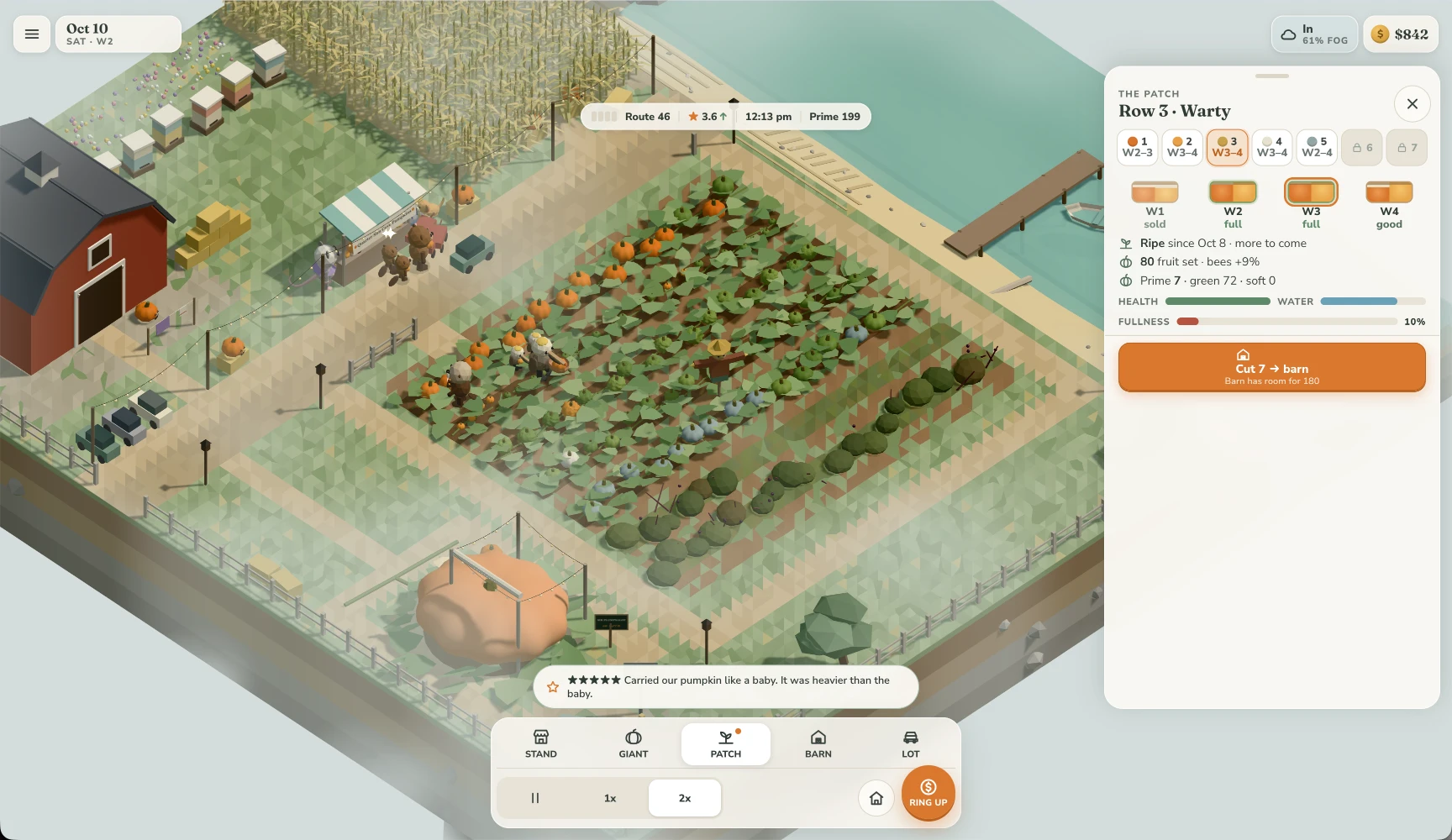
You can play the latest version here. I'm not convinced by the game mechanics yet - it's actually quite complicated: you have to decide when to plant pumpkins such that they will become ripe at the weekends in October with the most visitors.
Here's the initial brainstorming session, which resulted in this spec file. Then I had Opus 5.5 Ultracode burn millions of tokens and nearly two days building it.
I told Claude to "surprise and delight the user frequently" and the result is so many little details and easter eggs. There are mischievous raccoons, an elephant seal that runs the weigh-off, harbor seals that roll their pumpkins back into the ocean, a wandering goat, and superstitions about growing giant pumpkins that sometimes come true.
This isn't my best game yet - it's not as fun to play as Battle Drones - but it represents the kind of game I want more of: weird, fun, uniquely personal - something that wouldn't have been built in the before-times.
Four times as insulting
If you are offended by AI-generated art, AI-generated music, AI-generated writing, and AI-generated code, I have bad news for you: vibe coded games combine all of those at once.
The wider games community already has an aversion to AI-generated assets in games. This has been a growing issue over the past few years as tools like Midjourney have enabled developers to generate assets for their projects. This IGN story covering complaints about slop in Valve's Steam Next Fest is a good recent example.
We now have games where everything - code, assets, dialog, and even the game design itself - can be outsourced to the models. And the results don't suck!
Building a computer game used to be one of the most challenging projects in all of software development, combining a diverse range of skills and requiring intense focus and effort over many months or even years. And now here I am spitting out a playable multiplayer RTS by prompting on my phone!
I expect that, as we've already seen with programming, this will result in a split. Some players will refuse to have anything to do with games that were built in this way. Others may embrace this as opening up game development to a much wider audience. I lean in that direction!
I certainly won't be entering any of my vibe coded games in traditional game jams or competitions - I don't feel like I've earned that right. We'll likely see new avenues emerge for vibe game developers to compare their projects.
What happens if someone actually puts the work in?
The thing I find both exciting and shameful about this is that I have got interesting results from so little creative input. The projects I've described here are loosely ordered by how much effort I've put into them. Not a single project represents more than four hours of my work (plus many more hours of Claude Code churning away by itself).
Now imagine what could be achieved by anyone who takes this seriously, invests significant creative time, applies better taste in game design, and then playtests and iterates on the result until it's as good as they can make it.
I want to see games that wouldn't have existed without these new tools.
You should build a game!
Building games in this way is so much fun. It's the perfect application for vibe coding because it's so low stakes: how much damage can you cause with a bug in a personal vibe coded game project?
(OK, you can do some damage... my attempt at audio-based multiplayer gave my wife Natalie a nasty headache!)
All of my games so far have been HTML and JavaScript using static hosting (generally GitHub Pages or Cloudflare Pages). Modern browsers - including mobile browsers - are incredibly capable. Frontier models already know libraries like three.js and Phaser. I'm finding these mobile web games to be indistinguishable from the native experience, at least for the kinds of games I'm trying to build.
I suggest starting with a prompt like this:
Build a mobile-friendly three.js game where...
This works on both chatgpt.com and claude.ai - you don't even need to fire up a full coding agent. As one last example, here's "Build a mobile-friendly three.js game where a mouse has to hide from a cat" by Claude Opus 5.5 Extra and by GPT-6 Extra High.
Switch to Codex or Claude Code once your project passes the proof-of-concept phase.
And if the game isn't fun enough, add this:
Make it a LOT more fun
Tags: game-design, games, ai, generative-ai, chatgpt, llms, claude, vibe-coding, claude-code
相关条目
精选DeepSeek V4 在 OpenRouter 上的代币份额翻倍,智能体工作负载成主要驱动力
DeepSeek V4 的快速采用表明市场对高性能、低成本推理模型的强烈偏好,尤其是智能体场景将重塑 AI 部署格局。
91
精选启用两项设置使ARC-AGI-3基准测试分数提升三倍
这项发现太关键了!它表明模型的性能不仅取决于训练,还取决于推理时的配置。对于AI工程师和研究者来说,这是一个必须注意的优化方向。特别是那些在资源受限设备上部署模型的团队,可能会因此找到低成本提升能力的方法。
91
精选GPT-5.6:前沿智能与前沿效率的融合
这条消息值得关注,因为它标志着大模型竞争从单纯拼参数转向拼效率。对于AI开发者和企业决策者来说,GPT-5.6意味着可以用更少预算获得更高性能,尤其适合那些被推理成本挡在门外的长上下文或Agent场景。OpenAI这一步,可能重新定义‘前沿’的标准。
91
精选LFM2.5-Encoder:面向CPU快速长上下文推理的新模型
这篇博文让我眼前一亮,因为它直接解决了大模型在CPU上跑长上下文的痛点。对于没有高端GPU的团队或个人开发者,LFM2.5-Encoder系列提供了可立即使用的开源方案。尤其推荐给做RAG、文档搜索或代码分析的朋友——现在用普通服务器就能处理百万级token的文档了。
91
精选GPT-Red:OpenAI通过自我对弈实现AI红队自动化,提升模型鲁棒性
GPT-Red 是红队测试从人工到自动化的里程碑,特别适合安全工程师和对齐研究者关注。它直接降低了测试成本,但也引发了对“自动攻击”本身的伦理讨论——值得所有关注AI治理的人深入思考。
91
精选OpenAI推出GPT-5.5生物漏洞赏金计划
这个计划值得关注,因为它首次将AI漏洞赏金制度拓展到生物安全领域,不仅为安全社区提供了新的研究方向,也为AI风险治理提供了实际演练场。对模型安全研究者、生物安全专家以及关心AI双重用途的从业者尤其重要。
91
精选vLLM推出原生速度Transformers建模后端,大幅提升推理性能
这项更新对于AI工程团队非常关键:无需格式转换意味着能更快地迭代模型,而2-5倍的速度提升直接降低GPU成本。如果你正在做LLM在线服务或者批量推理,这几乎是必读的技术更新。
90
精选Google DeepMind 发布手语转文本模型 SL2T,助力聋人用户
这则消息的意义不仅在于技术突破,更在于AI开始真正关注边缘群体的需求。对开发者而言,SL2T的架构思路和技术路径值得深入研究;对无障碍倡导者来说,这是推动行业标准的重要案例。