Model Routing Is Simple. Until It Isn't.
Score
90深入剖析了模型路由这一较少被系统讨论的工程痛点,提供了新的技术方案和实验数据。
论证清晰,结构完整,来自 IBM Research 的研究团队,专业性和逻辑性较强。
直接针对多模型部署的实际问题,提出的方案具有可实施性和量化收益,对工程师有直接帮助。
文章发布于最新时间,且模型路由正是当前 LLM 落地阶段的核心挑战。
Hugging Face 官方博客,作者为 IBM Research,信源可信度高。
Base 89.5 × T1 Source weight ×1 = 90
Curation line 60Selected
Why selected
This article hits the core pain point of model deployment, providing in-depth analysis and actionable technical solutions that are highly instructive for AI engineering practice.
AI commentary
「This article is a must-read for any engineer focused on LLM deployment. It doesn't stay theoretical but provides a practical intelligent routing framework, especially valuable for those working on multi-model inference acceleration and cost control.」
Quick overview
IBM Research highlights on the Hugging Face blog that model routing, while seemingly straightforward, faces complex challenges including model selection overload, performance variance, cost optimization, and latency sensitivity. The post dissects the shortcomings of simple rule-based routing and introduces a context-aware intelligent routing approach to help developers balance efficiency and performance in multi-model deployments.
- Core challenges in model routing include model selection explosion, high performance variance, and cost-latency trade-offs.
- Traditional static routing rules fail to adapt to dynamic request patterns and model loads.
- IBM Research proposes a context-aware routing framework leveraging reinforcement learning.
- The framework can reduce total inference costs by up to 40% without sacrificing quality.
Full text
Showing the source text; the full translation is being generated.
Model Routing Is Simple. Until It Isn’t.
Enterprise Article Published July 15, 2026 Upvote 6


 Yara Rizk yarizk Follow
 ibm-research
 Eyal Shnarch eishna Follow ibm-research
 Jason Tsay jsntsay Follow ibm-research
 Merve Unuvar mrvnvr Follow ibm-research
- 1. Cost Is More Than Model Pricing
- 2. Complexity Is More Than Task Difficulty
- 3. Latency Is More Than Model Speed
- So How Did We Handle This?
- The Bigger Picture
- Acknowledgement
Except it’s not. Most routing systems assume that model selection is a classification problem. In our experience building routing into agentic systems, what looks like a model-selection problem quickly becomes a systems optimization problem. Three dimensions made this surprisingly hard for us.
1. Cost Is More Than Model Pricing
We expected GPT-4.1 to be cheaper than Claude Sonnet 4.6. It wasn’t.
Across 417 tasks on the AppWorld Test Challenge using the same CodeAct agent, Sonnet cost $79 total ($0.19/task) while GPT-4.1 cost $155 ($0.37/task) — nearly double. On paper, this makes no sense. GPT-4.1’s token pricing is lower on both input and output, and Sonnet takes roughly three times as many reasoning steps to finish the same tasks. By sticker price alone, GPT-4.1 should win easily.
The explanation? Caching — something most routing discussions ignore entirely. Agent workloads tend to reuse large chunks of context across steps. When cache hit rates are high, effective input costs drop dramatically. Sonnet’s lower cache-read pricing meant it benefited disproportionately from this pattern, enough to overcome both its higher base pricing and its longer trajectories.
The takeaway: actual cost depends on the interaction between the model, the workload, and the serving infrastructure. A router that only looks at pricing sheets is optimizing against the wrong numbers.
2. Complexity Is More Than Task Difficulty
A common routing strategy is to estimate how hard a task is and send harder tasks to stronger models. Intuitive, but it breaks down in two ways.
First, difficulty is often invisible at routing time. A request like "summarize this contract" looks simple, but might trigger retrieval, compliance checks, tool use, and multiple rounds of refinement before it’s done. Meanwhile, a highly technical prompt might be handled efficiently by a smaller specialized model. You often don’t know how hard a task actually is until execution is underway.
Second, even if you could perfectly estimate difficulty, it’s only one signal among many. In production, routers need to balance cost, latency, model specialization, and reliability simultaneously. Enterprise deployments pile on more: compliance requirements, data residency rules, privacy constraints, approved model lists. A task that would ideally go to one model might need to go elsewhere because of governance — and the router has to handle that gracefully.
Routers aren’t solving one problem. They’re constantly juggling cost, quality, latency, compliance, and reliability all at once.
3. Latency Is More Than Model Speed
It’s tempting to think about latency purely in terms of model size — bigger models are slower, smaller ones are faster. But what the user actually experiences depends on much more than that.
Routing itself adds overhead. Infrastructure factors — which hardware a model is running on, whether the cache is warm, how busy the endpoint is — often dominate end-to-end response times. A theoretically faster model can still produce a slower experience if the serving conditions aren’t right.
Then there’s routing granularity. Routing once per task adds minimal overhead. But routing at every step — which gives you more flexibility to adapt mid-execution — means every additional decision point introduces latency and operational complexity.
A router that ignores the serving system is optimizing against the wrong reality.
So How Did We Handle This?
These lessons shaped how we built our router. The key shift: we stopped treating routing as a classification problem and started treating it as an optimization problem. Rather than asking "which model is best for this task?", our algorithm optimizes across cost, quality, and latency simultaneously — while staying lightweight enough to avoid becoming a bottleneck itself.
The figure below shows the result on the AppWorld Test Challenge with a CodeAct agent. Each blue square is a different configuration of our router, tracing out a cost-accuracy frontier. The important thing isn't any single point — it's that the router gives you a range of operating points to choose from depending on whether you want to prioritize cost, latency, or accuracy. Configuration 1 (latency-optimized) lands at 84% accuracy for $93 and 83s — a 21% cost reduction and 9% latency reduction compared to running Opus alone, with only a 4% accuracy drop. Configuration 2 pushes cost even lower.
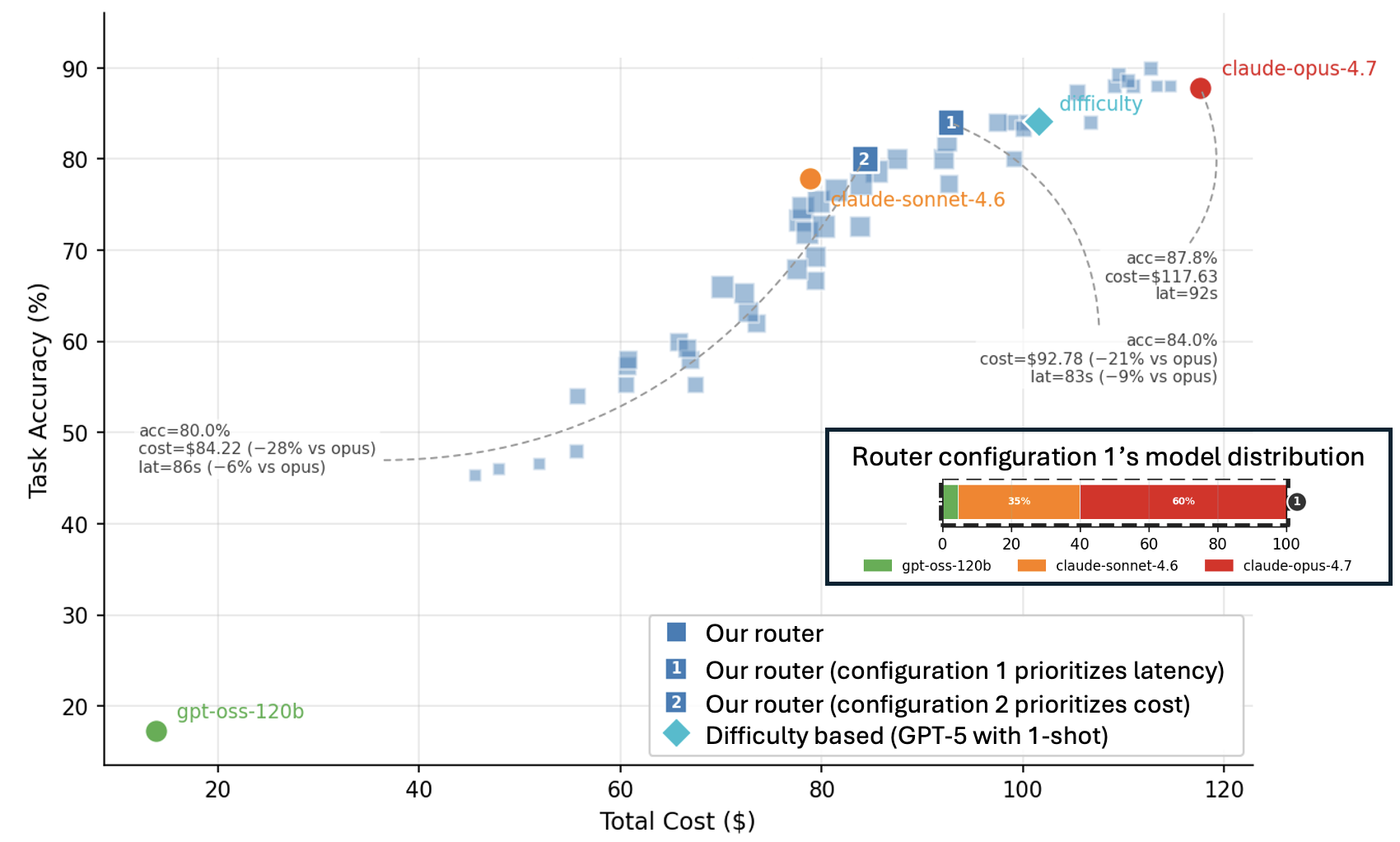
Notice that a standard difficulty-based router (the teal diamond) lands in a similar accuracy range but at higher cost — it doesn't explore the full tradeoff space the way an optimization-based approach can. And because the optimization itself is lightweight (roughly 6 ms and 2 kB of memory per task), the router doesn't become the bottleneck we warned about earlier.
The Bigger Picture
The lesson we took away from this work is that routing isn’t really about choosing models. It’s about optimizing systems. Models are one variable — an important one, but just one among caching behavior, infrastructure state, compliance constraints, and workload patterns.
When routing works well, it’s rarely because it found the "best" model for a given task. It’s because it found the best operating point for the entire system. That’s a harder problem than classification, but it’s the one worth solving.
We’ll be sharing more about the technical details behind our approach in a follow-up post. In the meantime, if you’re building routing into your own agentic systems, we’d love to hear what tradeoffs you’re running into.
Acknowledgement
This post was influenced by numerous conversations with colleagues, whose thoughtful questions, feedback, and insights helped refine our thinking.
More from this author

ScarfBench: Benchmarking AI Agents for Enterprise Java Framework Migration

Build real agentic apps using CUGA: two dozen working examples on a lightweight harness
Community
EditPreview Upload images, audio, and videos by dragging in the text input, pasting, or clicking here. Tap or paste here to upload images Comment· Sign up or log in to comment
Upvote 6Related items
FeaturedDeepSeek V4 Doubles Token Share on OpenRouter, Driven by Agentic Workloads
DeepSeek V4 在 OpenRouter 上的代币份额翻倍,智能体工作负载成主要驱动力
The rapid adoption of DeepSeek V4 signals a strong market preference for high-performance, low-cost inference models, especially as agentic use cases reshape AI deployment.
91
FeaturedEnabling Two Settings Triples ARC-AGI-3 Benchmark Scores
启用两项设置使ARC-AGI-3基准测试分数提升三倍
This finding is crucial! It shows that model performance depends not only on training but also on inference-time configuration. For AI engineers and researchers, this is a must-know optimization direction. Teams deploying models on resource-constrained devices in particular could find a low-cost way to boost capabilities.
91
FeaturedGPT-5.6: Fusing Frontier Intelligence with Frontier Efficiency
GPT-5.6:前沿智能与前沿效率的融合
This news is worth watching as it marks a shift from pure parameter scaling to efficiency competition. For AI developers and business decision-makers, GPT-5.6 means higher performance at lower cost, especially for long-context or agentic tasks previously hindered by inference expenses. OpenAI's move may redefine what 'frontier' means.
91
FeaturedLFM2.5-Encoders: New Models for Fast Long-Context Inference on CPU
LFM2.5-Encoder:面向CPU快速长上下文推理的新模型
This blog post catches my eye because it directly solves the pain point of running long-context LLMs on CPU. For teams or individual developers without high-end GPUs, the LFM2.5-Encoder series offers a ready-to-use open-source solution. Highly recommended for those working on RAG, document search, or code analysis—now a standard server can handle million-token documents.
91
FeaturedGPT-Red: OpenAI Automates Red Teaming via Self-Play to Boost Model Robustness
GPT-Red:OpenAI通过自我对弈实现AI红队自动化,提升模型鲁棒性
GPT-Red marks a milestone from human to automated red-teaming—essential for safety engineers and alignment researchers. While reducing cost, it also raises ethical questions about automated attacks, worth pondering for everyone in AI governance.
91
FeaturedOpenAI Launches GPT-5.5 Bio Bug Bounty Program
OpenAI推出GPT-5.5生物漏洞赏金计划
This program deserves attention as it pioneers the extension of AI bug bounty to biosecurity, offering a new research direction for the security community and a practical training ground for AI risk governance. It is particularly important for model safety researchers, biosecurity experts, and practitioners concerned about dual-use AI risks.
91
FeaturedvLLM Introduces Native-Speed Transformers Modeling Backend for Enhanced Inference Performance
vLLM推出原生速度Transformers建模后端,大幅提升推理性能
This update is critical for AI engineering teams: eliminating format conversion speeds up model iteration, and 2-5x speedup directly reduces GPU costs. If you're building LLM online services or batch inference, this is practically a must-read technical update.
90
FeaturedGoogle DeepMind Introduces SL2T, a Sign Language-to-Text Model for Deaf Users
Google DeepMind 发布手语转文本模型 SL2T,助力聋人用户
This news matters not only as a technical breakthrough but also as a sign that AI is beginning to address the needs of marginalized groups. For developers, the architecture and technical approach of SL2T merit deep study; for accessibility advocates, it's a key case for advancing industry standards.