Three LLM inflection points in twelve months
Score
68Why selected
保留在全量动态池,可作为背景信息或后续聚合信号。
AI commentary
「来自 Simon Willison 博客(Atom) 的这条信息指向模型能力或模型生态变化,适合用于判断近期 AI 圈的真实动向。」
Quick overview
I gave a keynote at the AI Engineer Code Summit a couple of weeks ago, constructed around the idea that there have been three significant inflection points in the abilities of LLMs and coding agents in the past twelve m…
- I gave a keynote at the AI Engineer Code Summit a couple of weeks ago, constructed around the idea that there have been three significant inflection points in the abilities of LLMs and coding agents in the past twelve m…
- Here's the video of the talk.
- In this post I'm going to pull out the major inflection point theme and interrogate it more deeply.
Full text
Showing the source text; the full translation is being generated.
I gave a keynote at the AI Engineer Code Summit a couple of weeks ago, constructed around the idea that there have been three significant inflection points in the abilities of LLMs and coding agents in the past twelve months.
Here's the video of the talk. In this post I'm going to pull out the major inflection point theme and interrogate it more deeply.
Coding agents in November 2025
Today, November 24th 2026, is the one year anniversary of the release of Claude Opus 4.5. With hindsight, this was a consequential model.
In the Opus 4.5 announcement, Anthropic said:
Testers noted that Claude Opus 4.5 handles ambiguity and reasons about tradeoffs without hand-holding. They told us that, when pointed at a complex, multi-system bug, Opus 4.5 figures out the fix. They said that tasks that were near-impossible for Sonnet 4.5 just a few weeks ago are now within reach.
This held up.
Claude Code was 9 months old at that point, having been introduced alongside Claude 3.7 Sonnet on February 24th, 2025.
Opus 4.5 was the first model I had used with Claude Code where the default result was generally the right thing. I hadn't been using Claude Code as a daily driver because it didn't feel reliable enough - I had to correct it often enough that it didn't feel like a clear accelerant.
The new Opus changed that. For most of the coding problems I faced on a daily basis, Opus would get them right. It was clearly faster than working through the problems myself.
Also in November, OpenAI released GPT-5.1 Instant, GPT-5.1 Thinking, GPT-5.1-Codex, and GPT-5.1-Codex-Max. These had a similar effect on their Codex coding agent: it became reliably useful for many of my coding tasks.
The timing was convenient, because the December holidays were upon us. A lot of people, myself included, spent December tinkering with these new tools to see what they could do. By January we were ready to use them for our actual work.
Fable class models in June/July
We got our first hint of Claude Fable in April, when Anthropic announced Claude Mythos and said that it was too dangerous to release, due to its improved cybersecurity capabilities. Mythos was a model that could not just find security vulnerabilities, it could also figure out how to exploit them.
In June we got to see how good that model was for ourselves, with the release of Claude Fable 5 - a defanged Mythos, that would solve most problems but would actively block you from using it for security work.
After three glorious days... the US government took it away from us. Fable 5 was placed under export controls that effectively banned the model. We wouldn't get it back until July 1st.
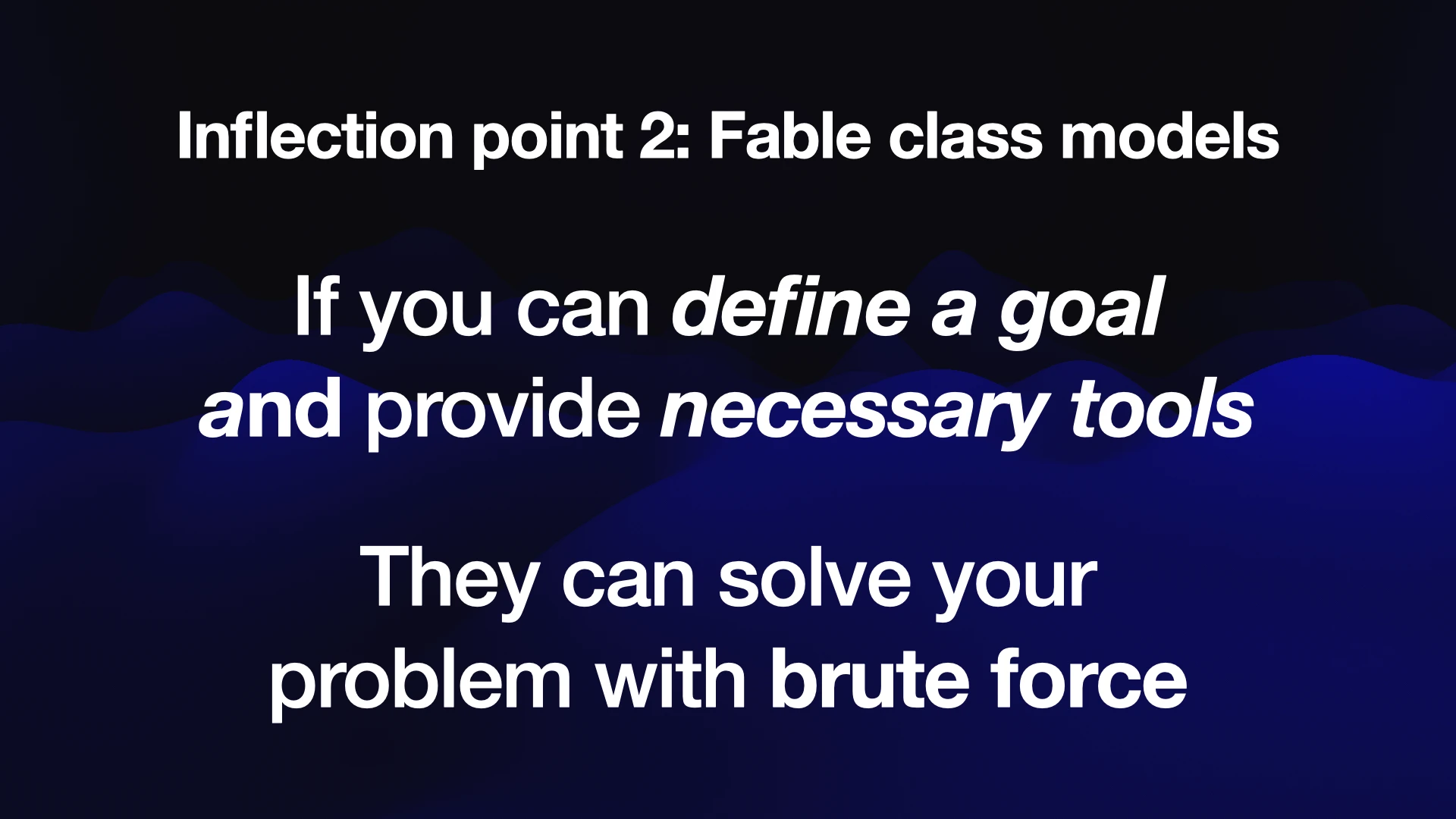
For me, Fable was an inflection point because it introduced us to what I now think of as Fable class models. My definition of these:
 In June I wrote about how Claude Fable is relentlessly proactive, after I asked it to help fix a display glitch in Safari and it spun up its own
pyobjc-framework-Quartz screenshot mechanism and a CORS-enabled localhost logging server to help resolve the bug.
A more recent example of the power of Fable class models is my mysterious beep finder from a couple of weeks ago. I gave Opus 5.5 and then Fable 5.2 access to five WebAudio microphones in a room full of boxes and it was able to triangulate the source of an infuriating mysterious beep to within about 40cm.
Give it a goal, give it the right tools, and watch it cook.
I'd currently class Claude Fable 5, 5.1, 5.2 and Claude Opus 5.5 as Fable class (I think of Opus 5.5 as "cheap Fable"). GPT-6 Astra got there for me too, and I think the new Gemini 4 Neon may count as well.
These now represent the baseline for what I expect from a frontier model.
3D modeling and game development in September/October
Something interesting happened with frontier LLMs over just the past four months: they got really good at 3D modeling. Set them up with Blender or ask them to write Three.js code and they'll produce credible models of almost anything you ask for.
I first noticed this with Claude Fable 5, but it really kicked into gear with Opus 5.5, GPT-5.6 Sol, GPT-6 Astra, and most recently the Gemini 4 family. Here's Gemini 4 Neon's attempt at "Make a three js animation where yonkers stands up as a big mech (cool stand up motion) and stomps around manhattan and queens and Brooklyn, use openstreetmap mapping data", for example.
3D spatial awareness is crucial if you want to use vision LLMs for robotics. I don't know if 3D modeling capabilities are a side-effect of the labs focusing on that or vice-versa.
Back in August I experimented with having Fable 5 build me a raccoon heist game. It had 3D graphics, looked like a game, and played really poorly. GPT-5.6 Sol Ultra did a much better job but the game itself was still pretty dull after the first 90 seconds of play.
I was somewhat relieved that designing a game that was fun appeared to remain a uniquely human pursuit. I even used that in a talk in September to reassure people that us humans still had a role to play!
Then, I tried telling Claude Opus 5.5 "This game isn't fun enough yet. Make it a LOT more fun." And it worked. My Command & Conquer-style RTS went from boring to deeply entertaining overnight, after Opus spent 12 hours playtesting new features and rebalancing the gameplay.
Opus 5.5 was the first model I'd used that appeared to understand fun. I've since worked on several little game projects where prompts like "Think hard about how to make sure it is both fun and beautiful" produced results that kept me engaged for significant amounts of time.
Opus 5.5 came out on September 22nd, 2026. I've been to two different conferences since then where people showed me game projects they'd been working on that really did feel like proper, worthwhile games.
The indie games scene has descended into a full-blown culture war over AI-assisted programming. A lot of people are calling GTA VI the last pre-generative AI blockbuster.
It feels like another inflection point to me.
Is Fable 5.2 an inflection point too?
I'm still trying to decide if Fable 5.2 represents a new inflection point, or just another incremental improvement.
I'm getting so much done with that model right now!
It seems to have taste that almost exactly matches my own. I have been burning through all sorts of gnarly problems that I've been thinking about (or procrastinating on) for several years now. The release notes for Datasette 1.0a42, 1.0a43, and 1.0a44 - plus LLM 0.37, 0.37.1, 0.37.2, 0.37.3, and 0.38 - all in the last three weeks, represent a flood of fixes, features and improvements.
If this does represent an inflection point, the key feature seems to be that if you can imagine and then clearly describe a piece of software, Fable can build it. That's a wild thing to say, but it matches my experience over the past few weeks.
Software development has transformed beyond recognition in the last year. I don't think I'll ever go back to typing most of my code by hand.
Tags: game-design, my-talks, ai, generative-ai, llms, annotated-talks, coding-agents, claude-code, codex, claude-mythos-fable
Related items
FeaturedDeepSeek V4 Doubles Token Share on OpenRouter, Driven by Agentic Workloads
DeepSeek V4 在 OpenRouter 上的代币份额翻倍,智能体工作负载成主要驱动力
The rapid adoption of DeepSeek V4 signals a strong market preference for high-performance, low-cost inference models, especially as agentic use cases reshape AI deployment.
91
FeaturedEnabling Two Settings Triples ARC-AGI-3 Benchmark Scores
启用两项设置使ARC-AGI-3基准测试分数提升三倍
This finding is crucial! It shows that model performance depends not only on training but also on inference-time configuration. For AI engineers and researchers, this is a must-know optimization direction. Teams deploying models on resource-constrained devices in particular could find a low-cost way to boost capabilities.
91
FeaturedGPT-5.6: Fusing Frontier Intelligence with Frontier Efficiency
GPT-5.6:前沿智能与前沿效率的融合
This news is worth watching as it marks a shift from pure parameter scaling to efficiency competition. For AI developers and business decision-makers, GPT-5.6 means higher performance at lower cost, especially for long-context or agentic tasks previously hindered by inference expenses. OpenAI's move may redefine what 'frontier' means.
91
FeaturedLFM2.5-Encoders: New Models for Fast Long-Context Inference on CPU
LFM2.5-Encoder:面向CPU快速长上下文推理的新模型
This blog post catches my eye because it directly solves the pain point of running long-context LLMs on CPU. For teams or individual developers without high-end GPUs, the LFM2.5-Encoder series offers a ready-to-use open-source solution. Highly recommended for those working on RAG, document search, or code analysis—now a standard server can handle million-token documents.
91
FeaturedGPT-Red: OpenAI Automates Red Teaming via Self-Play to Boost Model Robustness
GPT-Red:OpenAI通过自我对弈实现AI红队自动化,提升模型鲁棒性
GPT-Red marks a milestone from human to automated red-teaming—essential for safety engineers and alignment researchers. While reducing cost, it also raises ethical questions about automated attacks, worth pondering for everyone in AI governance.
91
FeaturedOpenAI Launches GPT-5.5 Bio Bug Bounty Program
OpenAI推出GPT-5.5生物漏洞赏金计划
This program deserves attention as it pioneers the extension of AI bug bounty to biosecurity, offering a new research direction for the security community and a practical training ground for AI risk governance. It is particularly important for model safety researchers, biosecurity experts, and practitioners concerned about dual-use AI risks.
91
FeaturedvLLM Introduces Native-Speed Transformers Modeling Backend for Enhanced Inference Performance
vLLM推出原生速度Transformers建模后端,大幅提升推理性能
This update is critical for AI engineering teams: eliminating format conversion speeds up model iteration, and 2-5x speedup directly reduces GPU costs. If you're building LLM online services or batch inference, this is practically a must-read technical update.
90
FeaturedGoogle DeepMind Introduces SL2T, a Sign Language-to-Text Model for Deaf Users
Google DeepMind 发布手语转文本模型 SL2T,助力聋人用户
This news matters not only as a technical breakthrough but also as a sign that AI is beginning to address the needs of marginalized groups. For developers, the architecture and technical approach of SL2T merit deep study; for accessibility advocates, it's a key case for advancing industry standards.