Three LLM inflection points in twelve months
评分
68精选理由
保留在全量动态池,可作为背景信息或后续聚合信号。
AI 点评
「来自 Simon Willison 博客(Atom) 的这条信息指向模型能力或模型生态变化,适合用于判断近期 AI 圈的真实动向。」
速览
I gave a keynote at the AI Engineer Code Summit a couple of weeks ago, constructed around the idea that there have been three significant inflection points in the abilities of LLMs and coding agents in the past twelve m…
- I gave a keynote at the AI Engineer Code Summit a couple of weeks ago, constructed around the idea that there have been three significant inflection points in the abilities of LLMs and coding agents in the past twelve m…
- Here's the video of the talk.
- In this post I'm going to pull out the major inflection point theme and interrogate it more deeply.
正文
以下为原文,中文全文翻译生成中
I gave a keynote at the AI Engineer Code Summit a couple of weeks ago, constructed around the idea that there have been three significant inflection points in the abilities of LLMs and coding agents in the past twelve months.
Here's the video of the talk. In this post I'm going to pull out the major inflection point theme and interrogate it more deeply.
Coding agents in November 2025
Today, November 24th 2026, is the one year anniversary of the release of Claude Opus 4.5. With hindsight, this was a consequential model.
In the Opus 4.5 announcement, Anthropic said:
Testers noted that Claude Opus 4.5 handles ambiguity and reasons about tradeoffs without hand-holding. They told us that, when pointed at a complex, multi-system bug, Opus 4.5 figures out the fix. They said that tasks that were near-impossible for Sonnet 4.5 just a few weeks ago are now within reach.
This held up.
Claude Code was 9 months old at that point, having been introduced alongside Claude 3.7 Sonnet on February 24th, 2025.
Opus 4.5 was the first model I had used with Claude Code where the default result was generally the right thing. I hadn't been using Claude Code as a daily driver because it didn't feel reliable enough - I had to correct it often enough that it didn't feel like a clear accelerant.
The new Opus changed that. For most of the coding problems I faced on a daily basis, Opus would get them right. It was clearly faster than working through the problems myself.
Also in November, OpenAI released GPT-5.1 Instant, GPT-5.1 Thinking, GPT-5.1-Codex, and GPT-5.1-Codex-Max. These had a similar effect on their Codex coding agent: it became reliably useful for many of my coding tasks.
The timing was convenient, because the December holidays were upon us. A lot of people, myself included, spent December tinkering with these new tools to see what they could do. By January we were ready to use them for our actual work.
Fable class models in June/July
We got our first hint of Claude Fable in April, when Anthropic announced Claude Mythos and said that it was too dangerous to release, due to its improved cybersecurity capabilities. Mythos was a model that could not just find security vulnerabilities, it could also figure out how to exploit them.
In June we got to see how good that model was for ourselves, with the release of Claude Fable 5 - a defanged Mythos, that would solve most problems but would actively block you from using it for security work.
After three glorious days... the US government took it away from us. Fable 5 was placed under export controls that effectively banned the model. We wouldn't get it back until July 1st.
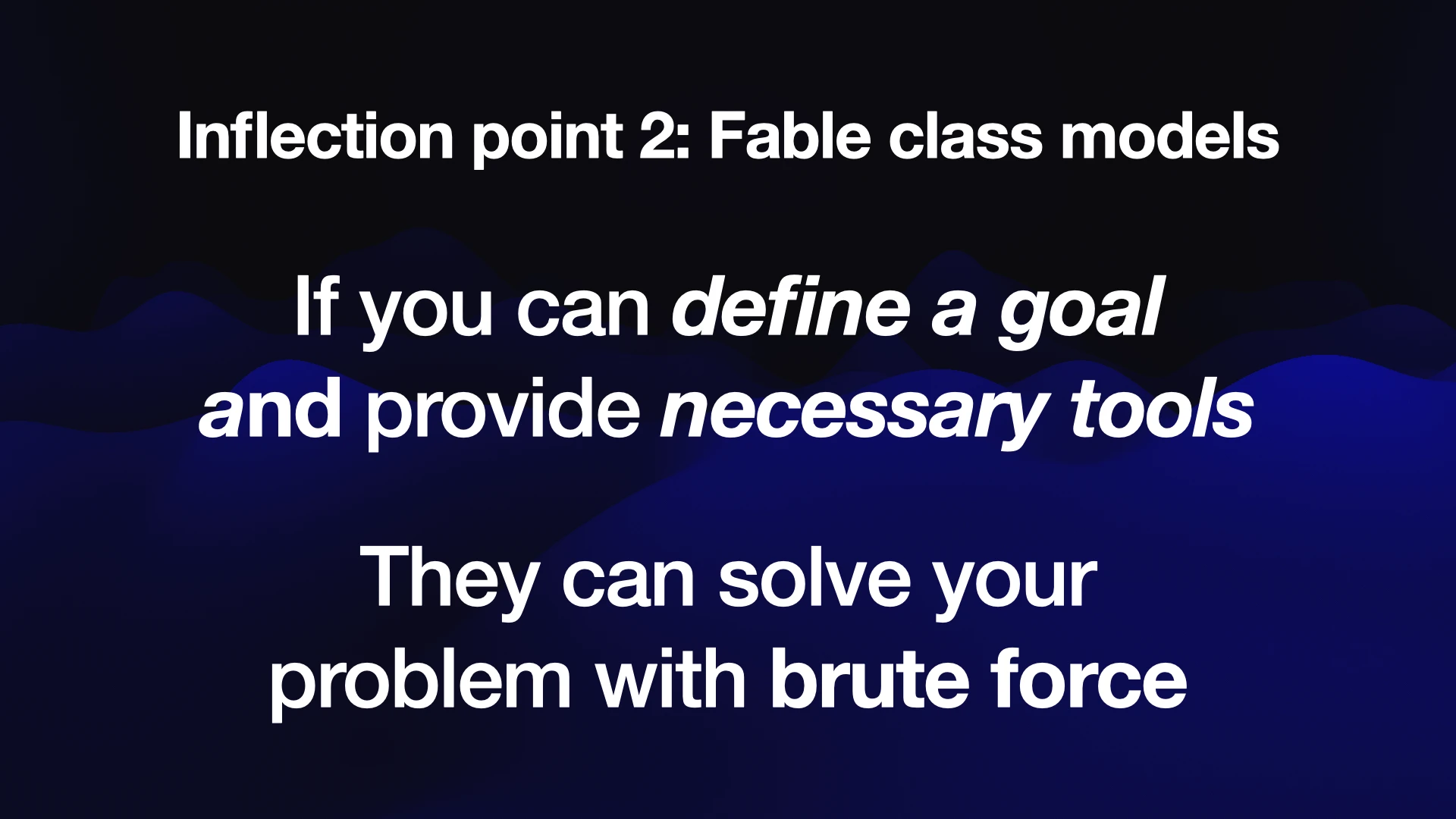
For me, Fable was an inflection point because it introduced us to what I now think of as Fable class models. My definition of these:
 In June I wrote about how Claude Fable is relentlessly proactive, after I asked it to help fix a display glitch in Safari and it spun up its own
pyobjc-framework-Quartz screenshot mechanism and a CORS-enabled localhost logging server to help resolve the bug.
A more recent example of the power of Fable class models is my mysterious beep finder from a couple of weeks ago. I gave Opus 5.5 and then Fable 5.2 access to five WebAudio microphones in a room full of boxes and it was able to triangulate the source of an infuriating mysterious beep to within about 40cm.
Give it a goal, give it the right tools, and watch it cook.
I'd currently class Claude Fable 5, 5.1, 5.2 and Claude Opus 5.5 as Fable class (I think of Opus 5.5 as "cheap Fable"). GPT-6 Astra got there for me too, and I think the new Gemini 4 Neon may count as well.
These now represent the baseline for what I expect from a frontier model.
3D modeling and game development in September/October
Something interesting happened with frontier LLMs over just the past four months: they got really good at 3D modeling. Set them up with Blender or ask them to write Three.js code and they'll produce credible models of almost anything you ask for.
I first noticed this with Claude Fable 5, but it really kicked into gear with Opus 5.5, GPT-5.6 Sol, GPT-6 Astra, and most recently the Gemini 4 family. Here's Gemini 4 Neon's attempt at "Make a three js animation where yonkers stands up as a big mech (cool stand up motion) and stomps around manhattan and queens and Brooklyn, use openstreetmap mapping data", for example.
3D spatial awareness is crucial if you want to use vision LLMs for robotics. I don't know if 3D modeling capabilities are a side-effect of the labs focusing on that or vice-versa.
Back in August I experimented with having Fable 5 build me a raccoon heist game. It had 3D graphics, looked like a game, and played really poorly. GPT-5.6 Sol Ultra did a much better job but the game itself was still pretty dull after the first 90 seconds of play.
I was somewhat relieved that designing a game that was fun appeared to remain a uniquely human pursuit. I even used that in a talk in September to reassure people that us humans still had a role to play!
Then, I tried telling Claude Opus 5.5 "This game isn't fun enough yet. Make it a LOT more fun." And it worked. My Command & Conquer-style RTS went from boring to deeply entertaining overnight, after Opus spent 12 hours playtesting new features and rebalancing the gameplay.
Opus 5.5 was the first model I'd used that appeared to understand fun. I've since worked on several little game projects where prompts like "Think hard about how to make sure it is both fun and beautiful" produced results that kept me engaged for significant amounts of time.
Opus 5.5 came out on September 22nd, 2026. I've been to two different conferences since then where people showed me game projects they'd been working on that really did feel like proper, worthwhile games.
The indie games scene has descended into a full-blown culture war over AI-assisted programming. A lot of people are calling GTA VI the last pre-generative AI blockbuster.
It feels like another inflection point to me.
Is Fable 5.2 an inflection point too?
I'm still trying to decide if Fable 5.2 represents a new inflection point, or just another incremental improvement.
I'm getting so much done with that model right now!
It seems to have taste that almost exactly matches my own. I have been burning through all sorts of gnarly problems that I've been thinking about (or procrastinating on) for several years now. The release notes for Datasette 1.0a42, 1.0a43, and 1.0a44 - plus LLM 0.37, 0.37.1, 0.37.2, 0.37.3, and 0.38 - all in the last three weeks, represent a flood of fixes, features and improvements.
If this does represent an inflection point, the key feature seems to be that if you can imagine and then clearly describe a piece of software, Fable can build it. That's a wild thing to say, but it matches my experience over the past few weeks.
Software development has transformed beyond recognition in the last year. I don't think I'll ever go back to typing most of my code by hand.
Tags: game-design, my-talks, ai, generative-ai, llms, annotated-talks, coding-agents, claude-code, codex, claude-mythos-fable
相关条目
精选DeepSeek V4 在 OpenRouter 上的代币份额翻倍,智能体工作负载成主要驱动力
DeepSeek V4 的快速采用表明市场对高性能、低成本推理模型的强烈偏好,尤其是智能体场景将重塑 AI 部署格局。
91
精选启用两项设置使ARC-AGI-3基准测试分数提升三倍
这项发现太关键了!它表明模型的性能不仅取决于训练,还取决于推理时的配置。对于AI工程师和研究者来说,这是一个必须注意的优化方向。特别是那些在资源受限设备上部署模型的团队,可能会因此找到低成本提升能力的方法。
91
精选GPT-5.6:前沿智能与前沿效率的融合
这条消息值得关注,因为它标志着大模型竞争从单纯拼参数转向拼效率。对于AI开发者和企业决策者来说,GPT-5.6意味着可以用更少预算获得更高性能,尤其适合那些被推理成本挡在门外的长上下文或Agent场景。OpenAI这一步,可能重新定义‘前沿’的标准。
91
精选LFM2.5-Encoder:面向CPU快速长上下文推理的新模型
这篇博文让我眼前一亮,因为它直接解决了大模型在CPU上跑长上下文的痛点。对于没有高端GPU的团队或个人开发者,LFM2.5-Encoder系列提供了可立即使用的开源方案。尤其推荐给做RAG、文档搜索或代码分析的朋友——现在用普通服务器就能处理百万级token的文档了。
91
精选GPT-Red:OpenAI通过自我对弈实现AI红队自动化,提升模型鲁棒性
GPT-Red 是红队测试从人工到自动化的里程碑,特别适合安全工程师和对齐研究者关注。它直接降低了测试成本,但也引发了对“自动攻击”本身的伦理讨论——值得所有关注AI治理的人深入思考。
91
精选OpenAI推出GPT-5.5生物漏洞赏金计划
这个计划值得关注,因为它首次将AI漏洞赏金制度拓展到生物安全领域,不仅为安全社区提供了新的研究方向,也为AI风险治理提供了实际演练场。对模型安全研究者、生物安全专家以及关心AI双重用途的从业者尤其重要。
91
精选vLLM推出原生速度Transformers建模后端,大幅提升推理性能
这项更新对于AI工程团队非常关键:无需格式转换意味着能更快地迭代模型,而2-5倍的速度提升直接降低GPU成本。如果你正在做LLM在线服务或者批量推理,这几乎是必读的技术更新。
90
精选Google DeepMind 发布手语转文本模型 SL2T,助力聋人用户
这则消息的意义不仅在于技术突破,更在于AI开始真正关注边缘群体的需求。对开发者而言,SL2T的架构思路和技术路径值得深入研究;对无障碍倡导者来说,这是推动行业标准的重要案例。