Ladybird's first alpha release
Score
67Why selected
保留在全量动态池,可作为背景信息或后续聚合信号。
AI commentary
「来自 Simon Willison 博客(Atom) 的这条信息指向模型能力或模型生态变化,适合用于判断近期 AI 圈的真实动向。」
Quick overview
Ladybird is an astonishingly ambitious project: a new browser, in 2026, with its own implementation of most of the key components - HTML parsing, CSS engine, layout, JavaScript, even WebAssembly. It still uses a few ext…
- Ladybird is an astonishingly ambitious project: a new browser, in 2026, with its own implementation of most of the key components - HTML parsing, CSS engine, layout, JavaScript, even WebAssembly.
- It still uses a few external components - things like HarfBuzz for text shaping, Skia for 2D graphics, ffmpeg for video, and SQLite for the things you do with SQLite.
- Everything else is part of Ladybird, or code brought in from Ladybird's even more ambitious predecessor project SerenityOS.
Full text
Showing the source text; the full translation is being generated.
Ladybird is an astonishingly ambitious project: a new browser, in 2026, with its own implementation of most of the key components - HTML parsing, CSS engine, layout, JavaScript, even WebAssembly. It still uses a few external components - things like HarfBuzz for text shaping, Skia for 2D graphics, ffmpeg for video, and SQLite for the things you do with SQLite. Everything else is part of Ladybird, or code brought in from Ladybird's even more ambitious predecessor project SerenityOS.
This morning the Ladybird project released their first alpha, which means you can now install the browser (on macOS or Linux) without having to compile it yourself!
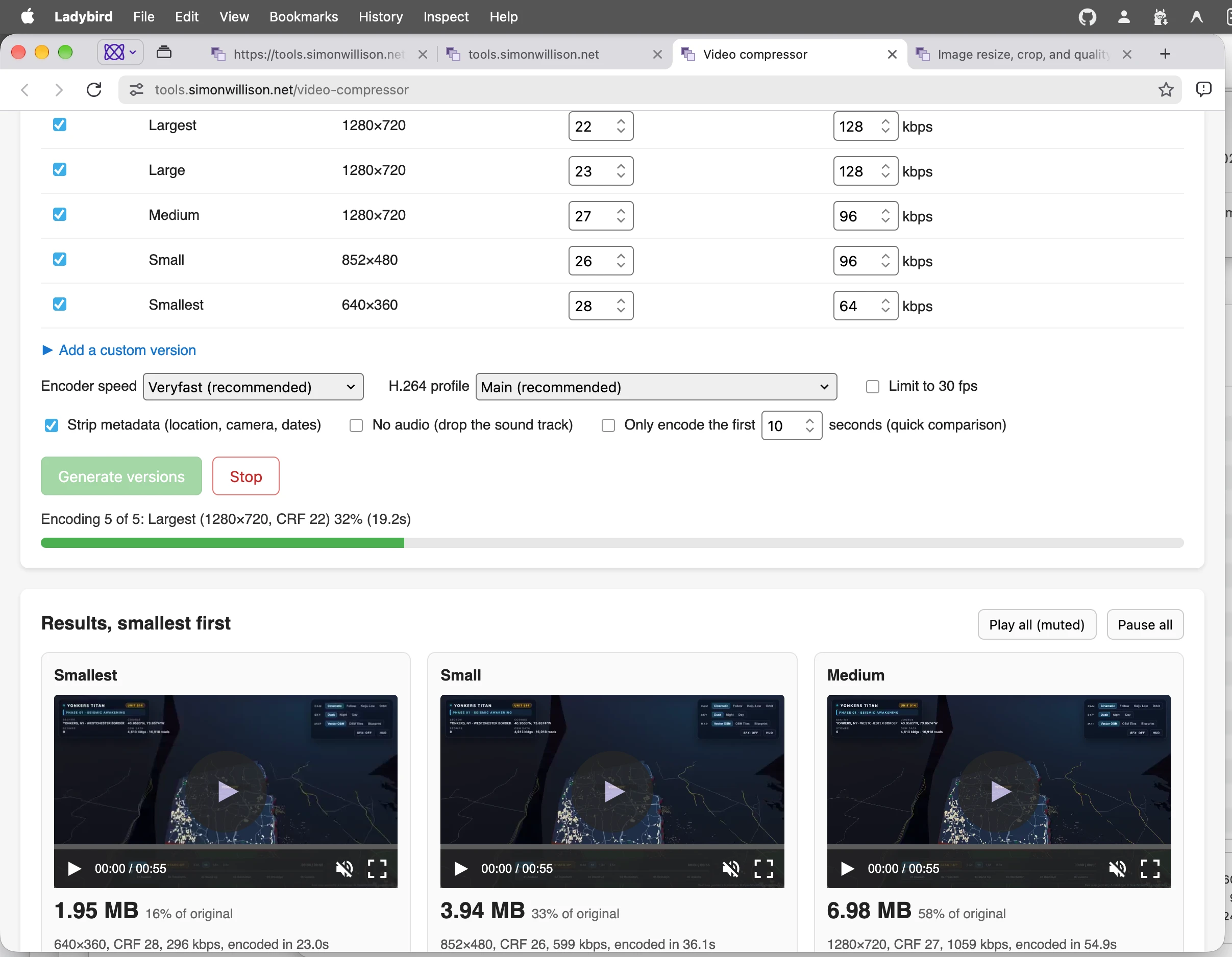
I've been trying it out today, and it's very impressive. It feels fast, the UI is lightweight and intuitive, and most of the websites I've tried to load in it have worked as they should. It looks like this (showing my video-compressor tool):
Here's the process tree after I opened six tabs in one window and another tab in a second window (generated by this script, thanks Claude):
Ladybird (72925)  [240 MB]
└── Hub (72926)  [61 MB]
    ├── RequestServer (72927)  [29 MB]
    ├── ProcessReaper (72928)  [1 MB]
    ├── Compositor (72930)  [123 MB]
    ├── RequestServer (72953)  [36 MB]
    ├── WebContent (72984)  [819 MB]
    ├── MediaServer (73006)  [118 MB]
    ├── VideoDecoderServer (73007)  [20 MB]
    ├── WebContent (73052)  [144 MB]
    ├── WebContent (73057)  [73 MB]
    ├── WebContent (73073)  [166 MB]
    ├── WebContent (73094)  [70 MB]
    ├── WebContent (73112)  [116 MB]
    ├── RequestServer (73113)  [27 MB]
    └── WebContent (73185)  [60 MB]
Ladybird runs different tabs in different processes, an isolation mechanism used by most browsers (well, technically Chrome uses a process-per-site).
I tried Ladybird against several of my more advanced tool examples - like the video-compressor shown above, which runs ffmpeg compiled to WebAssembly. I had it resize its own screenshot using my image-resize tool. It happily runs my Pyodide REPL (Python compiled to WebAssembly) too.
The one thing I tried that didn't work was Datasette Lite, which runs Pyodide in a complicated arrangement of service workers and web workers. Attempting to start Datasette Lite displays this error:
undefined is not a function (evaluated from 'navigator.serviceWorker.startMessages')
I filed an issue about this, then found a FIXME annotation in the source code.
The October explosion
The project has been leaning heavily into coding agents this year. On February 23, 2026 Andreas Kling published Ladybird adopts Rust, with help from AI, describing how they ported parts of their LibJS JavaScript engine from C++ to 25,000 lines of Rust in two weeks using Claude Code and Codex.
Here's the GitHub contributions chart for Ladybird over the past twelve months:
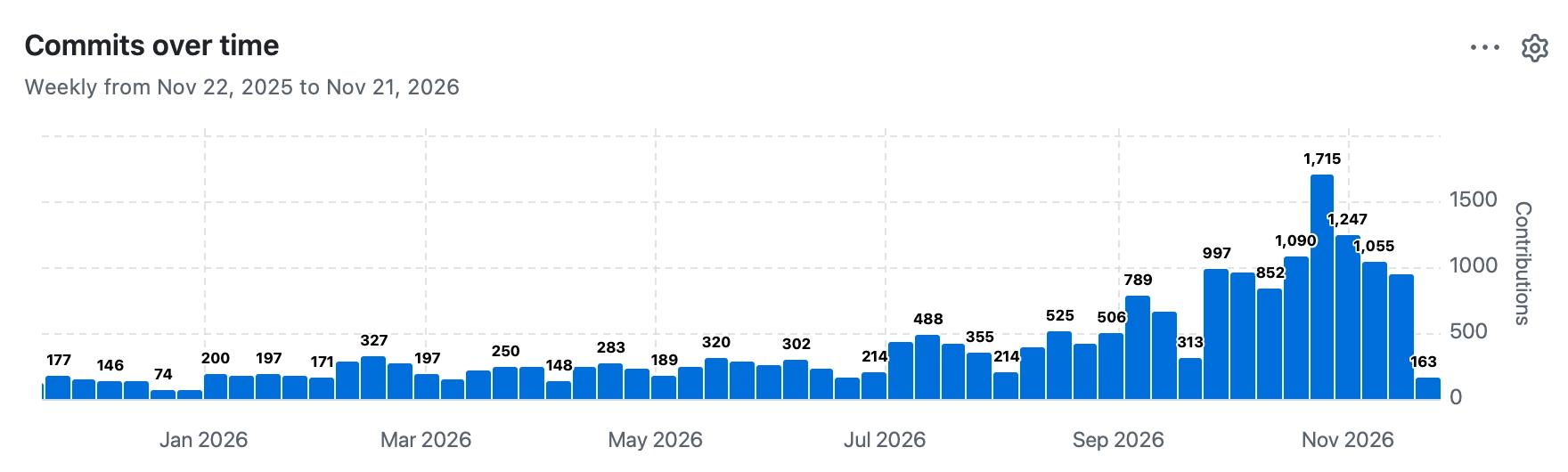
That uptick in October corresponds to the landing of a wealth of big improvements.
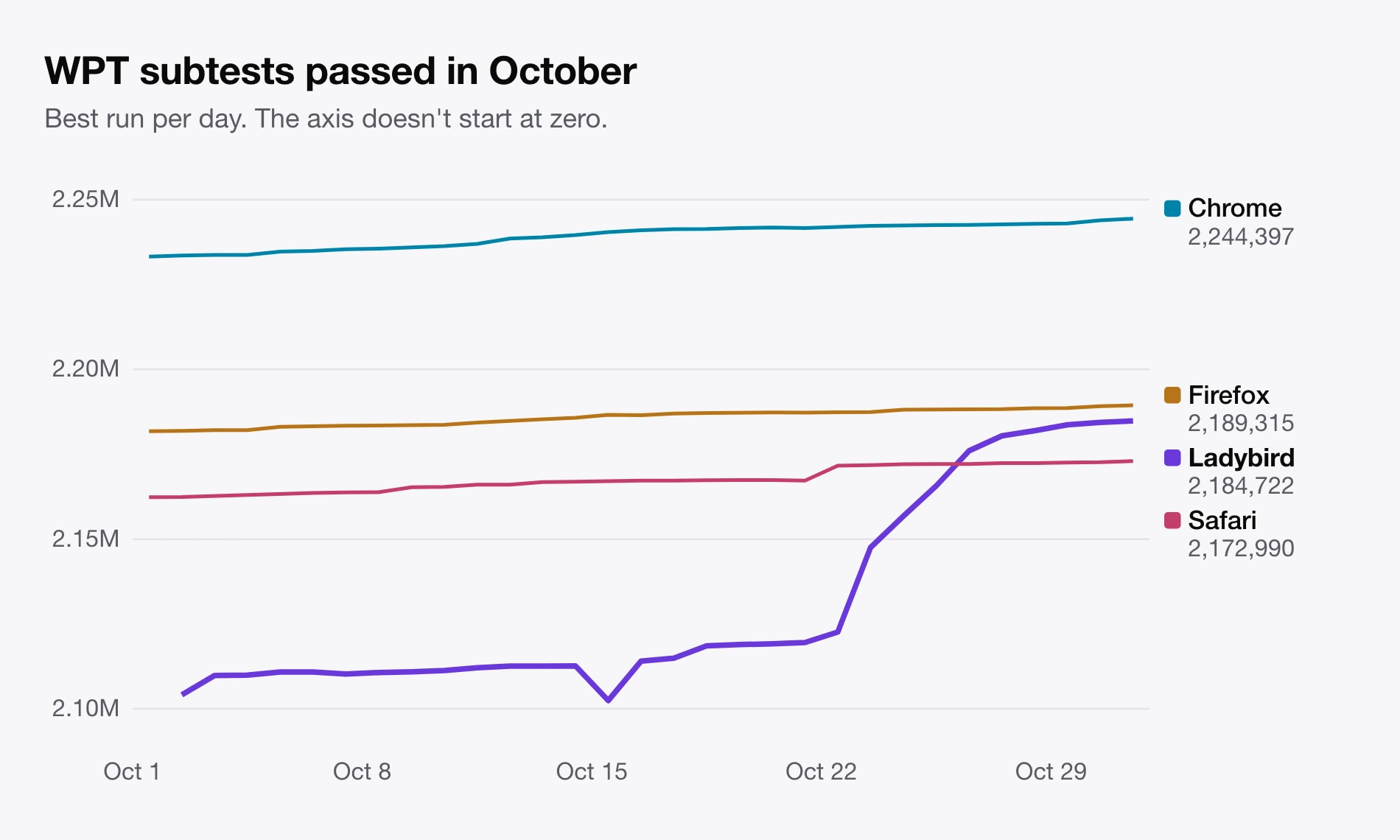
This Month in Ladybird — October 2026 describes what happened. In addition to moving style and layout to their own thread, landing a new JavaScript JIT, and replacing their C++ with Cranelift WebAssembly engine with new code that achieved a 7x boost on the JetStream 3 WASM benchmark, they gained 75,650 new passes on the ~2.25 million subtest web-platform-tests suite, beating Safari!
How did they do that? Coding agents:
Most of that gain came in five days, from about 2.12 million on October 22 to about 2.18 million on October 27. We pointed AI coding agents at WPT and asked them to fill in missing functionality. They made lots of small fixes, and those added up. Our biggest gains for the month were about 30,000 in
/cssand 10,000 in/editing.
I'm interested in what models they are using here - I know Andreas uses Codex and Claude Code, but I haven't seen him talk about specific model versions. Claude Opus 5.5 came out on September 22, 2026 and Claude Fable 5.2 on November 9, 2026 (after that window). I'd love to know what they were using for that huge leap in the last week of October.
Should you use Ladybird?
Here's what Andreas says about Ladybird's suitability for use as a daily browser:
This is an alpha, so some websites won’t work, and it will crash sometimes. When that happens, tell us! You can report a broken site from inside the browser. After a crash, you can read the crash report and decide whether to send it. Our privacy policy has the details.
We want security nerds to hack it! A new browser gets hacked, over and over, and that’s part of the process, so we make no promises about security today. When you pwn us, please tell us how so we can harden Ladybird!
Given how hard it is to secure a web browser, and the hostility of the environment they operate in, I won't be using Ladybird to sign into GitHub or Gmail or any of my other sensitive accounts.
I'm going to keep it around for anonymous browsing though, partly to participate in the testing efforts but mainly because it gives me a glimmer of optimism to see a promising new entrant in the stagnant browser engine market start to grow its wings.
Tags: browsers, ai, rust, webassembly, generative-ai, llms, andreas-kling, ladybird, coding-agents
Related items
FeaturedDeepSeek V4 Doubles Token Share on OpenRouter, Driven by Agentic Workloads
DeepSeek V4 在 OpenRouter 上的代币份额翻倍,智能体工作负载成主要驱动力
The rapid adoption of DeepSeek V4 signals a strong market preference for high-performance, low-cost inference models, especially as agentic use cases reshape AI deployment.
91
FeaturedEnabling Two Settings Triples ARC-AGI-3 Benchmark Scores
启用两项设置使ARC-AGI-3基准测试分数提升三倍
This finding is crucial! It shows that model performance depends not only on training but also on inference-time configuration. For AI engineers and researchers, this is a must-know optimization direction. Teams deploying models on resource-constrained devices in particular could find a low-cost way to boost capabilities.
91
FeaturedGPT-5.6: Fusing Frontier Intelligence with Frontier Efficiency
GPT-5.6:前沿智能与前沿效率的融合
This news is worth watching as it marks a shift from pure parameter scaling to efficiency competition. For AI developers and business decision-makers, GPT-5.6 means higher performance at lower cost, especially for long-context or agentic tasks previously hindered by inference expenses. OpenAI's move may redefine what 'frontier' means.
91
FeaturedLFM2.5-Encoders: New Models for Fast Long-Context Inference on CPU
LFM2.5-Encoder:面向CPU快速长上下文推理的新模型
This blog post catches my eye because it directly solves the pain point of running long-context LLMs on CPU. For teams or individual developers without high-end GPUs, the LFM2.5-Encoder series offers a ready-to-use open-source solution. Highly recommended for those working on RAG, document search, or code analysis—now a standard server can handle million-token documents.
91
FeaturedGPT-Red: OpenAI Automates Red Teaming via Self-Play to Boost Model Robustness
GPT-Red:OpenAI通过自我对弈实现AI红队自动化,提升模型鲁棒性
GPT-Red marks a milestone from human to automated red-teaming—essential for safety engineers and alignment researchers. While reducing cost, it also raises ethical questions about automated attacks, worth pondering for everyone in AI governance.
91
FeaturedOpenAI Launches GPT-5.5 Bio Bug Bounty Program
OpenAI推出GPT-5.5生物漏洞赏金计划
This program deserves attention as it pioneers the extension of AI bug bounty to biosecurity, offering a new research direction for the security community and a practical training ground for AI risk governance. It is particularly important for model safety researchers, biosecurity experts, and practitioners concerned about dual-use AI risks.
91
FeaturedvLLM Introduces Native-Speed Transformers Modeling Backend for Enhanced Inference Performance
vLLM推出原生速度Transformers建模后端,大幅提升推理性能
This update is critical for AI engineering teams: eliminating format conversion speeds up model iteration, and 2-5x speedup directly reduces GPU costs. If you're building LLM online services or batch inference, this is practically a must-read technical update.
90
FeaturedGoogle DeepMind Introduces SL2T, a Sign Language-to-Text Model for Deaf Users
Google DeepMind 发布手语转文本模型 SL2T,助力聋人用户
This news matters not only as a technical breakthrough but also as a sign that AI is beginning to address the needs of marginalized groups. For developers, the architecture and technical approach of SL2T merit deep study; for accessibility advocates, it's a key case for advancing industry standards.