Ladybird's first alpha release
评分
67精选理由
保留在全量动态池,可作为背景信息或后续聚合信号。
AI 点评
「来自 Simon Willison 博客(Atom) 的这条信息指向模型能力或模型生态变化,适合用于判断近期 AI 圈的真实动向。」
速览
Ladybird is an astonishingly ambitious project: a new browser, in 2026, with its own implementation of most of the key components - HTML parsing, CSS engine, layout, JavaScript, even WebAssembly. It still uses a few ext…
- Ladybird is an astonishingly ambitious project: a new browser, in 2026, with its own implementation of most of the key components - HTML parsing, CSS engine, layout, JavaScript, even WebAssembly.
- It still uses a few external components - things like HarfBuzz for text shaping, Skia for 2D graphics, ffmpeg for video, and SQLite for the things you do with SQLite.
- Everything else is part of Ladybird, or code brought in from Ladybird's even more ambitious predecessor project SerenityOS.
正文
以下为原文,中文全文翻译生成中
Ladybird is an astonishingly ambitious project: a new browser, in 2026, with its own implementation of most of the key components - HTML parsing, CSS engine, layout, JavaScript, even WebAssembly. It still uses a few external components - things like HarfBuzz for text shaping, Skia for 2D graphics, ffmpeg for video, and SQLite for the things you do with SQLite. Everything else is part of Ladybird, or code brought in from Ladybird's even more ambitious predecessor project SerenityOS.
This morning the Ladybird project released their first alpha, which means you can now install the browser (on macOS or Linux) without having to compile it yourself!
I've been trying it out today, and it's very impressive. It feels fast, the UI is lightweight and intuitive, and most of the websites I've tried to load in it have worked as they should. It looks like this (showing my video-compressor tool):
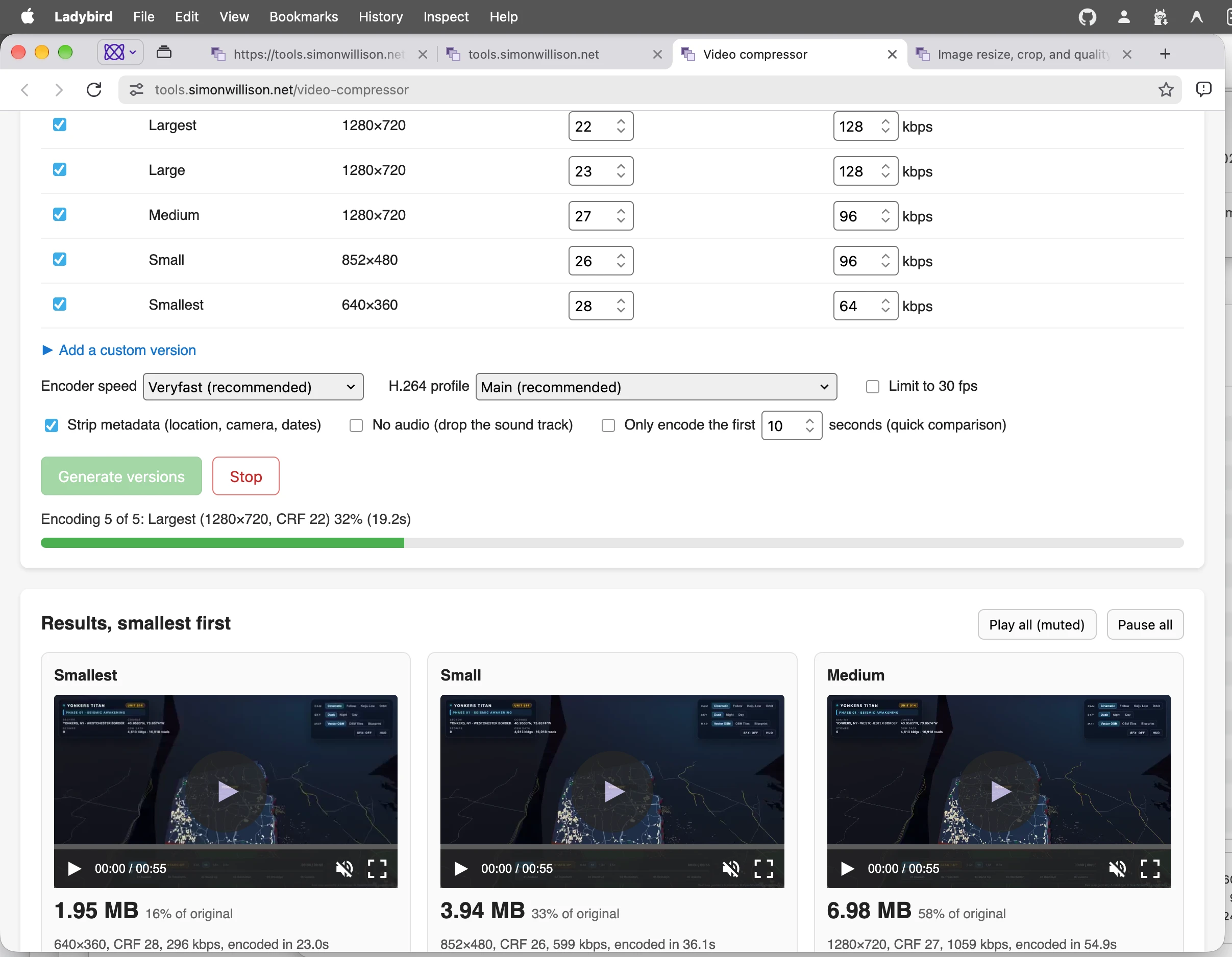
Here's the process tree after I opened six tabs in one window and another tab in a second window (generated by this script, thanks Claude):
Ladybird (72925)  [240 MB]
└── Hub (72926)  [61 MB]
    ├── RequestServer (72927)  [29 MB]
    ├── ProcessReaper (72928)  [1 MB]
    ├── Compositor (72930)  [123 MB]
    ├── RequestServer (72953)  [36 MB]
    ├── WebContent (72984)  [819 MB]
    ├── MediaServer (73006)  [118 MB]
    ├── VideoDecoderServer (73007)  [20 MB]
    ├── WebContent (73052)  [144 MB]
    ├── WebContent (73057)  [73 MB]
    ├── WebContent (73073)  [166 MB]
    ├── WebContent (73094)  [70 MB]
    ├── WebContent (73112)  [116 MB]
    ├── RequestServer (73113)  [27 MB]
    └── WebContent (73185)  [60 MB]
Ladybird runs different tabs in different processes, an isolation mechanism used by most browsers (well, technically Chrome uses a process-per-site).
I tried Ladybird against several of my more advanced tool examples - like the video-compressor shown above, which runs ffmpeg compiled to WebAssembly. I had it resize its own screenshot using my image-resize tool. It happily runs my Pyodide REPL (Python compiled to WebAssembly) too.
The one thing I tried that didn't work was Datasette Lite, which runs Pyodide in a complicated arrangement of service workers and web workers. Attempting to start Datasette Lite displays this error:
undefined is not a function (evaluated from 'navigator.serviceWorker.startMessages')
I filed an issue about this, then found a FIXME annotation in the source code.
The October explosion
The project has been leaning heavily into coding agents this year. On February 23, 2026 Andreas Kling published Ladybird adopts Rust, with help from AI, describing how they ported parts of their LibJS JavaScript engine from C++ to 25,000 lines of Rust in two weeks using Claude Code and Codex.
Here's the GitHub contributions chart for Ladybird over the past twelve months:
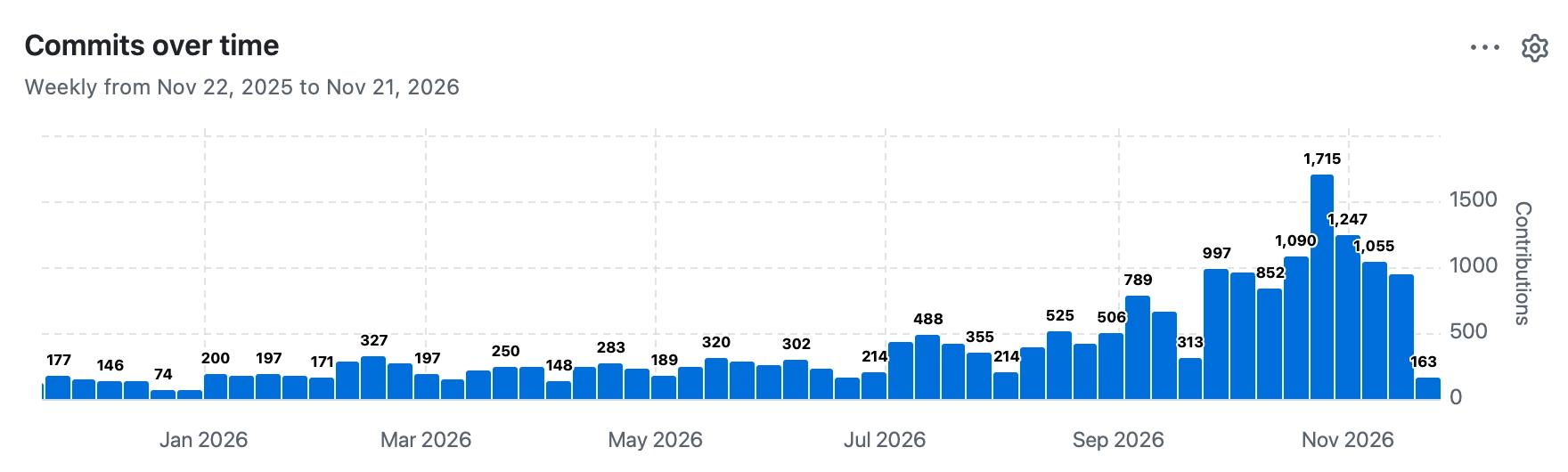
That uptick in October corresponds to the landing of a wealth of big improvements.
This Month in Ladybird — October 2026 describes what happened. In addition to moving style and layout to their own thread, landing a new JavaScript JIT, and replacing their C++ with Cranelift WebAssembly engine with new code that achieved a 7x boost on the JetStream 3 WASM benchmark, they gained 75,650 new passes on the ~2.25 million subtest web-platform-tests suite, beating Safari!
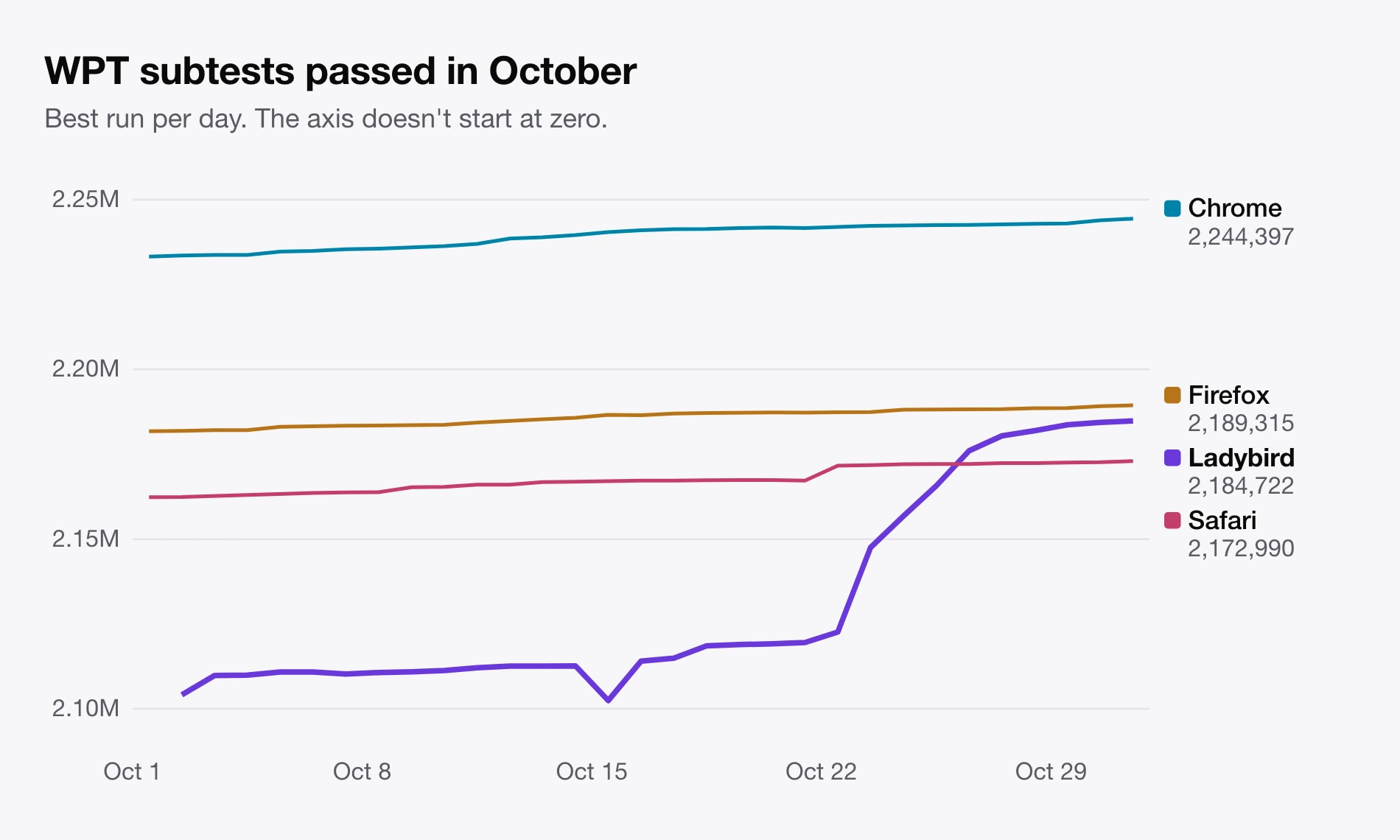
How did they do that? Coding agents:
Most of that gain came in five days, from about 2.12 million on October 22 to about 2.18 million on October 27. We pointed AI coding agents at WPT and asked them to fill in missing functionality. They made lots of small fixes, and those added up. Our biggest gains for the month were about 30,000 in
/cssand 10,000 in/editing.
I'm interested in what models they are using here - I know Andreas uses Codex and Claude Code, but I haven't seen him talk about specific model versions. Claude Opus 5.5 came out on September 22, 2026 and Claude Fable 5.2 on November 9, 2026 (after that window). I'd love to know what they were using for that huge leap in the last week of October.
Should you use Ladybird?
Here's what Andreas says about Ladybird's suitability for use as a daily browser:
This is an alpha, so some websites won’t work, and it will crash sometimes. When that happens, tell us! You can report a broken site from inside the browser. After a crash, you can read the crash report and decide whether to send it. Our privacy policy has the details.
We want security nerds to hack it! A new browser gets hacked, over and over, and that’s part of the process, so we make no promises about security today. When you pwn us, please tell us how so we can harden Ladybird!
Given how hard it is to secure a web browser, and the hostility of the environment they operate in, I won't be using Ladybird to sign into GitHub or Gmail or any of my other sensitive accounts.
I'm going to keep it around for anonymous browsing though, partly to participate in the testing efforts but mainly because it gives me a glimmer of optimism to see a promising new entrant in the stagnant browser engine market start to grow its wings.
Tags: browsers, ai, rust, webassembly, generative-ai, llms, andreas-kling, ladybird, coding-agents
相关条目
精选DeepSeek V4 在 OpenRouter 上的代币份额翻倍,智能体工作负载成主要驱动力
DeepSeek V4 的快速采用表明市场对高性能、低成本推理模型的强烈偏好,尤其是智能体场景将重塑 AI 部署格局。
91
精选启用两项设置使ARC-AGI-3基准测试分数提升三倍
这项发现太关键了!它表明模型的性能不仅取决于训练,还取决于推理时的配置。对于AI工程师和研究者来说,这是一个必须注意的优化方向。特别是那些在资源受限设备上部署模型的团队,可能会因此找到低成本提升能力的方法。
91
精选GPT-5.6:前沿智能与前沿效率的融合
这条消息值得关注,因为它标志着大模型竞争从单纯拼参数转向拼效率。对于AI开发者和企业决策者来说,GPT-5.6意味着可以用更少预算获得更高性能,尤其适合那些被推理成本挡在门外的长上下文或Agent场景。OpenAI这一步,可能重新定义‘前沿’的标准。
91
精选LFM2.5-Encoder:面向CPU快速长上下文推理的新模型
这篇博文让我眼前一亮,因为它直接解决了大模型在CPU上跑长上下文的痛点。对于没有高端GPU的团队或个人开发者,LFM2.5-Encoder系列提供了可立即使用的开源方案。尤其推荐给做RAG、文档搜索或代码分析的朋友——现在用普通服务器就能处理百万级token的文档了。
91
精选GPT-Red:OpenAI通过自我对弈实现AI红队自动化,提升模型鲁棒性
GPT-Red 是红队测试从人工到自动化的里程碑,特别适合安全工程师和对齐研究者关注。它直接降低了测试成本,但也引发了对“自动攻击”本身的伦理讨论——值得所有关注AI治理的人深入思考。
91
精选OpenAI推出GPT-5.5生物漏洞赏金计划
这个计划值得关注,因为它首次将AI漏洞赏金制度拓展到生物安全领域,不仅为安全社区提供了新的研究方向,也为AI风险治理提供了实际演练场。对模型安全研究者、生物安全专家以及关心AI双重用途的从业者尤其重要。
91
精选vLLM推出原生速度Transformers建模后端,大幅提升推理性能
这项更新对于AI工程团队非常关键:无需格式转换意味着能更快地迭代模型,而2-5倍的速度提升直接降低GPU成本。如果你正在做LLM在线服务或者批量推理,这几乎是必读的技术更新。
90
精选Google DeepMind 发布手语转文本模型 SL2T,助力聋人用户
这则消息的意义不仅在于技术突破,更在于AI开始真正关注边缘群体的需求。对开发者而言,SL2T的架构思路和技术路径值得深入研究;对无障碍倡导者来说,这是推动行业标准的重要案例。