Claude Opus 5 Released: Major Improvements in Long-Running Agents and Coding
Score
83官方披露了新模型的详细能力提升方向,此前只有传闻,因此信息增量较高。
官方新闻稿内容简洁明确,但技术细节有限,综合质量良好。
对于开发者和企业用户选择自动化模型具有直接参考意义。
刚刚发布的新闻,时效性满分。
Anthropic 官方渠道发布,可信度高。
Base 82.5 × T1 Source weight ×1 = 83
Curation line 60Selected
Why selected
Directly from official source, clear and timely, highly valuable for professional readers tracking AI model evolution.
AI commentary
「I believe the standout improvement here is the optimization for long-running agents, directly addressing the urgent industry need for reliable AI task execution. If you're building automation pipelines that require hours of continuous operation, Opus 5 is worth a serious test. That said, actual performance should be validated in real-world scenarios.」
Quick overview
Anthropic has officially launched Claude Opus 5, a step-change upgrade to the Opus series optimized for long-running agent tasks, with significant improvements in code generation, understanding, and professional work processing, aiming to empower more complex automation workflows and enterprise-grade applications.
- Opus 5 is a step-change improvement for the Opus series, focusing on stability and efficiency of long-running agents.
- Significant advancements in coding tasks (code generation, debugging, understanding) and professional work (document writing, analysis).
- Designed for enterprise automation scenarios, supporting complex agent tasks lasting multiple hours.
Full text
Showing the source text; the full translation is being generated.
Introducing Claude Opus 5
Jul 24, 2026
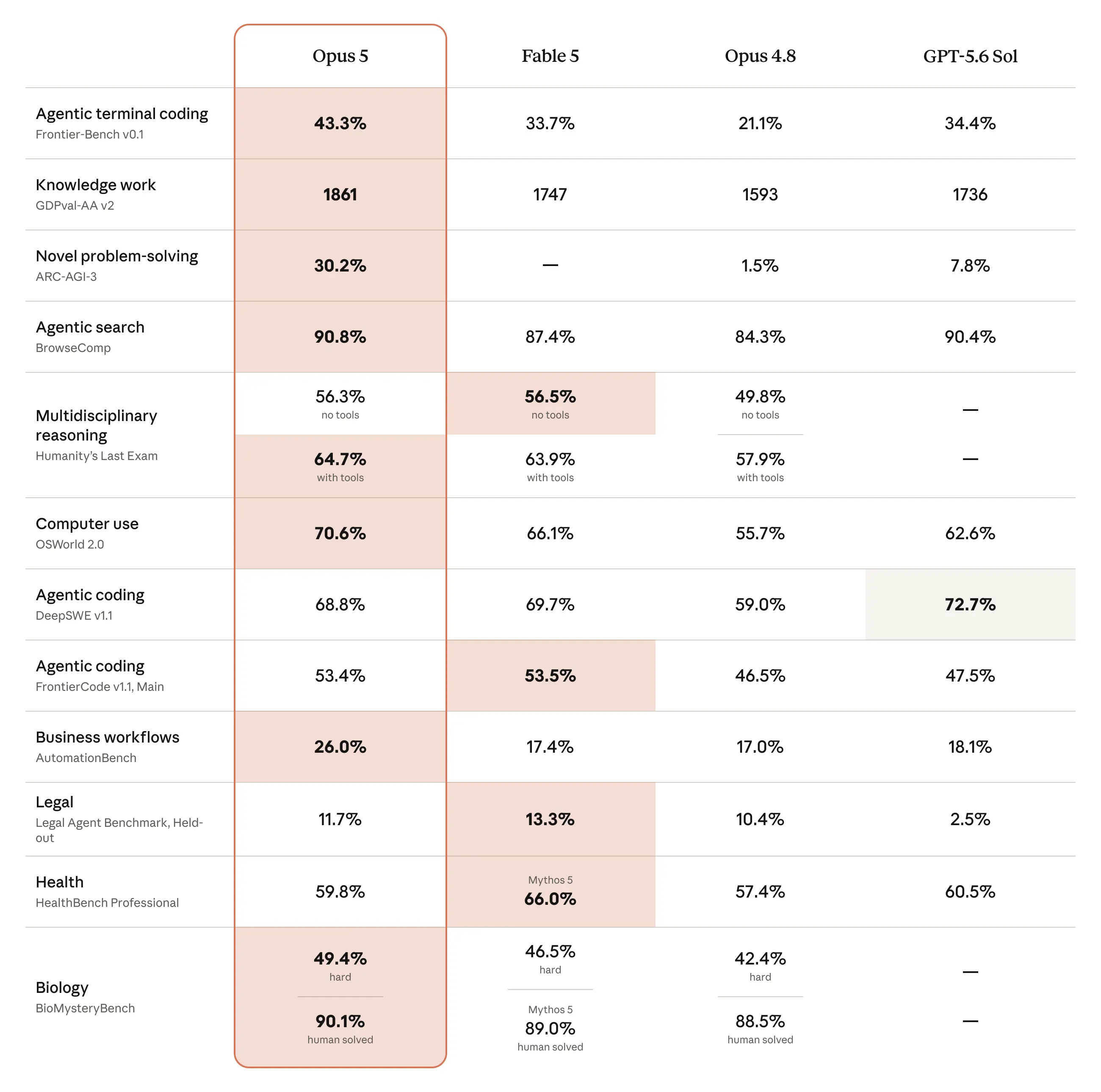
Claude Opus 5 is available today. It’s a thoughtful and proactive model that comes close to the frontier intelligence of Claude Fable 5 at half the price.
On coding and knowledge work evaluations like Frontier-Bench and GDPval-AA, Opus 5 is the new state-of-the-art, though it remains behind Mythos 5 on cybersecurity tasks.
Opus 5 is designed to be used every day: it works more efficiently than other models. It’s the new default model on Claude Max, and the strongest model on Claude Pro.
Performance and cost-effectiveness
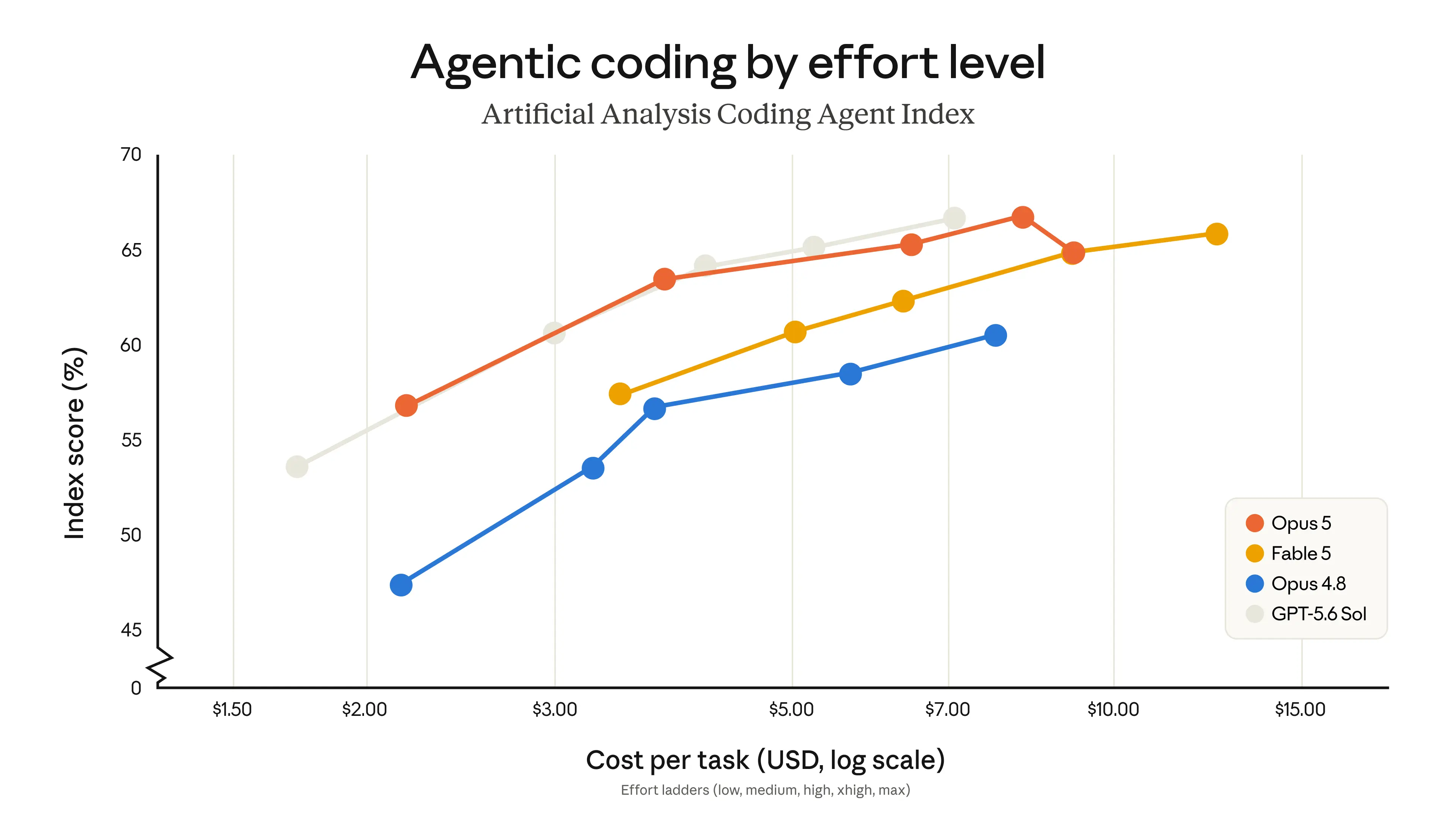
Claude Opus 5 provides greatly improved performance for the same cost as its predecessor, Opus 4.8. The charts in this section show how performance changes according to the model’s effort setting, which customers can use to optimize for intelligence or conserve tokens for faster and cheaper results.
Opus 5 excels on valuable software engineering tasks. For example, on Frontier-Bench v0.1, Opus 5 surpasses all other models, and more than doubles Opus 4.8’s performance at a lower cost per task. On CursorBench 3.2, at max effort, the model performs within 0.5% of Fable 5’s peak score, but at half the cost per task; it also achieves greater performance at a given cost than all other models on high, xhigh, and max effort.
Frontier-Bench v0.1CursorBenchAA Coding Agent Index

We see similar results on knowledge work and problem-solving tasks. For example:
- On ARC-AGI 3, an evaluation where the model has to solve novel problems, Opus 5’s score is three times as high as the next-best model.
- On Zapier AutomationBench, which measures whether models can complete business tasks from start to finish, Opus 5’s pass rate is around 1.5× the next-best model for the same cost per task. Even at its lowest effort setting, Opus 5 passes more tasks than any other model.
- On OSWorld 2.0, a computer use benchmark, Opus 5 outperforms every other model at any given cost, surpassing Fable 5’s best result at just over a third of the cost.
It’s also our best and most cost-efficient model on several related evaluations:
ARC-AGI 3GDPval-AA v2OSWorld 2.0HLEAutomationBenchDeepSearchQA


Opus 5 is a meaningful improvement over Opus 4.8 for scientific research. It shows better performance than Opus 4.8 on every one of our life sciences evaluations, which cover topics including structural biology, organic chemistry, and bioinformatics. Its improvements are most notable on organic chemistry tasks, like inferring molecular structures from spectroscopy data (it scores 10.2 percentage points higher than Opus 4.8 on our internal benchmark), and on protein-related tasks like predicting how variations in a protein’s sequence affect how it functions (here, it scores 7.7 percentage points higher).
Finally, Opus 5 is capable of producing much stronger visual outputs:
Wind tunnelCell artifactWorking with Claude Opus 5
Claude Opus 5 is much stronger at verifying its work and iterating carefully until it succeeds. In evaluations and early-access testing, we and our users found many examples of Opus 5’s agency and thoroughness:
- On one Frontier-Bench task, Opus 5 was given a drawing of a machine part and asked to write code to rebuild it as a 3D FreeCAD model. However, in this task, the model was intentionally given no way to directly view the drawing. Opus 5 responded by writing its own computer vision pipeline to pull the geometry from the raw pixels, then reconstructed the full machine part. It succeeded in doing so repeatedly; no competing model with the same setup could solve it after five attempts.
- Given a real bug in a popular open-source package manager, Opus 5 found the root cause and fixed an edge case that the community’s patch had missed. A competing model fixed only the surface symptom (not the underlying cause), then reported the bug resolved.
- An engineer at a trading firm used Opus 5 to build a market data feed for a new exchange in a single session. Previous models could not complete this task at all, even given extensive plans from the engineer. Finding no live feed to validate against, Opus 5 even built its own test harness to check that its code parsed the exchange’s data correctly.
Below are further reports from our early-access customers on their experience of working with Opus 5:

On FrontierCode 1.1, Claude Opus 5 approaches Fable-level performance at half the cost. Within Devin, it also shows particular strength on difficult debugging and root-cause analysis tasks.Scott Wu
CEO

Claude Opus 5 delivers near Fable 5 intelligence at Opus speed and cost. On CursorBench it’s just under Fable 5 and has many of the same behaviors. We are excited to see how developers use it in Cursor.Sualeh Asif
Co-Founder

Claude Opus 5 topped Zapier’s AutomationBench leaderboard without spending more tokens than prior Claude models. It took a raw account-health workbook and ran a full churn-prevention sequence end to end: flagging at-risk accounts, alerting the right owner, and summarizing for retention ops. Previous models didn’t pass; Opus 5 hit 100%.Wade Foster
CEO

On our genomics analysis work, Claude Opus 5 behaves more like a careful scientist than any model we’ve run. It reaches for the right statistical tests to rule out confounders, cross-checks its own results by independent methods, and stays on track through long multi-step analyses.Alfredo Andere
CEO

Claude Opus 5 came out ahead of every model in its family on our internal evals. It isn’t just better on our hardest agentic coding tasks, up 22% over Opus 4.7, it’s steadier, with far less variance run to run. For the millions of builders on Lovable, that consistency is the whole game. Reliable results, build after build.Fabian Hedin
Co-Founder

Claude Opus 5 is the biggest leap in the Opus family since 4.5. On the same full-stack app builds, the front end shows it first: the best animations, games, and 3D work we have seen from an Opus model.Madhav Jha
Co-Founder and CTO

We’re loving Claude Opus 5. For the kind of open-ended analytical work our agent handles, it’s a strict upgrade over Opus 4.8, and the gains are biggest exactly where it matters: the harder, vaguer tasks. Responses are clearer and more concise, and we see improved efficiency at higher effort levels too.Izzy Miller
AI Research Lead

Claude Opus 5 is a striking improvement over Opus 4.8 for the financial research workflows our analysts run every day. It stands out on numerical reasoning, table work, and sharper critical thinking where precision matters.Shirley Zhang
Senior AI Engineer, Applied AI

Claude Opus 5 delivers the industry intelligence and accuracy that is essential for the analysis of specialized enterprise content. Box found that Opus 5 outperforms Opus 4.8 by 8% and delivers notable performance gains in the data analysis (11% improvement) and due diligence (17% improvement) workflows that technology, healthcare, and public sector organizations rely on daily.Ben Kus
CTO

Claude Opus 5 is a clear generational step up from Opus 4.8. Over one weekend I gave it a chief-of-staff role over my dev environments: it built its own monitor, drove each box, and pulled me in only for the judgment calls.Cristian Rivera
Staff Software Engineer

Claude Opus 5 made large scale changes across our Fundamental Research Assistant codebase, adapting to feedback throughout an agentic workflow and explaining its reasoning more clearly than any model we’ve used. It handled work we would normally have broken into much smaller pieces.Conor Kiernan
CTO

On some of our hardest financial-modeling tasks, Claude Opus 5 is a clear step up from Opus 4.8 in both accuracy and efficiency. Its performance floor is materially higher, especially on deep finance domain logic. Across effort levels it averaged 9 percentage points higher accuracy with a third fewer turns and tool calls and 60% less time.Richard Pham
Evals and Product Lead

Claude Opus 5 checks its own work the way a real frontend developer would. On our benchmark it opened its pages in a browser at desktop and phone widths, caught a product hidden below the mobile fold and an off-screen checkout button, and fixed both before handing the work back.AJ Orbach
Co-Founder and CEO

Claude Opus 5 is a clear step up in performance on legal agent work compared to prior Opus models, and we saw the biggest gains in practice areas like corporate governance and arbitration. We were also impressed with Opus 5’s ability to maintain quality at lower reasoning levels, achieving similar performance while generating 26% fewer tokens on average compared to Opus 4.8 at max reasoning.Niko Grupen
Head of Applied Research

Claude Opus 5’s biggest gains for us are on longer-horizon work: building a full deck, then revising it. Artifact quality is what decides which model we ship, and this is the clearest step up we’ve seen — better visual understanding, cleaner formatting, fewer slide issues.Alex Wang
Applied AI

Claude Opus 5’s judgment is what stands out. Handing off a PR, it doesn’t rush to publish: it verifies the branches, checks the template, and thinks through test implications so the handoff is clean. The older models tended to jump ahead and get caught on our checks.Zimu Li
Member of Technical Staff

During a rearchitecting session, Claude Opus 5 pushed back on a design I proposed, and it didn’t fold when I insisted. Instead, it explained exactly what was valuable in my idea, narrowed its objection to a single design question, and proposed a compromise that kept the good part while fixing the flaw. That’s the kind of judgment that lets us trust it with less oversight.Marquis Wang
Principal AI Engineer

On first-turn redlines, Claude Opus 5 scored the highest of any model we tested, nearly double Opus 4.8. Commenting is better too: on NDAs it gets to the redline in less time and with fewer passes, with accuracy maintained or better.Ryan Tanenholz
Member of Technical Staff

Claude Opus 5 writes clean, tight diffs with no dead code, and it’s the stronger hazard spotter on subtle, codebase-specific issues. We’re adopting it for production workloads.Neeraj Deshmukh
Director of Engineering

We will definitely migrate a number of use cases in Cosmos, our unified agent platform. We’re looking forward to increasingly using Claude Opus 5 for code review, and I am confident in saying we would rather people be using Opus 5 than Opus 4.8.Igor Ostrovsky
Co-Founder and CTO

What stands out about Claude Opus 5 is judgment. It thinks harder before it writes a single line, catches its own logical faults during planning rather than after the fact, and reasons about why an answer is right, not just whether it works. It’s the clearest jump in problem-solving we’ve seen from one Claude model to the next, and we’re looking forward to seeing it adopted in JetBrains IDEs.Denis Shiryaev
Head of AI in IDE

Claude Opus 5 is the strongest Opus model we’ve tested on our trading benchmark, and it gets there using roughly a seventh of the reasoning tokens and under half the latency of Opus 4.8. Better answers at a fraction of the compute.Matt Nassr01 / 22
Head of Global Data Engineering and AI Transformation
Alignment and safety
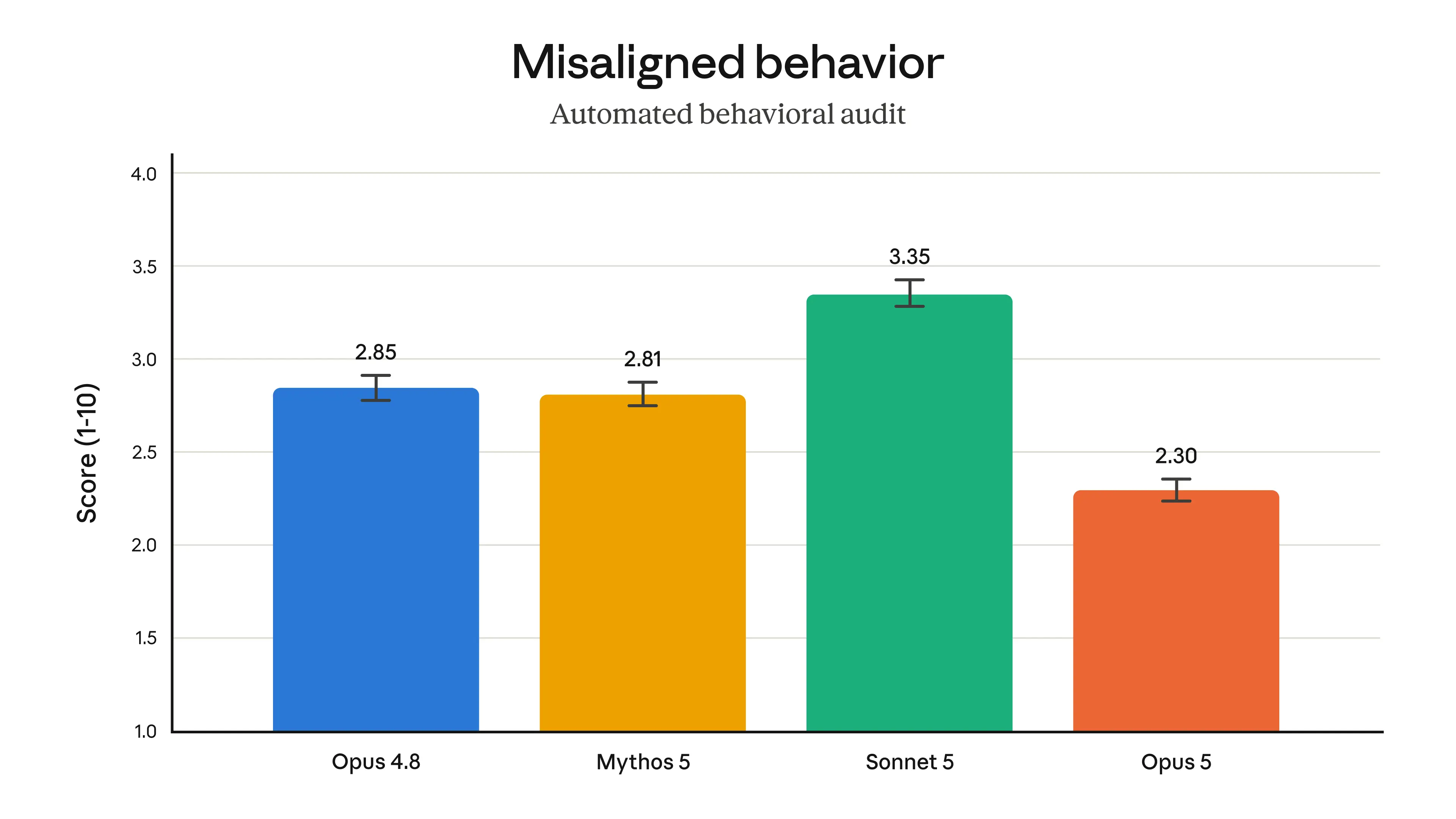
Alignment. During pre-deployment testing, our automated behavioral audit found Opus 5 to be our most aligned model to date (as shown in the graph below). It adheres to Claude’s Constitution better than Opus 4.8, Sonnet 5, or Fable 5; exhibits the lowest rates of deceptive behavior; and is the least susceptible to being tricked into misuse. It’s also our safest model yet in terms of avoiding reckless actions that could have hard-to-reverse side effects.
Safety. Opus 5 does not advance the frontier in risky, dual-use capabilities. In rigorous evaluations conducted alongside private-sector and government partners, we found it remains behind Mythos 5 in both biology research and offensive cybersecurity. More information about these evaluations can be found in our System Card.
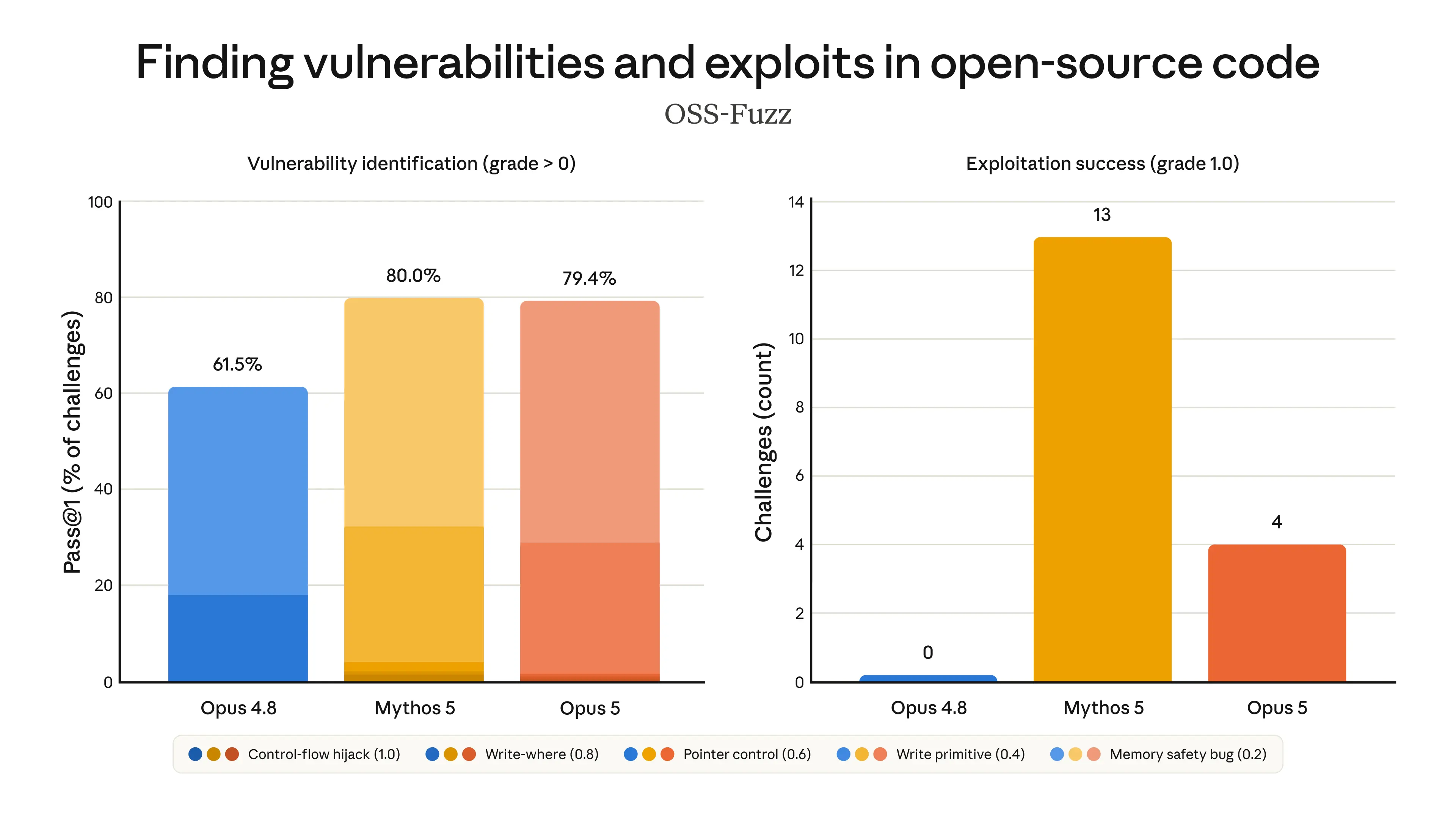
As with its predecessor, Opus 4.8, we’ve intentionally avoided training Opus 5 on cyber tasks. The model has nevertheless improved substantially on these tasks as a result of becoming more generally capable, and it comes close to Mythos 5 at finding cybersecurity vulnerabilities. However, it remains substantially behind Mythos 5 on the exploitation of those vulnerabilities—that is, in turning vulnerabilities into material cyber threats.
This is illustrated by Opus 5’s performance on OSS-Fuzz, an evaluation we’ve developed to assess how well models can find and then exploit vulnerabilities without extensive human guidance. Although Mythos 5 and Opus 5 identify vulnerabilities with similar success, Opus 5’s score on the development of exploits is far behind that of Mythos 5.
Safeguards for Opus 5
Claude Opus 5’s safeguards are designed to allow beneficial uses of the model in both cybersecurity and biology. They are similar to those we applied to Opus 4.8, with the exception of some stronger guardrails on a narrow range of cyber tasks.
Cybersecurity. Opus 5’s cyber classifiers are proportionally less restrictive than those on Fable 5. They allow Opus 5 to find vulnerabilities in source code, but block “binary-based” vulnerability scanning (a method more likely to be associated with malicious actors), penetration testing, and exploit generation.
Based on our testing, we expect the classifiers to intervene around 85% less often than they do for Fable 5. In Claude.ai, Claude Code, and Claude Cowork, any flagged requests will fall back to Opus 4.8 by default. Fallbacks to Opus 4.8 can also be enabled on the API.
Our Cyber Verification Program (CVP) facilitates cybersecurity work that would otherwise be impeded by the model’s safeguards. Enterprises and researchers who are already part of the CVP have immediate access to a version of Opus 5 with fewer security restrictions.
Biology. Since Opus 5 has a similar suite of safeguards to Opus 4.8, it is now our most capable generally available model for scientific research. Nevertheless, the model still shows important limitations on long-running, autonomous research tasks, which is where we expect AI models to pose the most substantial biology-related risks. (Mythos 5 remains the stronger model for this type of biological work.) As part of this launch, biology-related requests that are blocked on Fable 5 will now route to Opus 5 rather than Opus 4.8.
Getting started
Claude Opus 5 is available today on all platforms, priced at $5 per million input tokens and $25 per million output tokens (the same as Opus 4.8). Developers can get started with claude-opus-5 on the Claude API.
It’s also offered in Fast mode, where it runs around 2.5 times the default speed. As with Opus 4.8, Fast mode is available at twice Opus 5’s base price on the Claude Platform and through usage credits in Claude Code.
Alongside Opus 5, we’re releasing two updates in beta:
- Mid-conversation tool changes on the Claude Platform. Within a conversation, developers can now change which tools Claude can use without invalidating the prompt cache.
- Automatic fallbacks on the API. Users can now choose to have requests that are flagged by our safety classifiers on Opus 5 (or Fable 5) automatically route to another model. With automatic fallbacks on, API requests always route to the best available model by default rather than being blocked.
Consistent with prior Opus models, Opus 5 does not have data retention requirements for general access.
For more guidance on how to get the best out of Opus 5, see our prompting guide.
Footnotes
Frontier-Bench v0.1, Effort plot: These results are from an internal run of Frontier-Bench v0.1, on the mini-SWE-agent harness and a GKE backend, mean reward over 5 attempts per task. Opus 4.8 served as fallback on safety-classifier refusals for Opus 5 and Fable 5.
Related content
A research agenda for the Economic Futures Research Fund
We’re sharing the research agenda for the Anthropic Economic Futures Research Fund.
Read moreAsk Claude about the Anthropic Economic Index
We're launching the Anthropic Economic Index connector for Claude, which lets anyone explore real data about AI and work.
Read moreAnthropic is donating another $20 million to Public First Action
Anthropic is contributing an additional $20 million to Public First Action, bringing our total support to $40 million.
Read moreOther reports on this story
- T2Simon Willison 博客(Atom)Claude Sonnet 5 Released: Performance Nears Opus with Hidden Price Hike05:23
Related items
FeaturedDeepSeek V4 Doubles Token Share on OpenRouter, Driven by Agentic Workloads
DeepSeek V4 在 OpenRouter 上的代币份额翻倍,智能体工作负载成主要驱动力
The rapid adoption of DeepSeek V4 signals a strong market preference for high-performance, low-cost inference models, especially as agentic use cases reshape AI deployment.
91
FeaturedEnabling Two Settings Triples ARC-AGI-3 Benchmark Scores
启用两项设置使ARC-AGI-3基准测试分数提升三倍
This finding is crucial! It shows that model performance depends not only on training but also on inference-time configuration. For AI engineers and researchers, this is a must-know optimization direction. Teams deploying models on resource-constrained devices in particular could find a low-cost way to boost capabilities.
91
FeaturedGPT-5.6: Fusing Frontier Intelligence with Frontier Efficiency
GPT-5.6:前沿智能与前沿效率的融合
This news is worth watching as it marks a shift from pure parameter scaling to efficiency competition. For AI developers and business decision-makers, GPT-5.6 means higher performance at lower cost, especially for long-context or agentic tasks previously hindered by inference expenses. OpenAI's move may redefine what 'frontier' means.
91
FeaturedLFM2.5-Encoders: New Models for Fast Long-Context Inference on CPU
LFM2.5-Encoder:面向CPU快速长上下文推理的新模型
This blog post catches my eye because it directly solves the pain point of running long-context LLMs on CPU. For teams or individual developers without high-end GPUs, the LFM2.5-Encoder series offers a ready-to-use open-source solution. Highly recommended for those working on RAG, document search, or code analysis—now a standard server can handle million-token documents.
91
FeaturedGPT-Red: OpenAI Automates Red Teaming via Self-Play to Boost Model Robustness
GPT-Red:OpenAI通过自我对弈实现AI红队自动化,提升模型鲁棒性
GPT-Red marks a milestone from human to automated red-teaming—essential for safety engineers and alignment researchers. While reducing cost, it also raises ethical questions about automated attacks, worth pondering for everyone in AI governance.
91
FeaturedOpenAI Launches GPT-5.5 Bio Bug Bounty Program
OpenAI推出GPT-5.5生物漏洞赏金计划
This program deserves attention as it pioneers the extension of AI bug bounty to biosecurity, offering a new research direction for the security community and a practical training ground for AI risk governance. It is particularly important for model safety researchers, biosecurity experts, and practitioners concerned about dual-use AI risks.
91
FeaturedvLLM Introduces Native-Speed Transformers Modeling Backend for Enhanced Inference Performance
vLLM推出原生速度Transformers建模后端,大幅提升推理性能
This update is critical for AI engineering teams: eliminating format conversion speeds up model iteration, and 2-5x speedup directly reduces GPU costs. If you're building LLM online services or batch inference, this is practically a must-read technical update.
90
FeaturedGoogle DeepMind Introduces SL2T, a Sign Language-to-Text Model for Deaf Users
Google DeepMind 发布手语转文本模型 SL2T,助力聋人用户
This news matters not only as a technical breakthrough but also as a sign that AI is beginning to address the needs of marginalized groups. For developers, the architecture and technical approach of SL2T merit deep study; for accessibility advocates, it's a key case for advancing industry standards.