The U.S. Census Bureau and “Super Intelligence”
Score
68Why selected
保留在全量动态池,可作为背景信息或后续聚合信号。
AI commentary
「来自 Simon Willison 博客(Atom) 的这条信息指向模型能力或模型生态变化,适合用于判断近期 AI 圈的真实动向。」
Quick overview
I was reminded today of AI Adoption Rate Trending Down for Large Companies, a chart produced by Apollo Global Management in September 2025, which appeared to show a slowdown in U.S. corporate AI adoption based on number…
- I was reminded today of AI Adoption Rate Trending Down for Large Companies, a chart produced by Apollo Global Management in September 2025, which appeared to show a slowdown in U.S.
- corporate AI adoption based on numbers collected by the U.S.
- At the time I used that chart to demonstrate GPT-5 data analysis, and then to experiment with Claude's new Code Interpreter.
Full text
Showing the source text; the full translation is being generated.
I was reminded today of AI Adoption Rate Trending Down for Large Companies, a chart produced by Apollo Global Management in September 2025, which appeared to show a slowdown in U.S. corporate AI adoption based on numbers collected by the U.S. Census Bureau. At the time I used that chart to demonstrate GPT-5 data analysis, and then to experiment with Claude's new Code Interpreter. I decided to try running those numbers again to see what had changed over the past year, and in doing so learned that the Bureau has fallen foul of Executive Order 14434, aka the asinine Super Intelligence one.
First, the updated chart
Every two weeks the U.S. Census Bureau runs a survey called the Business Trends and Outlook Survey (aka BTOS). Each time it goes to 200,000 businesses out of 1.2 million total - the surveyed group (a "panel") cycles such that an individual business only completes the survey every twelve weeks.
The latest data is published on alternating Thursdays at 10am.
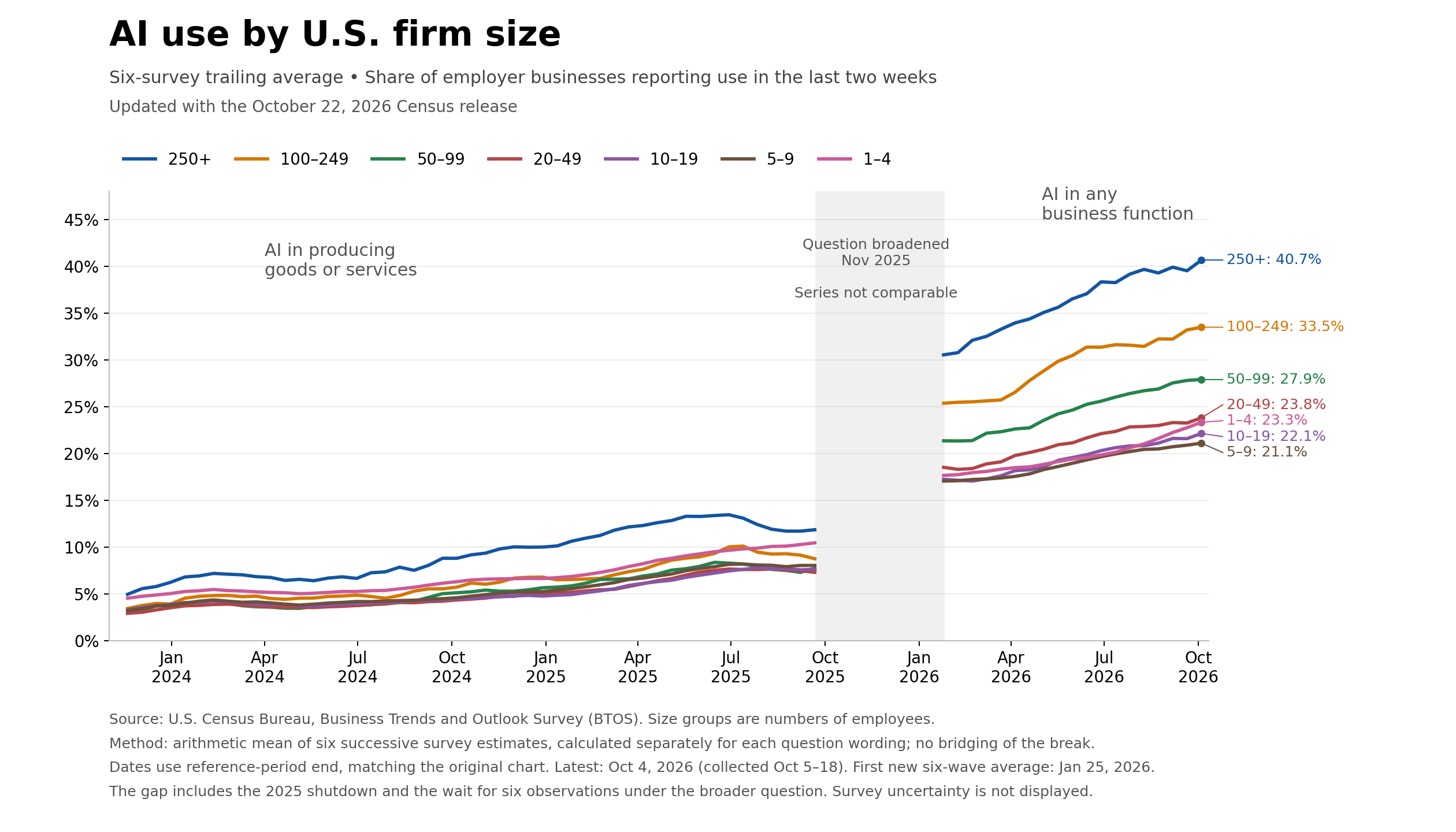
I used the most recent numbers (published October 22, 2026) to create a new version of the AI adoption chart, updated to reflect both the last twelve months and a change that was made to the survey question sent out by the Bureau:
For comparison, here's that AI adoption chart from last year (my GPT-5 version):
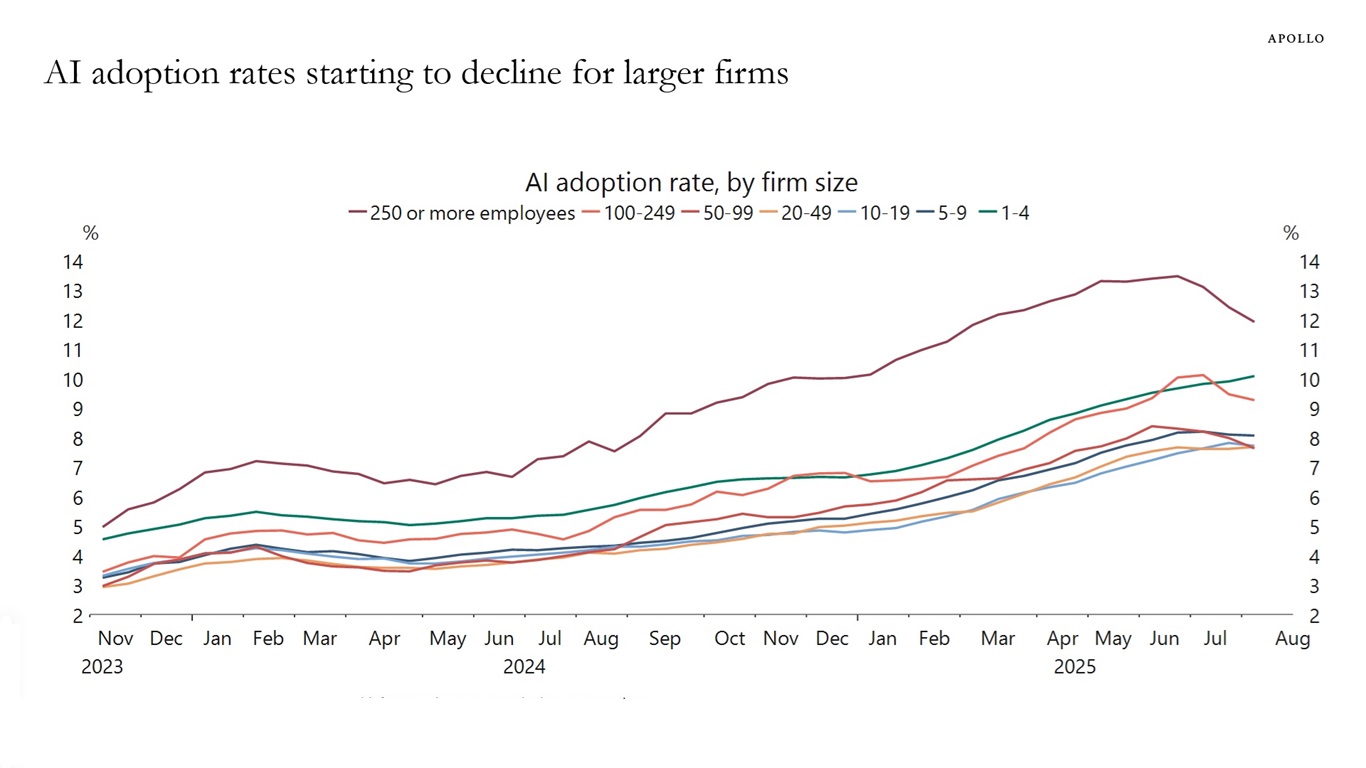
In September 2025 the largest (250+ employees) companies answered "yes" around 12% of the time to the question about whether they used AI in "producing goods or services".
Under the new "any business function" wording, by February 2026, those same large companies answered "yes" around 30% of the time, and by October 2026 that had increased to around 40%.
The data in the above chart comes from the "Employment size class" XLSX file, available from here. Here's a copy of the file I used.
You can view the survey document that is sent out to businesses - here's my snapshot copy of that 346KB PDF.
The changing language of the questions
As the chart demonstrates, the question asked by the Bureau changed in a material way on November 17th, 2025. Prior to that date, the question they asked was this (emphasis mine):
In the last two weeks, did this business use Artificial Intelligence (AI) in producing goods or services? (Examples of AI: machine learning, natural language processing, virtual agents, voice recognition, etc.)
On December 3rd, 2025, the Bureau announced a significant change to that question. Here's the replacement:
In the last two weeks, did this business use Artificial Intelligence (AI) in any of its business functions? (Examples of AI: machine learning, natural language processing, virtual agents, voice recognition, etc.)
No more "producing goods or services" - now it's "in any of its business functions"! This means that the answers to the question before and after November 17th are not directly comparable.
From October 19, 2026, they ask about Super Intelligence
When I went looking for the updated question language in the latest XLSX file, I couldn't find it. I found this instead:
In the last two weeks, did this business use Super Intelligence or SI (formerly referred to as Artificial Intelligence or AI) in any of its business functions? (Examples of SI use include: SI-powered data analysis; generative SI for marketing, product design, or coding; virtual SI agents for customer service; SI-powered forecasting or pricing; SI-driven computer vision for quality control, etc.)
The BTOS about page explains what happened:
Beginning with the October 19, 2026 collection, instrument wording was updated due to Executive Order 14434.
The current numbers reflect the old Artificial Intelligence survey wording - the first survey results reflecting the Super Intelligence wording are due for publication on Thursday.
Is this going to affect the survey?
The obvious open question here is whether this wording change is going to affect the survey results.
The businesses answering this survey will have last seen that question twelve weeks ago, when it was still called AI. Hopefully the new language isn't going to confuse them, especially since the survey helpfully spells out "formerly referred to as Artificial Intelligence or AI".
I can't help but laugh at the absurdity of "SI-powered data analysis; generative SI for marketing, product design, or coding; virtual SI agents for customer service" though.
Tags: census, surveys, ai, generative-ai, llms
Related items
FeaturedDeepSeek V4 Doubles Token Share on OpenRouter, Driven by Agentic Workloads
DeepSeek V4 在 OpenRouter 上的代币份额翻倍,智能体工作负载成主要驱动力
The rapid adoption of DeepSeek V4 signals a strong market preference for high-performance, low-cost inference models, especially as agentic use cases reshape AI deployment.
91
FeaturedEnabling Two Settings Triples ARC-AGI-3 Benchmark Scores
启用两项设置使ARC-AGI-3基准测试分数提升三倍
This finding is crucial! It shows that model performance depends not only on training but also on inference-time configuration. For AI engineers and researchers, this is a must-know optimization direction. Teams deploying models on resource-constrained devices in particular could find a low-cost way to boost capabilities.
91
FeaturedGPT-5.6: Fusing Frontier Intelligence with Frontier Efficiency
GPT-5.6:前沿智能与前沿效率的融合
This news is worth watching as it marks a shift from pure parameter scaling to efficiency competition. For AI developers and business decision-makers, GPT-5.6 means higher performance at lower cost, especially for long-context or agentic tasks previously hindered by inference expenses. OpenAI's move may redefine what 'frontier' means.
91
FeaturedLFM2.5-Encoders: New Models for Fast Long-Context Inference on CPU
LFM2.5-Encoder:面向CPU快速长上下文推理的新模型
This blog post catches my eye because it directly solves the pain point of running long-context LLMs on CPU. For teams or individual developers without high-end GPUs, the LFM2.5-Encoder series offers a ready-to-use open-source solution. Highly recommended for those working on RAG, document search, or code analysis—now a standard server can handle million-token documents.
91
FeaturedGPT-Red: OpenAI Automates Red Teaming via Self-Play to Boost Model Robustness
GPT-Red:OpenAI通过自我对弈实现AI红队自动化,提升模型鲁棒性
GPT-Red marks a milestone from human to automated red-teaming—essential for safety engineers and alignment researchers. While reducing cost, it also raises ethical questions about automated attacks, worth pondering for everyone in AI governance.
91
FeaturedOpenAI Launches GPT-5.5 Bio Bug Bounty Program
OpenAI推出GPT-5.5生物漏洞赏金计划
This program deserves attention as it pioneers the extension of AI bug bounty to biosecurity, offering a new research direction for the security community and a practical training ground for AI risk governance. It is particularly important for model safety researchers, biosecurity experts, and practitioners concerned about dual-use AI risks.
91
FeaturedvLLM Introduces Native-Speed Transformers Modeling Backend for Enhanced Inference Performance
vLLM推出原生速度Transformers建模后端,大幅提升推理性能
This update is critical for AI engineering teams: eliminating format conversion speeds up model iteration, and 2-5x speedup directly reduces GPU costs. If you're building LLM online services or batch inference, this is practically a must-read technical update.
90
FeaturedGoogle DeepMind Introduces SL2T, a Sign Language-to-Text Model for Deaf Users
Google DeepMind 发布手语转文本模型 SL2T,助力聋人用户
This news matters not only as a technical breakthrough but also as a sign that AI is beginning to address the needs of marginalized groups. For developers, the architecture and technical approach of SL2T merit deep study; for accessibility advocates, it's a key case for advancing industry standards.