The U.S. Census Bureau and “Super Intelligence”
评分
68精选理由
保留在全量动态池,可作为背景信息或后续聚合信号。
AI 点评
「来自 Simon Willison 博客(Atom) 的这条信息指向模型能力或模型生态变化,适合用于判断近期 AI 圈的真实动向。」
速览
I was reminded today of AI Adoption Rate Trending Down for Large Companies, a chart produced by Apollo Global Management in September 2025, which appeared to show a slowdown in U.S. corporate AI adoption based on number…
- I was reminded today of AI Adoption Rate Trending Down for Large Companies, a chart produced by Apollo Global Management in September 2025, which appeared to show a slowdown in U.S.
- corporate AI adoption based on numbers collected by the U.S.
- At the time I used that chart to demonstrate GPT-5 data analysis, and then to experiment with Claude's new Code Interpreter.
正文
以下为原文,中文全文翻译生成中
I was reminded today of AI Adoption Rate Trending Down for Large Companies, a chart produced by Apollo Global Management in September 2025, which appeared to show a slowdown in U.S. corporate AI adoption based on numbers collected by the U.S. Census Bureau. At the time I used that chart to demonstrate GPT-5 data analysis, and then to experiment with Claude's new Code Interpreter. I decided to try running those numbers again to see what had changed over the past year, and in doing so learned that the Bureau has fallen foul of Executive Order 14434, aka the asinine Super Intelligence one.
First, the updated chart
Every two weeks the U.S. Census Bureau runs a survey called the Business Trends and Outlook Survey (aka BTOS). Each time it goes to 200,000 businesses out of 1.2 million total - the surveyed group (a "panel") cycles such that an individual business only completes the survey every twelve weeks.
The latest data is published on alternating Thursdays at 10am.
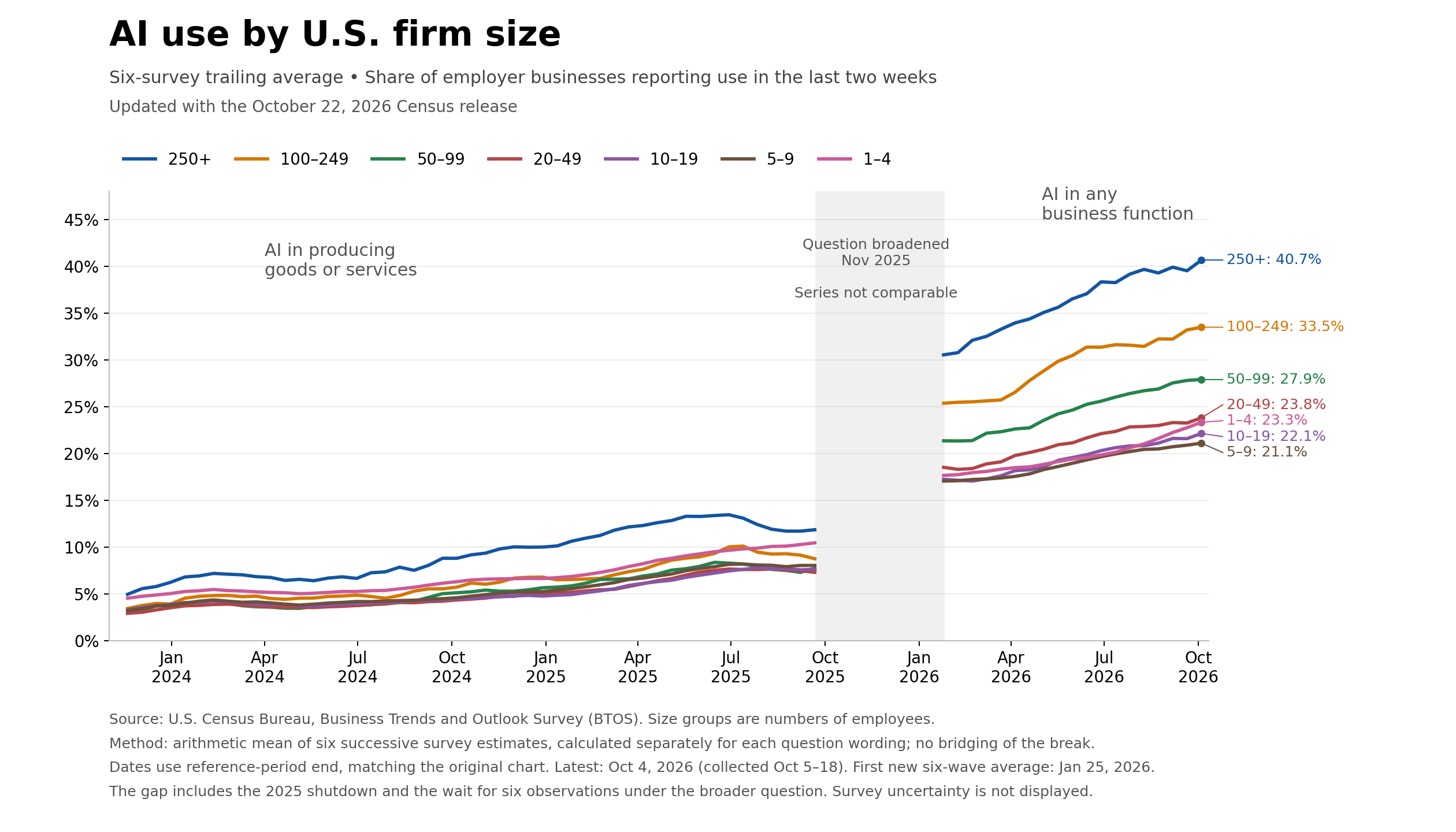
I used the most recent numbers (published October 22, 2026) to create a new version of the AI adoption chart, updated to reflect both the last twelve months and a change that was made to the survey question sent out by the Bureau:
For comparison, here's that AI adoption chart from last year (my GPT-5 version):
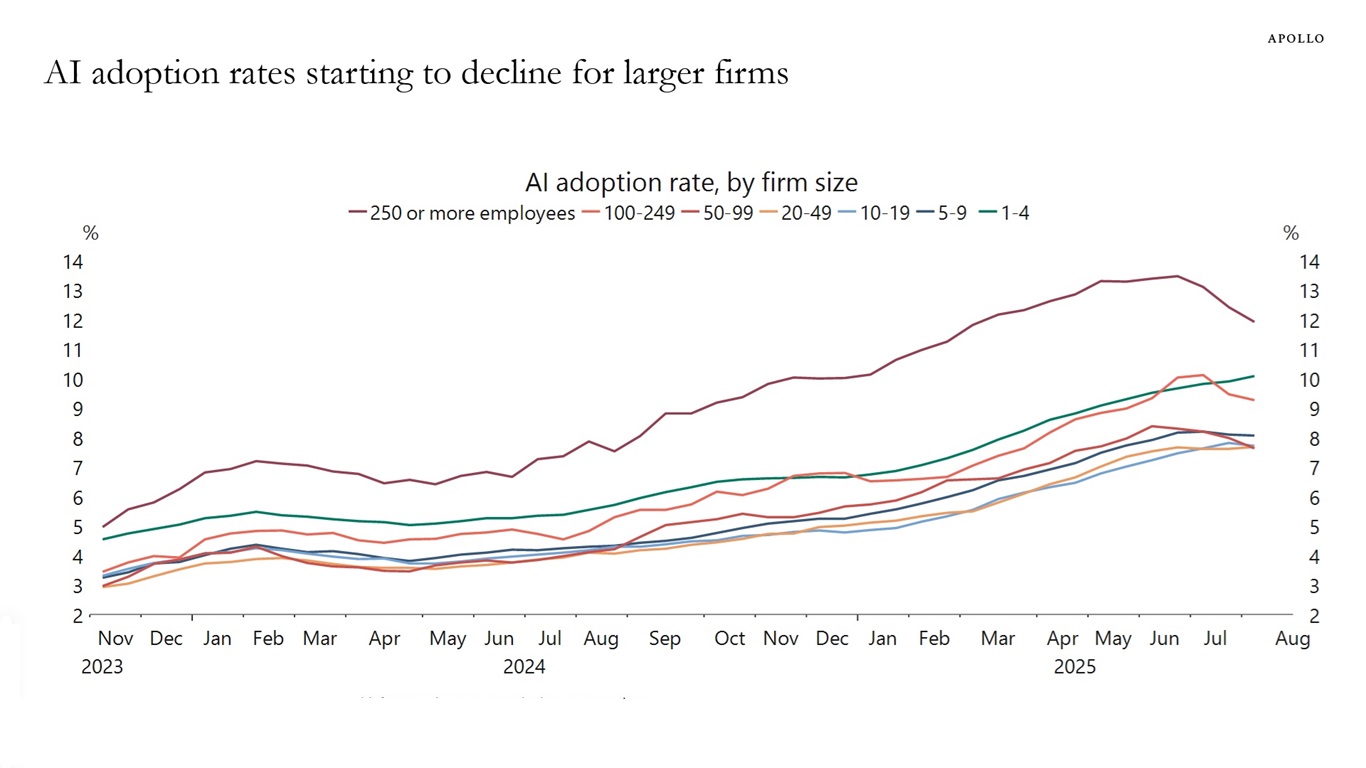
In September 2025 the largest (250+ employees) companies answered "yes" around 12% of the time to the question about whether they used AI in "producing goods or services".
Under the new "any business function" wording, by February 2026, those same large companies answered "yes" around 30% of the time, and by October 2026 that had increased to around 40%.
The data in the above chart comes from the "Employment size class" XLSX file, available from here. Here's a copy of the file I used.
You can view the survey document that is sent out to businesses - here's my snapshot copy of that 346KB PDF.
The changing language of the questions
As the chart demonstrates, the question asked by the Bureau changed in a material way on November 17th, 2025. Prior to that date, the question they asked was this (emphasis mine):
In the last two weeks, did this business use Artificial Intelligence (AI) in producing goods or services? (Examples of AI: machine learning, natural language processing, virtual agents, voice recognition, etc.)
On December 3rd, 2025, the Bureau announced a significant change to that question. Here's the replacement:
In the last two weeks, did this business use Artificial Intelligence (AI) in any of its business functions? (Examples of AI: machine learning, natural language processing, virtual agents, voice recognition, etc.)
No more "producing goods or services" - now it's "in any of its business functions"! This means that the answers to the question before and after November 17th are not directly comparable.
From October 19, 2026, they ask about Super Intelligence
When I went looking for the updated question language in the latest XLSX file, I couldn't find it. I found this instead:
In the last two weeks, did this business use Super Intelligence or SI (formerly referred to as Artificial Intelligence or AI) in any of its business functions? (Examples of SI use include: SI-powered data analysis; generative SI for marketing, product design, or coding; virtual SI agents for customer service; SI-powered forecasting or pricing; SI-driven computer vision for quality control, etc.)
The BTOS about page explains what happened:
Beginning with the October 19, 2026 collection, instrument wording was updated due to Executive Order 14434.
The current numbers reflect the old Artificial Intelligence survey wording - the first survey results reflecting the Super Intelligence wording are due for publication on Thursday.
Is this going to affect the survey?
The obvious open question here is whether this wording change is going to affect the survey results.
The businesses answering this survey will have last seen that question twelve weeks ago, when it was still called AI. Hopefully the new language isn't going to confuse them, especially since the survey helpfully spells out "formerly referred to as Artificial Intelligence or AI".
I can't help but laugh at the absurdity of "SI-powered data analysis; generative SI for marketing, product design, or coding; virtual SI agents for customer service" though.
Tags: census, surveys, ai, generative-ai, llms
相关条目
精选DeepSeek V4 在 OpenRouter 上的代币份额翻倍,智能体工作负载成主要驱动力
DeepSeek V4 的快速采用表明市场对高性能、低成本推理模型的强烈偏好,尤其是智能体场景将重塑 AI 部署格局。
91
精选启用两项设置使ARC-AGI-3基准测试分数提升三倍
这项发现太关键了!它表明模型的性能不仅取决于训练,还取决于推理时的配置。对于AI工程师和研究者来说,这是一个必须注意的优化方向。特别是那些在资源受限设备上部署模型的团队,可能会因此找到低成本提升能力的方法。
91
精选GPT-5.6:前沿智能与前沿效率的融合
这条消息值得关注,因为它标志着大模型竞争从单纯拼参数转向拼效率。对于AI开发者和企业决策者来说,GPT-5.6意味着可以用更少预算获得更高性能,尤其适合那些被推理成本挡在门外的长上下文或Agent场景。OpenAI这一步,可能重新定义‘前沿’的标准。
91
精选LFM2.5-Encoder:面向CPU快速长上下文推理的新模型
这篇博文让我眼前一亮,因为它直接解决了大模型在CPU上跑长上下文的痛点。对于没有高端GPU的团队或个人开发者,LFM2.5-Encoder系列提供了可立即使用的开源方案。尤其推荐给做RAG、文档搜索或代码分析的朋友——现在用普通服务器就能处理百万级token的文档了。
91
精选GPT-Red:OpenAI通过自我对弈实现AI红队自动化,提升模型鲁棒性
GPT-Red 是红队测试从人工到自动化的里程碑,特别适合安全工程师和对齐研究者关注。它直接降低了测试成本,但也引发了对“自动攻击”本身的伦理讨论——值得所有关注AI治理的人深入思考。
91
精选OpenAI推出GPT-5.5生物漏洞赏金计划
这个计划值得关注,因为它首次将AI漏洞赏金制度拓展到生物安全领域,不仅为安全社区提供了新的研究方向,也为AI风险治理提供了实际演练场。对模型安全研究者、生物安全专家以及关心AI双重用途的从业者尤其重要。
91
精选vLLM推出原生速度Transformers建模后端,大幅提升推理性能
这项更新对于AI工程团队非常关键:无需格式转换意味着能更快地迭代模型,而2-5倍的速度提升直接降低GPU成本。如果你正在做LLM在线服务或者批量推理,这几乎是必读的技术更新。
90
精选Google DeepMind 发布手语转文本模型 SL2T,助力聋人用户
这则消息的意义不仅在于技术突破,更在于AI开始真正关注边缘群体的需求。对开发者而言,SL2T的架构思路和技术路径值得深入研究;对无障碍倡导者来说,这是推动行业标准的重要案例。